

Local Marketing ROI: Simple Formulas for Small Businesses
September 8, 2026 · By Miro Giovannini
If you're spending money on Google Ads or Facebook every month and still answering "I think so?" when someone asks whether it's working, you have a local marketing ROI problem, and you're not alone. Most small business owners aren't measuring return on their local marketing because nobody ever handed them a formula. This article does exactly that.
Measuring local marketing ROI isn't a skill reserved for agencies with enterprise dashboards. Once you have the inputs on hand, the calculation takes minutes. Collecting those inputs the first time is the part that takes real work, and that's where most owners stop. If you want the qualitative version of this question first, how to know if your digital marketing is actually working covers the signals to watch. This article covers the math.
By the time you finish reading, you'll have the core formula, realistic benchmarks by channel, a simple attribution setup, the right tools for your budget, and five specific tactics to improve your numbers starting this week.
The ROI Formula Every Local Business Owner Should Know
Breaking Down the Core Calculation
The fundamental formula is straightforward: ROI = (Revenue Generated − Marketing Cost) ÷ Marketing Cost × 100. That gives you a percentage. A positive number means the campaign paid for itself and then some. A negative number means you spent more than you earned.
Here's how that looks in practice. A landscaping company spends $500 on Google Ads in a month. Those ads generate 10 leads. The owner closes 2 of them at an average job value of $600, producing $1,200 in revenue. The calculation: ($1,200 − $500) ÷ $500 × 100 = 140%. That's a campaign worth keeping. The percentage itself matters less than whether the number is positive and trending upward month over month.
Estimating Revenue When You Can't Track It Perfectly
Not every sale traces cleanly back to a campaign. For those situations, use the lead-based version: Revenue = Leads × Close Rate × Average Sale. Plug in real numbers from your own business: 100 leads, a 10% close rate, and a $250 average sale produce $2,500 in estimated campaign revenue.
This is an estimate, and you should treat it as one. Over time, the goal is to close the gap between estimates and actual tracked revenue, which is what the attribution setup below is for. Start with the estimate so you're measuring something instead of nothing.
Calculating Your Local Customer Acquisition Cost
ROI tells you the return on a campaign. Customer acquisition cost (CAC) tells you what it costs to win a single new customer, and it's the most useful companion metric you can track. The formula: total marketing spend ÷ new customers generated in that period.
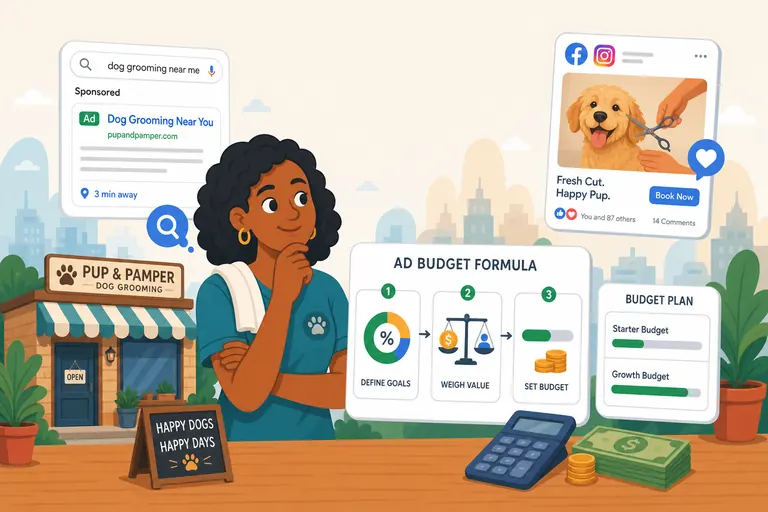
CAC varies enormously by industry, ticket size, and market, so treat any published benchmark as directional. What matters is the relationship between your CAC and what a customer is worth to you. In general, search ads tend to produce the lowest CAC for local service businesses because you're reaching people already looking for the service, social ads sit higher because you're creating the demand, and in-person channels like events or trade shows tend to be the most expensive once staffing and follow-up are counted. Knowing roughly where your channels land tells you whether your mix makes sense before you go any further. The small business ad budget formula walks through how CAC and lifetime value should set your spending ceiling in the first place.
Local Marketing ROI Benchmarks by Channel
The Baseline Benchmark to Aim For
A common working target for paid local marketing is a 3:1 to 5:1 revenue-to-spend ratio, which is 300% to 500% ROI. For every dollar in, you want three to five back in revenue before calling a paid campaign a success. That ratio isn't a law of physics, it's a rule of thumb that leaves enough gross margin to cover delivery costs and still profit. If your margins are thin, you need a higher ratio. If you sell a high-margin service with strong repeat business, you can justify a lower one.
Email marketing and local SEO often beat paid ads on ROI over time, but they take longer to show measurable results. Local SEO typically starts moving around three to six months and compounds by six to twelve. Google Ads can show results in days. Use both, but measure them on different clocks, and see Google Ads vs. SEO: where to spend your budget if you're deciding how to split.
How Benchmarks Shift by Channel and Industry
Reported ROI ranges swing widely by industry because the underlying economics differ. A retailer with a 35% gross margin and a $60 ticket needs a completely different return than a home services company with a $1,200 job and a 60% margin. Restaurants and local service businesses are especially hard to pin to one figure, since outcomes depend on ticket size, repeat rate, and labor cost. For those businesses, tracking CAC alongside retention gives a fuller picture than any single ROI percentage.
Campaign age matters too. A campaign in its first 60 days will rarely hit mature-account numbers, because both the platform's Smart Bidding learning period and your own optimization work need conversion data to improve. Track the trend rather than judging a campaign on its first month alone.
Why Comparing Yourself to National Averages Will Mislead You
National benchmarks pool thousands of businesses across different markets, sizes, and competitive landscapes. A dental practice in Chatsworth competing for local search traffic faces a completely different cost reality than a national e-commerce brand running the same type of ad. Using a national average as your target is like benchmarking your restaurant's foot traffic against a countrywide figure without accounting for your neighborhood. The same caution applies to published cost figures, as covered in how much Google Ads cost for small businesses.
Set your own internal benchmarks. Track ROI monthly, then measure improvement against your own prior performance. In high-competition markets like Greater Los Angeles, cost per click and CAC will run higher than national figures suggest. A "good" ROI threshold in Southern California should reflect what's achievable in your market, not what works for a business in a lower-cost region.

How to Connect Your Ads to Real-World Results
Tracking Phone Calls and Form Fills by Channel
The starting point for any attribution setup is giving each marketing channel its own trackable conversion event. Google Ads gets one phone number. Facebook gets another. Each campaign gets a distinct landing page or form. It isn't complicated, but without it every call that comes in is unattributable and your ROI calculation is built on guesswork.
UTM parameters on every URL are non-negotiable. Google Analytics uses those tags to identify the campaign, source, and medium behind a visit. Without them, traffic that should be credited to a campaign frequently lands in Direct or Unassigned, which quietly understates your paid channels. Tagging a campaign takes about five minutes and saves hours of confusion in reporting later.
Attributing Walk-Ins and Store Visits to Specific Campaigns
Google Ads can estimate store visits when a verified business location is linked to your account. When someone who interacted with an ad later visits your physical location, Google can attribute that as a store visit conversion. This data is modeled and estimated, not an exact headcount, so use it to compare campaigns against each other rather than as proof of precise foot traffic.
The most reliable approach to local attribution is offline conversion import. You upload actual sale data from your POS or CRM along with the Google Click ID (GCLID) captured at the original click, and Google matches the real sale back to the campaign that drove it. Meta offers an equivalent offline upload. For most local service businesses this is a one-time technical lift that permanently improves reporting quality, though capturing GCLIDs into your CRM may need developer help or a paid connector.
A Simple Attribution Stack That Works for Most Local Businesses
You don't need an enterprise analytics system. A practical three-part setup covers most local businesses: GA4 for free web attribution, a call tracking platform for phone leads, and platform-native conversion tracking through Google Ads and the Meta pixel. That combination gives you directional data on every major channel at a manageable cost.
Start by tracking one channel thoroughly before expanding. If Google Ads drives most of your business, get that attribution dialed in first, then add call tracking for inbound phone leads. Once you have a clean baseline from those two, add Meta and compare it against what you already know. If Meta is the channel in question, why your Facebook ads aren't working starts with exactly this measurement question.
Free and Affordable Tools to Measure Local Campaign Performance
Start With What's Already Free
GA4 is your baseline and it costs nothing. It connects directly to Google Ads, tracks web events and traffic sources, and shows which channels are driving form submissions and page visits. Its limitation for local businesses is real: GA4 doesn't capture offline revenue or phone calls, so it will always undercount true ROI on campaigns where calls drive the business.
Google Business Profile performance reporting adds a second free layer. It shows calls, direction requests, and website clicks generated directly from your Google Search and Maps listing. Use it to estimate SEO-driven revenue: if your profile produces 200 website clicks and your site converts 8% of them at a $150 average sale, that's roughly $2,400 in estimated revenue from local organic visibility. Not perfect, but far better than no measurement, and optimizing that profile is usually the cheapest ROI win available to a local business.
Call Tracking and Lead Attribution Tools Worth Paying For
For any local service business that runs on phone calls, call tracking is the single highest-impact tool you can add. Platforms like CallRail and WhatConverts assign unique phone numbers by channel, record call length, and report which campaign or keyword produced each call. Entry-level plans generally start in the $30 to $50 per month range, so check current pricing before you commit.
Adding call tracking usually changes the picture more than owners expect. Before it, every inbound call is a mystery. After it, you know whether it came from a Google ad, an organic search, or a Facebook campaign, and you can assign that lead a cost and a return, which is the whole foundation of an honest ROI calculation.
Sanity-Check the Numbers Against Your Own P&L
Whatever the dashboards say, the final check is your bank account. If platforms report $40,000 in attributed revenue and your books show $22,000 in total sales, the attribution is double-counting, usually because Google and Meta each claim the same conversion. Reconcile platform-reported revenue against actual revenue every month and trust the P&L. The U.S. Small Business Administration's marketing and sales guidance is a good plain-language reference for tying marketing plans back to real business numbers.
Improving Local Marketing ROI: Five Practical Tactics
1. Tighten Your Geographic Targeting
Many local businesses are unknowingly showing ads to people outside their service area. Someone in a zip code you don't serve clicks your ad, you pay for the click, and you get nothing. Audit your location reports in Google Ads and Meta to find which zip codes or cities are spending money without generating conversions. Cutting those areas often raises ROI without changing anything else about the campaign.
2. Send Paid Traffic to a Dedicated Landing Page, Not Your Homepage
Your homepage serves multiple audiences and multiple purposes. A landing page serves one visitor with one offer and one call to action. Routing paid traffic to a page with a single prompt, call now, request a quote, book online, consistently outperforms a general website because there's nowhere else for the visitor to go. The full comparison is in landing page vs. homepage: where your Google Ads should go.
For local businesses, that landing page needs three things above the fold: your service area, a clickable phone number, and social proof from local customers. That combination tells the visitor immediately that you serve their neighborhood and that people nearby already trust you.
3. Shift Budget Toward Your Highest-Performing Channel
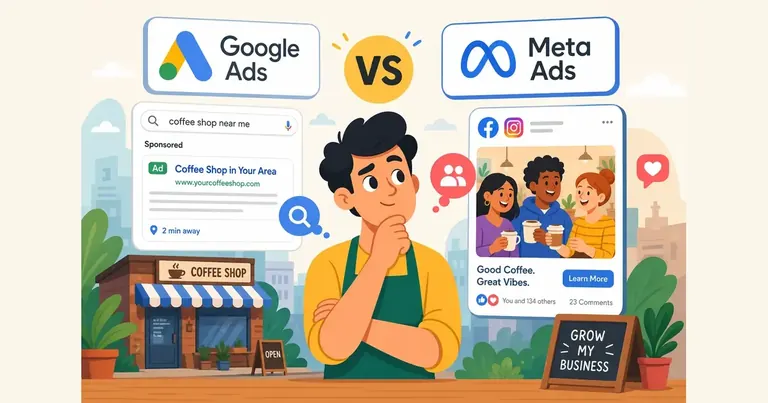
Run a simple monthly review: cost per lead and cost per new customer by channel. Then move dollars away from the highest-CAC channel toward the lowest. Most owners keep equal budgets across channels out of habit rather than performance data, which quietly kills overall ROI. Shifting even 20% of a Facebook budget toward Google Ads, when Google is converting at half the cost per customer, can move your blended ROI within a single month. If you're weighing the two platforms in general, Google Ads or Meta Ads for local business breaks down which fits which situation.
4. Factor In Repeat Business and Lifetime Value
ROI calculated on the first sale alone undervalues any channel that brings in customers with high repeat rates. A customer acquired for $80 who books three times a year at $150 per visit generates $450 in year-one revenue. That $80 CAC looks completely different once you count the full relationship instead of only the first transaction.
Estimate lifetime value roughly before writing off a channel as too expensive. A salon client who visits six times a year at $90 per visit for four years represents $2,160 in revenue. A $100 CAC to acquire that customer isn't expensive, it's one of the better investments available. This is also the logic behind how much of your revenue should go to marketing in the first place.
5. Review and Cut Underperforming Campaigns Monthly
The biggest ROI improvements usually come from stopping what isn't working, not from adding spend. Set a recurring monthly review covering total spend, leads generated, cost per lead, and new customers by channel. For most small accounts that's 15 to 60 minutes depending on complexity. Any campaign running 60 days without a measurable conversion result should be paused, revised, or replaced. Keeping it alive without a clear reason isn't a strategy, it's a budget leak.
Where to Go From Here
Calculating local marketing ROI doesn't require a marketing degree or an agency retainer. It requires consistent tracking, realistic benchmarks for your channel and market, and a monthly habit of reviewing what the numbers actually say. The formula is simple. The hard part is running it every month without skipping.
The framework is this: apply the ROI formula to every active campaign, set benchmarks against your own history rather than national averages, build a simple attribution stack that captures both web and phone leads, reconcile it against your P&L, and cut anything that can't show results after 60 days. That process alone puts you ahead of most local businesses still guessing.
Start with one channel. Run the formula on last month's spend. See what the number tells you, and let that decide next month's budget.

Ready to bring in more customers?
Get a free 30-minute marketing review. We'll look at what you have today and identify the one or two changes that could make the biggest difference.