
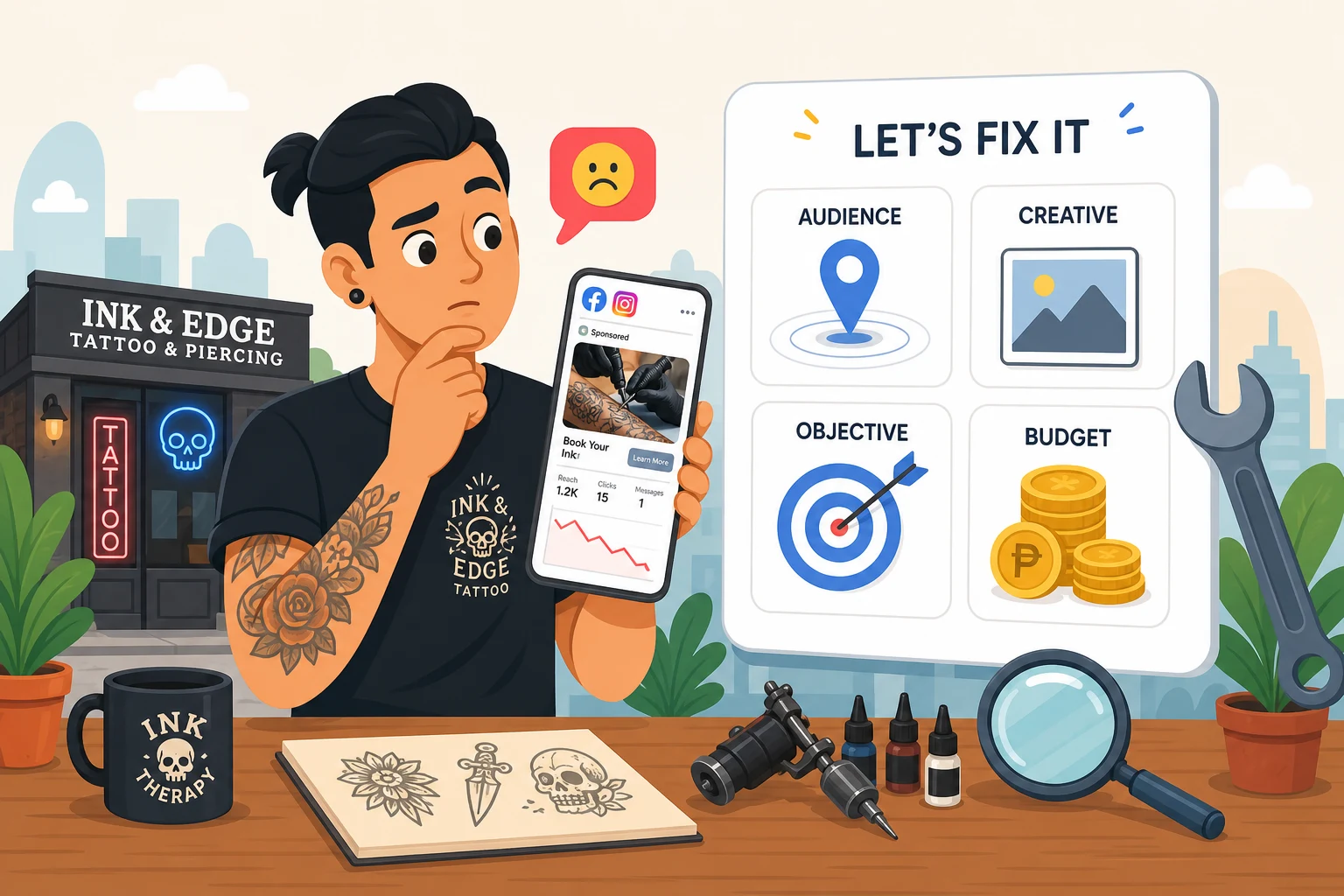
Why Your Facebook Ads Aren't Working (And How to Fix It)
August 25, 2026 · By Miro Giovannini
You set up the campaign, picked an audience, wrote some copy, hit publish, and watched $300 disappear over two weeks with almost nothing to show for it. No calls, no form fills, maybe a few link clicks that went nowhere. If you run a local business in the San Fernando Valley or anywhere in Greater Los Angeles, that story probably sounds familiar. The frustrating part is that most Facebook ads don't fail because the platform doesn't work. They fail because a small number of specific, fixable problems are stacking on top of each other, and once you know where to look, you can improve Facebook ad results faster than you'd expect.
Improving Facebook ad results isn't about finding a secret audience or spending more money on the same broken setup. It's about diagnosing what's actually wrong. This guide walks through four root causes that explain the overwhelming majority of underperforming local ad campaigns, with concrete fixes for each one. No glossy promises, no overnight guarantees. Just the actual problems and how to address them.
The four root causes most local advertisers never diagnose
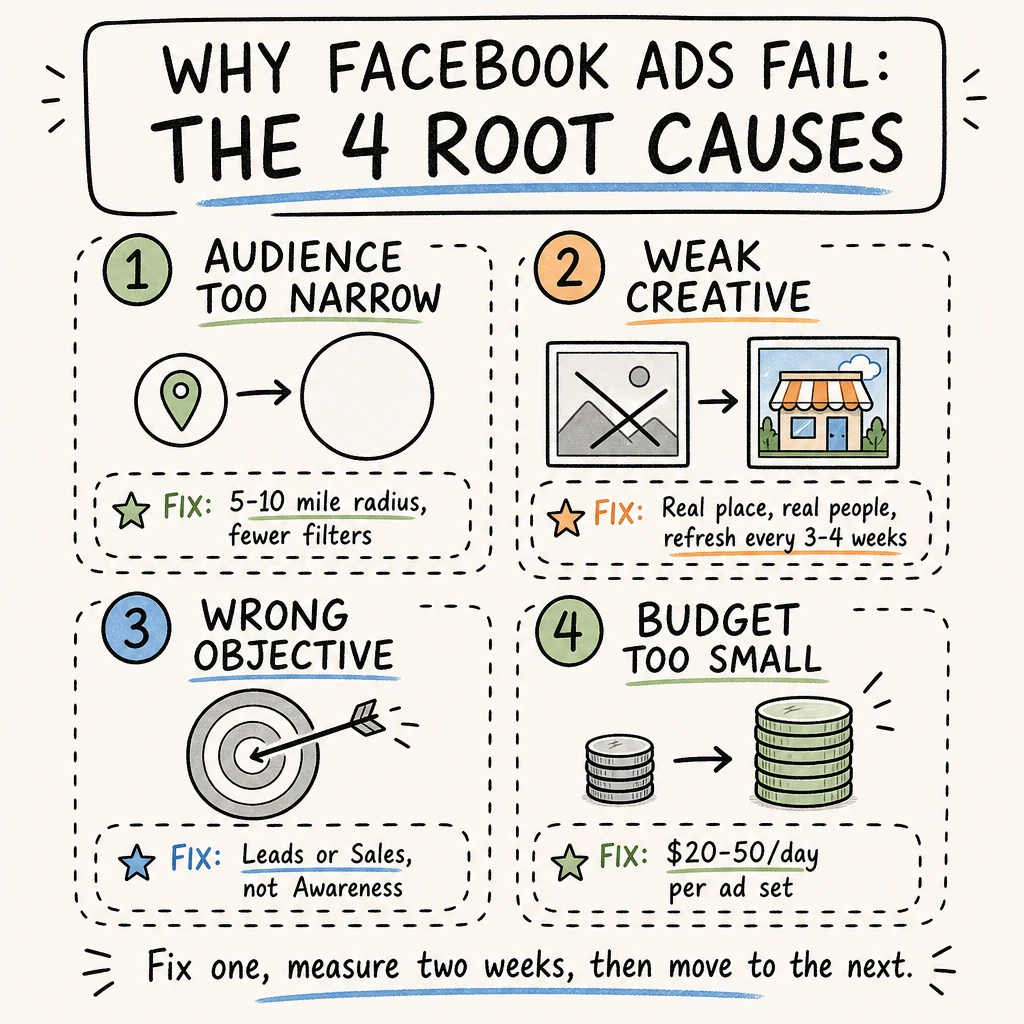
If your symptoms are more about weak results than a broken setup, the companion piece on why your Facebook ads aren't getting results covers that side of the problem. This guide is the diagnostic version: Facebook ad failure for local businesses almost always traces back to one of four places: the wrong audience, weak creative, the wrong campaign objective, or a budget that's too small to generate meaningful data. Most business owners treat these as separate mysteries when they're actually a diagnostic checklist you can work through in order.
The more dangerous scenario is when multiple problems show up at the same time. A too-narrow audience paired with weak creative and an underfunded campaign creates a compounding failure that looks random but isn't. Picture a salon running a brand awareness campaign at $5 a day, targeting a one-mile radius filtered by three interest categories, using a stock photo of a woman with generic hair. Every element of that setup is working against the result the owner actually wants. Fixing just one piece won't be enough.
The reason fixing all four problems matters comes down to how Meta's delivery system actually works. The algorithm learns by finding conversions and actions that match what you told it to optimize for. Without the right signals, sufficient budget, and a large enough audience, it can't do that job. Give it one of those things and not the others, and you're still stuck.
How to Improve Facebook Ad Results with Better Audience Targeting
Geo-targeting should be a local business's biggest advantage on Facebook. You can reach people within a specific distance of your location in a way that national brands can't replicate. But most local advertisers either set it up too narrow or layer on so many interest filters that they accidentally strangle their own delivery.
Radius sizing
A one-mile radius is often too small, particularly in a dense metro area. For a local service business in the San Fernando Valley, a five- to ten-mile radius is a far more functional starting point. At a one-mile radius, your potential audience shrinks so much that Meta struggles to find enough users to serve the ad, especially once you start adding demographic and interest filters on top. In practice, audiences below 50,000 people tend to create delivery problems, a threshold Meta's own documentation acknowledges when describing audience size guidance. In most parts of Los Angeles, a five-mile radius with minimal filtering gets you into the 100,000 to 300,000 range, which is the practical sweet spot for local campaigns.
Interest-targeting sounds logical but often backfires. Each filter you add shrinks the audience exponentially. Stacking "homeowners" plus "home improvement" plus "DIY enthusiasts" plus a specific income bracket can take a viable audience down to something Meta can barely work with. Start with broad demographic and location targeting, then layer in lookalike audiences built from your actual customer list once you have conversion history to draw from.
Customer lists and lookalikes
That customer list matters more than most advertisers realize. Uploading an existing customer list or targeting website visitors through the Meta Pixel consistently outperforms cold interest-based targeting. Even a few hundred existing customers can serve as a useful seed for a lookalike campaign, Meta recommends a minimum seed of at least 100 matched users, and a few hundred gives the algorithm more pattern recognition to work with. Those lookalike audiences then find new prospects who actually resemble your best customers rather than people who happen to follow a loosely related Facebook page.
For stronger attribution across all of these audience strategies, connecting the Facebook Pixel with the Conversions API gives you a more complete data signal. Browser-based tracking alone misses a growing share of actions due to ad blockers and iOS privacy changes. The Conversions API fills in those gaps server-side, which directly improves Facebook ad ROAS by giving the algorithm cleaner data to optimize against.
Improve Facebook Ad Results by Fixing Ad Creative
Perfect targeting delivers zero results if the ad doesn't stop the scroll. For local businesses, the two most consistent creative failures are generic stock imagery and copy that describes features instead of outcomes.
Local relevance in the first seconds
The opening of a video or the primary image of a static ad has to signal local relevance immediately. That means showing real locations, real staff, real work, or recognizable neighborhood context. A photo of your actual storefront, a short clip of a completed job, or a customer speaking directly to the camera will outperform a polished stock image in a local market nearly every time. In local service campaigns, short video and before/after visuals consistently outrank other formats in performance. The reason is simple: local buyers are evaluating trust, not just aesthetics. Front-load that local relevance in the opening seconds so the right viewer knows instantly the ad is meant for them.
The copy problem is just as common. "We offer high-quality HVAC repair" tells a homeowner almost nothing they can act on. "Most Sherman Oaks homeowners we work with save $300 on their first service call" is specific, outcome-focused, and grounded in a real place. Local buyers respond to specificity and geography in a way that generic feature lists never achieve. Write the headline and primary text as if you're explaining the value to a neighbor, not presenting a pitch deck.
Managing creative fatigue
Creative fatigue is a real performance killer for small local audiences. Running the same creative for more than four weeks to an audience of 150,000 people will drive frequency up quickly. Frequency data from local campaigns consistently shows CTR declining noticeably at 2.5 to 3.0, with more pronounced drops above 4.0. Watch your click-through rate and cost-per-result weekly. When CTR starts slipping and cost-per-result starts rising together, that's the signal to refresh the creative before fatigue fully sets in. Industry guidance generally suggests refreshing creatives every three to four weeks, or sooner if your CTR or cost-per-acquisition starts degrading. Rotating at least one major element, the image, the headline, or the opening hook, resets the clock.
Campaign Objectives That Work Against Your Actual Goal
Choosing the wrong campaign objective is one of the most common and least-discussed mistakes local advertisers make. The objective tells Meta's algorithm what behavior to optimize for, and if that behavior doesn't match what you actually want, you'll generate the wrong kind of activity at the wrong price.
Reach and brand awareness objectives optimize for impressions, not actions. If your goal is phone calls or form fills, an awareness campaign will generate views efficiently but almost never produce the contacts you need. These objectives make sense in specific situations: a new business launching to a cold audience, or promoting an event to people who've never heard of you. For a plumber or a salon trying to generate appointments, they actively hurt results by routing budget toward people who will see the ad but have no reason to act.
The practical objective match is straightforward. Use the Leads objective for form fills, contact inquiries, and direct response actions. Use the Sales objective for bookings, purchases, or any conversion that happens on your website. Use Traffic only when your genuine goal is landing page visits and you have a separate way to track what happens after the click. The objective should match the action you're willing to pay for, because Meta can only optimize for what you tell it to find.
The cost comparison fools a lot of advertisers. Traffic campaigns almost always show a lower cost per click than Leads campaigns, and industry CPC benchmarks confirm that clicks on Facebook are cheap relative to other platforms. But a cheap click is not a cheap customer. Traffic optimizes for clicks, not form submissions, so many of those cheaper clicks never contact you. A local contractor running a Traffic campaign for phone call leads is paying for site visits, most of which don't convert. Switching to a Leads objective with a properly tracked conversion event changes what Meta is chasing on your behalf.
Improve Facebook Ad Results: Budget and Bidding
Underfunding is the quietest killer in local ad campaigns. It's not that Facebook ads don't work at small budgets. The real constraint is that Meta's algorithm needs a minimum amount of conversion data to optimize, and tiny budgets prevent that data from accumulating fast enough to matter.
Every ad set goes through a learning phase where Meta tests delivery against different audience segments, times of day, and placements. Per Meta's own documentation on the learning phase, an ad set generally needs about 50 optimization events per week to exit that phase and stabilize performance. If you're running a Leads campaign where each lead costs $20 to $25, a daily budget of $5 or $10 means you might generate two or three leads per week at best. At that pace, the campaign can stay stuck in the learning phase indefinitely, which shows up in inconsistent delivery and unpredictable costs. A practical minimum for a Leads or Sales campaign is in the range of $20 to $50 per day per ad set, with $50 a day representing a safer floor for stable learning. A useful rule of thumb: multiply your target cost-per-result by 50, then divide by 7 to get a daily budget that gives the algorithm enough events to learn from.
Lowest-cost (automatic) bidding is the right starting point for most local campaigns, bid caps introduced before you have stable conversion data restrict delivery at exactly the moment the algorithm needs flexibility to learn. Save cost-cap strategies for accounts with at least several weeks of consistent conversion history and a clear sense of what a realistic result costs.
On the ABO versus CBO question: for most local businesses running one to three active campaigns, ad-set-level budgets give better visibility and control. You know exactly how much each ad set is spending and can make direct adjustments. Campaign budget optimization makes more sense once you have multiple proven ad sets running simultaneously and want Meta to shift spend automatically toward whichever one is performing best. Start with ABO while you're still testing and learning; move to CBO when you have winning combinations worth scaling. If you're still deciding how much to put behind paid ads at all, the guide on how much of your revenue should go to marketing sets the ceiling before you set the daily budget.
Where San Fernando Valley business owners go to stop wasting ad spend
Knowing what's wrong is only useful if you have a clear path to fix it, which is where targeted, locally focused guidance pays off. The Miro Giovannini Blog was created to translate Meta Ads strategy into plain-language guides that local business owners can apply without a marketing team or an agency retainer. If you're still weighing platforms altogether, start with Google Ads or Meta Ads: which is better for local business. The Meta Ads content covers beginner-friendly targeting walkthroughs, creative guidance for neighborhood-level campaigns, and ad spend troubleshooting designed for the San Fernando Valley market and similar local business environments across Greater Los Angeles.
Your actual next step is simpler than a full campaign rebuild. Pick the one root cause from this article that matches what you're experiencing right now and fix that first. If your audience is too narrow, widen the radius and pull back on the interest filters. If frequency is climbing and CTR is falling, swap the creative before fatigue fully takes hold. If you're running an awareness campaign to get phone calls, switch the objective to Leads and track the conversion event properly. And if the ads are technically working but nobody books, the problem may sit after the click, on your landing page. If your daily budget is under $20 on a lead generation campaign, that number needs to go up before anything else you change will matter.
It's also worth confirming you're measuring the right things before you judge any of these fixes, which is what knowing if your digital marketing is actually working explains. Progress on Facebook ads is cumulative. One solid fix creates the conditions for the next fix to work. You don't need to rebuild everything at once, you need to stop the biggest leak first, measure what happens, and move from there. Start with one fix today to improve Facebook ad results, measure for two weeks, and scale what works.
Frequently asked questions about improving Facebook ad results
How can I improve Facebook ad results for a local service business?
Start by diagnosing the four root causes: audience size, creative relevance, campaign objective, and daily budget. Most underperforming local campaigns have at least two of these misaligned. Fix the most obvious issue first, give it two weeks of data, and move to the next.
What budget do I need to improve Facebook ad ROAS for a local campaign?
A practical minimum for a Leads or Sales campaign is $20 to $50 per day per ad set. Below that threshold, the algorithm rarely exits the learning phase, which produces erratic costs and inconsistent delivery. Stable ROAS data requires at least 50 optimization events per week per ad set.
Does the Facebook Pixel still matter for improving Meta ad performance?
Yes, and pairing it with the Conversions API matters even more. The Pixel handles browser-side tracking while the Conversions API fills in server-side data that iOS changes and ad blockers would otherwise miss. Together they give Meta the cleanest possible signal for optimization, which directly improves Meta ad performance and lowers wasted spend.

Ready to bring in more customers?
Get a free 30-minute marketing review. We'll look at what you have today and identify the one or two changes that could make the biggest difference.