

How Much to Spend on Ads: The Small Business Formula
September 1, 2026 · By Miro Giovannini
Most local businesses should put roughly 1 to 4 percent of annual revenue into paid advertising, inside a total marketing budget of 7 to 8 percent of revenue. That is the short answer. The longer answer is that the exact number matters far less than the order in which you decide it, and almost nobody does it in the right order.
Here is what usually happens instead. You pick a number. Maybe $500. Maybe $1,000. You pick it because it feels like a reasonable amount to "try," you run ads for a month, and then you cannot tell whether any of it worked. That is how most local business owners set an advertising budget, and it is exactly why so many either overspend into frustration or pull back and swear off paid ads entirely.
I have worked through this with local businesses across the San Fernando Valley and Greater Los Angeles. The ones who get consistent results from paid advertising do not necessarily spend more. They spend with a framework: a revenue ceiling, a CAC and LTV check, a test budget, and a decision rule for scaling. This guide walks through all four.
How Much Should a Small Business Spend on Ads Per Month?
Before you touch a platform, you need a ceiling. The widely cited benchmark, echoed in SBA guidance on marketing budgets, puts total marketing spend at 7 to 8 percent of gross annual revenue. For a business doing $400,000 a year, that is $28,000 to $32,000 in total marketing. That is the full envelope: ads, SEO, website costs, email tools, everything.
Paid advertising alone is a smaller slice inside that total, typically 1 to 4 percent of annual revenue depending on your growth stage. On $400,000 in revenue, that is roughly $330 to $1,300 per month. An established business with strong word-of-mouth referrals can operate near the low end. A business actively trying to grow its customer base should sit at the high end or above it.
What Percentage of Revenue Should Go to Advertising by Growth Stage?
Growth stage changes the answer more than industry does. New or fast-growing local businesses often need to push 10 to 12 percent of revenue into marketing overall, because you are building awareness from zero and paying to be discovered at all. An established salon with a loyal client base can run leaner and still fill the calendar.
The SBA's own guidance on marketing and sales makes the same point in different words: the budget follows the plan, not the reverse. Decide what you are trying to buy first, then price it.
Does the Right Ad Budget Change for B2C vs B2B Local Businesses?
Yes. B2C local businesses like restaurants, gyms, and contractors generally sit in the 5 to 10 percent range for total marketing, because they need reach and frequency to stay top of mind. B2B-oriented local businesses can run leaner at 2 to 5 percent, since a smaller number of higher-value relationships carries the revenue. Figure out which category you are in before you set a single dollar amount.
This article is about the ad budget specifically. If you want the wider view of how much of your total revenue should go to marketing across every channel, that breakdown lives in a separate guide on what percentage of revenue should go to marketing.
The Small Business Ad Budget Formula in Three Steps
Once you have a revenue-based ceiling, the next step is turning it into a real monthly number with defensible logic behind it. No spreadsheet required, just honest answers to three questions.
Step 1: How Do You Calculate Your Monthly Ad Budget Ceiling?
Take your annual revenue, apply 7 to 8 percent (or 10 to 12 percent if you are in growth mode), and divide by twelve. That is your total monthly marketing ceiling. From there, decide what share goes to paid advertising versus everything else: SEO, your website, email.
For most local businesses just starting with paid ads, sending 20 to 40 percent of the marketing ceiling to paid channels is a practical starting allocation. It is enough to generate real data without draining the budget meant for the rest of your marketing.
Step 2: How Do You Check CAC Against LTV Before You Spend?
CAC, or customer acquisition cost, is straightforward: total ad spend divided by new customers acquired in the same period. Spend $4,000, bring in 80 new customers, and your CAC is $50. LTV, or lifetime value, is average profit per customer multiplied by how long they stay. If each customer is worth $180 in profit over their lifetime, your LTV to CAC ratio is 3.6 to 1. That is a green light.
The benchmark that matters: 3 to 1 or better is healthy and supports scaling. Below 2 to 1, something is broken in the offer or the funnel, and adding ad spend will not fix it. Run this math before you commit to any advertising budget. It tells you more than any platform dashboard will.
If you cannot calculate CAC because you do not know where your customers came from, that is the real problem, and it comes before budget. Fixing measurement first is the whole point of knowing whether your digital marketing is actually working.
Step 3: Why Should You Start with a Test Budget Instead of a Full Commitment?
Rather than committing your full calculated ceiling upfront, run a structured test. On Meta, that means $20 to $50 per day. On Google Search, $10 to $50 per day. Keep it to one platform, one offer, and one audience for 60 to 90 days, or until you have collected enough conversion data to see a pattern.
The goal of this phase is not profit. It is data. You are buying real cost-per-lead numbers from your actual market instead of estimating from industry averages. Many owners skip this step, jump straight to a full budget, and then cannot figure out why the ads did not work.

What Do Google and Meta Ads Actually Cost for a Local Business?
The most common budgeting mistake I see is setting a monthly ad spend too small to generate useful data in a competitive market. Published benchmark averages float around the internet constantly and most of them are stale, aggregated across industries, or both. Use directional expectations, then replace them with your own numbers within the first month.
What Is a Realistic Monthly Minimum for Google Search Ads?
In local service categories, a search click is usually a few dollars, and in the most competitive trades it can run well into double digits. Because Google Search charges per click and clicks in these categories are expensive, a practical monthly minimum to gather usable data in an urban market is $300 to $500 at the very low end, with $1,000 or more producing cleaner results where competition is real.
Google's documentation on average daily budgets is worth reading before you set the number, because Google spends against a monthly average rather than a hard daily cap. Daily spend can exceed your daily budget on high-traffic days and Google balances it out across the month. Owners who do not know this panic on day three.
What Is the Minimum Facebook and Instagram Ad Budget That Produces Real Data?
Meta's technical minimum is about a dollar a day, and that number is meaningless for a local business trying to generate leads. The real floor for usable conversion data is $20 to $50 per day, or roughly $600 to $1,500 per month.
The reason is mechanical, not philosophical. Meta's delivery system needs a volume of conversion events before it optimizes properly, which is what the learning phase exists to accumulate. Underfund a campaign and it never exits learning, so it never gets good. That is one of the four root causes behind Facebook ads that are not working, and no amount of creative tinkering compensates for it.
Why Don't Cheaper Clicks Mean Better Results?
Display and social clicks are dramatically cheaper than search clicks, which makes them look like the smart buy. They are not automatically the smart buy. A cheap click from someone passively browsing a recipe site costs you more in the end if it never converts.
The intent of the audience determines the value of the click, not the price of the click. Google Search connects you with people actively looking for your service right now. Display and Meta build awareness with people who are not. Both belong in a mature advertising budget, but they serve different purposes and deserve different expectations.
How Should You Split Your Ad Budget Between Google and Meta?
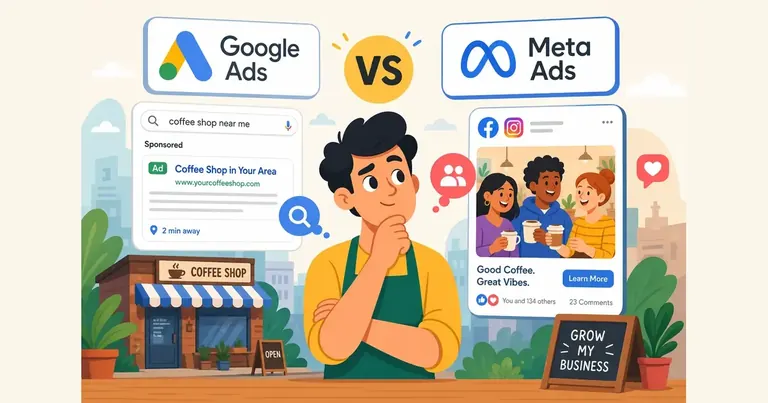
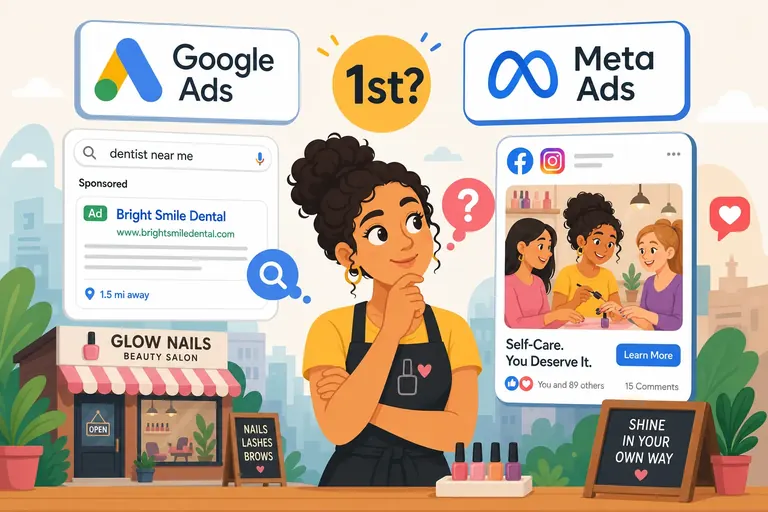
This is the question I hear most from owners who are ready to run ads but not sure where to start. The answer depends on your business type and what state the customer is in when they need you. If you are choosing between the two platforms rather than splitting between them, start with the direct comparison of Google Ads versus Meta Ads for local business.
When Should Google Search Get the Larger Share of Your Budget?
For service businesses where customers search with urgent intent, Google Search earns the bigger slice. A homeowner whose pipe burst at 9pm is not scrolling Instagram. They are searching "emergency plumber near me."
For plumbers, HVAC companies, pest control, dentists, and similar businesses, the majority of the paid budget should go to Google Search, commonly 50 to 70 percent depending on how intent-driven the category is. On a $1,000 per month budget, that is $600 to $700 to Google with the remainder on Meta for retargeting and visibility. Treat these as starting ranges and let your own CAC data set the final split.
When Does Meta Deserve More of Your Ad Spend?
Restaurants, retail shops, gyms, and lifestyle businesses work differently. A restaurant in Burbank does not need to catch someone mid-search. It needs someone to see a photo of a wood-fired pizza in their Instagram feed and think "I need to go there this weekend." Discovery and visual appeal drive that decision, not search intent.
For these businesses, shifting the majority of spend toward Meta, in the same 50 to 70 percent range, often produces better early results than the reverse. The platform that matches how your customer actually decides should get the bigger share.
Sample Monthly Ad Budgets for a Small Business
Abstract percentages only go so far. Here is what the math looks like in practice.
What Can You Expect from a $500 to $1,000 Per Month Ad Budget?
At $1,000 per month, a reasonable starting split for a local service business is $600 on Google Search, $300 on Meta for awareness and retargeting, and $100 behind the organic posts that are already performing.
At this level, realistic expectations are somewhere around 20 to 50 leads per month, and that range moves a lot with market competitiveness, offer quality, and how well the page converts. This is a data-gathering budget, not a scaling budget. You are finding out what works before you spend more. It also assumes traffic lands somewhere built to convert, which is why the choice between a landing page and your homepage changes results at any budget level.
What Changes at a $1,500 to $2,000 Per Month Ad Budget?
Once early data confirms a working offer and a CAC that fits your LTV math, moving to $1,500 to $2,000 per month allows simultaneous testing on both platforms. You can run Google Search for high-intent buyers, use Meta to retarget website visitors who did not convert, and still have budget left to test a second audience or a new creative angle.
This range supports sustained local visibility in competitive urban markets and produces enough monthly data to make real optimization decisions rather than guesses.
How Do You Know If Your Ad Spend Is Actually Working?
Spending on ads without a clear decision rule for when to scale or cut is how local businesses waste thousands of dollars. Two things to watch.
Which Metric Tells You When to Scale Your Ad Budget?
Come back to the ratio from Step 2. If LTV to CAC sits at 3 to 1 or better, the economics support more spend. Scale incrementally, roughly 20 percent at a time, rather than doubling overnight, because a sudden budget jump resets the platform's optimization and you lose the performance you were trying to grow.
If the ratio drops below 2 to 1, pause and fix the funnel before adding money. The ratio does not lie, and checking it monthly keeps you from confusing activity with results.
What Platform Metrics Signal It Is Time to Cut?
On Google Ads, watch cost per conversion, impression share, and whether your clicks are turning into anything at all. Clicks without customers is its own diagnosable problem, and I broke down the usual causes in a guide on Google Ads getting clicks but not customers.
On Meta, watch cost per result and ad frequency. When the same people have seen your ad repeatedly, engagement drops and costs climb. When you see that pattern, expand the audience or refresh the creative before the cost per result gets worse.
How Much to Spend on Ads: Follow the Formula in Order
Deciding how much to spend on ads stops being guesswork when you follow the sequence. Set the ceiling from revenue. Run the CAC and LTV math to confirm the economics work. Test on one platform with one offer and one audience before committing the full budget. Then let the data decide when to scale or cut.
The number you land on matters less than the fact that you can explain it. An owner who knows their CAC, their LTV, and their monthly ceiling can evaluate ad performance in five minutes. An owner who picked $500 because it felt about right will be guessing forever.
If you want help setting the number for your business, or a second opinion on whether your current spend is defensible, book a call and we will look at your numbers together. You can also browse the rest of the local marketing guides written for small businesses in competitive markets like the San Fernando Valley and Greater Los Angeles.
Miro Giovannini is a marketing consultant working with local businesses in the San Fernando Valley and Greater Los Angeles on Google Ads, Meta Ads, and local SEO.

Ready to bring in more customers?
Get a free 30-minute marketing review. We'll look at what you have today and identify the one or two changes that could make the biggest difference.