

How Much Do Google Ads Cost for Small Businesses?
June 12, 2026 · By Miro Giovannini
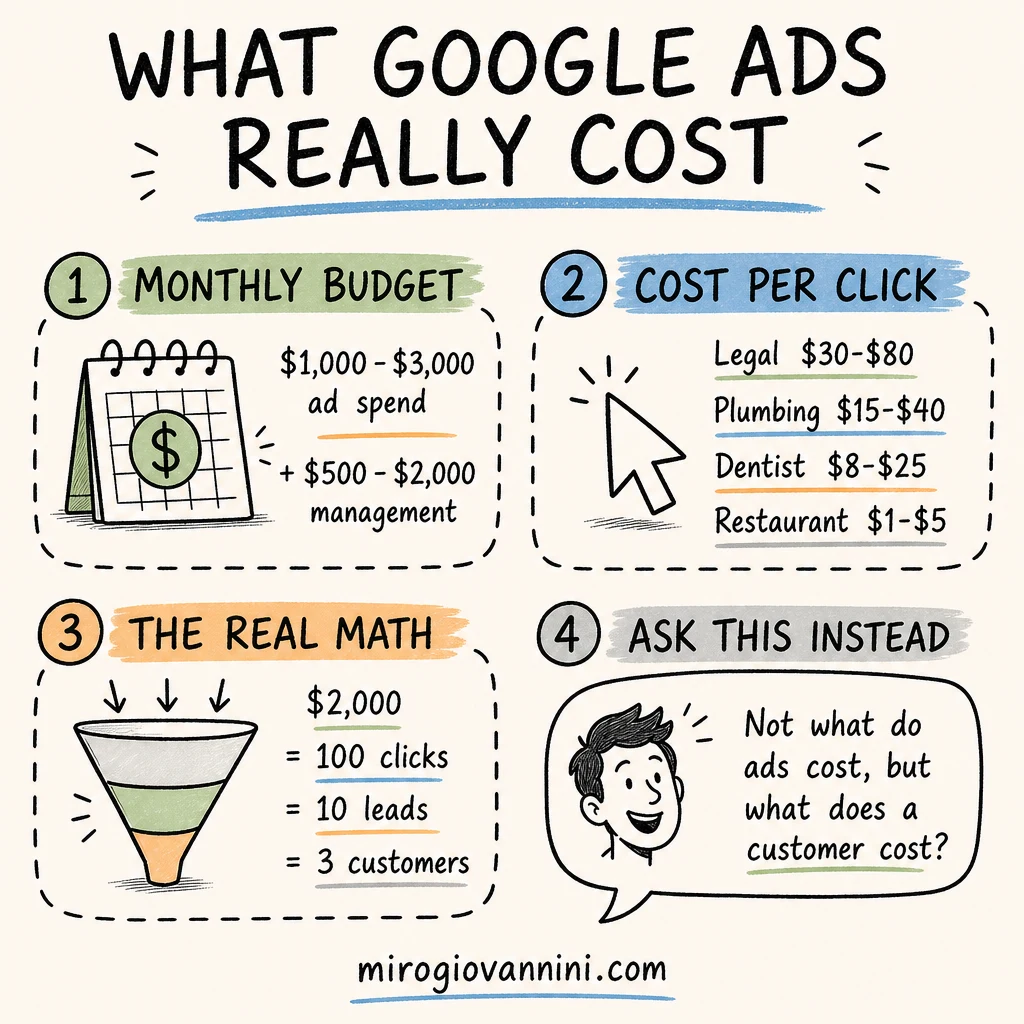
Most small businesses I work with in the San Fernando Valley spend between $1,000 and $3,000 per month on Google Ads, plus a management fee if someone else runs the campaigns. That is the honest range. But the number that actually matters is not your monthly budget — it is what one new customer ends up costing you, and whether that customer is worth more than you paid to get them.
Here is how Google Ads pricing really works, what drives the price up or down, and how to decide what your business should spend.
How Much Do Google Ads Cost per Month for a Small Business?
For a local service business targeting one metro area, a workable starting budget is $1,000 to $2,500 per month in ad spend. Below $1,000 you rarely collect enough clicks to learn anything useful, so you end up paying for data you cannot act on. Above $3,000, most local businesses start hitting the ceiling of how many people search for what they sell in their service area each month.
Two businesses on the same $2,000 budget can get wildly different results, because budget is only the input. The output depends on your cost per click, your conversion rate, and how much a customer is worth to you.
How Does Google Decide What You Pay per Click?
Google Ads runs an auction every time someone searches. You are not simply outbidding competitors — Google combines your bid with your ad quality to decide who shows up and in what order, which is why the highest bidder does not automatically win. Google's own documentation on Quality Score explains that expected click-through rate, ad relevance, and landing page experience all feed into that calculation.
The practical consequence: two advertisers bidding the same amount can pay very different prices. A relevant ad pointing to a fast, matching landing page gets cheaper clicks than a generic ad pointing to a homepage. That is not a trick, it is how the system is designed.
You only pay when someone clicks. Impressions are free.
What Is a Realistic Cost per Click in Los Angeles?
Cost per click varies enormously by industry, mostly because the value of a customer varies enormously. Based on what I see running accounts for local businesses in the LA area, these are typical ranges:
- Plumbing and HVAC: $15 to $40 per click
- Legal services: $30 to $80 and up
- Home remodeling and contractors: $10 to $35
- Dentists and medical practices: $8 to $25
- Auto repair: $6 to $18
- Real estate: $5 to $20
- Personal trainers and studios: $3 to $12
- Restaurants: $1 to $5
These are averages from accounts I manage, not published benchmarks, and yours will move depending on your keywords, your Quality Score, how tightly you target your area, and how many competitors are bidding in your zip codes right now.
Notice the pattern: the expensive industries are the ones where a single closed job is worth thousands. A $40 click hurts far less when the job it produces is worth $12,000.
Why Are Some Keywords So Much More Expensive?
Price follows intent. "Emergency plumber Sherman Oaks" costs several times more than "plumbing tips" because one of those searchers has water on the floor and a credit card in hand. Competition matters too: in categories where three or four well-funded companies bid on every commercial keyword, everyone's costs rise together. You cannot control the auction, but you can choose which auctions to enter.
What Does a $2,000 Monthly Budget Actually Buy You?
Let's walk through the math with a home remodeling business in Encino at a $20 average cost per click. This is an illustration, not a promise:
- $2,000 in ad spend gets you roughly 100 clicks
- If 10 percent of those clicks turn into a call or form fill, that is 10 leads
- If you close 3 out of 10 leads, that is 3 new projects
- At an average project value of $8,000, that is $24,000 in revenue
That is a 12:1 return, and it is achievable — but only if every step holds up. Drop the conversion rate from 10 percent to 3 percent, which is what happens when ads point at a homepage instead of a dedicated landing page, and the same $2,000 produces three leads instead of ten. Same budget, one third of the business.
This is why I tell owners to stop asking what Google Ads cost and start asking what their funnel converts at.
What Happens if You Only Spend $500 a Month?
At a $20 cost per click, $500 buys 25 clicks. Twenty-five clicks in a month is not a campaign, it is a rounding error — you will get one lead in a good month and zero in a normal one, and you will have no idea whether the problem was your keywords, your page, or luck. If $500 is genuinely your ceiling right now, put it into your Google Business Profile, reviews, and your website first. Those work on a smaller budget.
What Is a Good Cost per Lead and Cost per Customer?
Work backwards from what a customer is worth to you. If your average customer is worth $5,000 in profit and you close one out of every four leads, you can afford to pay several hundred dollars per lead and still come out far ahead. If you sell a $60 service with no repeat business, a $40 lead is a disaster.
A simple rule I use with clients: your target cost per acquisition should be no more than 20 to 25 percent of the gross profit on that first sale, unless you have strong repeat business or referrals to lean on. That leaves room for the campaigns to have bad weeks without putting you underwater.
If you have never mapped this out, how to know if your digital marketing is actually working walks through the numbers you need to track before you scale spend.
How Much Should You Pay Someone to Manage Google Ads?
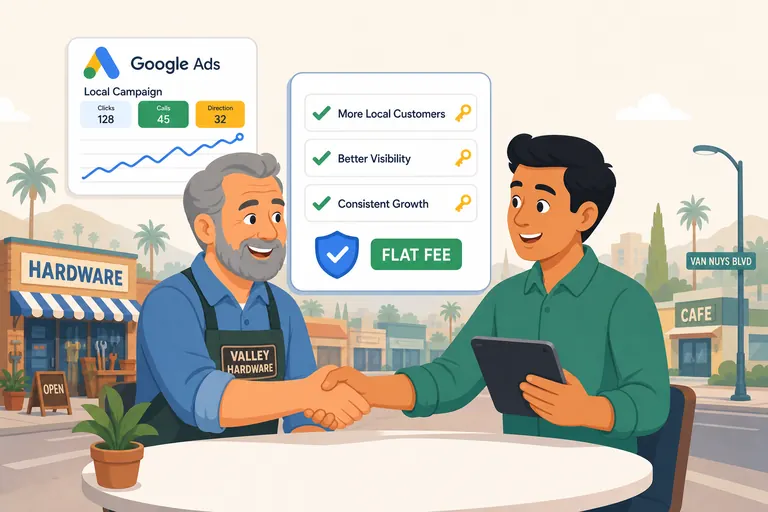
Management fees for local businesses typically run $500 to $2,000 per month, or 10 to 20 percent of ad spend for larger accounts. Some agencies charge a percentage, some a flat fee. Flat fees are usually better for you, because a percentage model quietly rewards your agency for spending more of your money.
What you should get for that fee:
- Search term monitoring and negative keywords, so you stop paying for searches that will never buy
- Conversion tracking that is set up correctly and actually verified
- Landing page and ad testing, not just "we made a new ad this month"
- Bid and budget adjustments based on which campaigns produce customers
- A monthly report you can read in five minutes and understand
If the only thing you receive is a dashboard screenshot with clicks and impressions, you are paying for reporting, not management.
Should You Run Google Ads Yourself?
You can, and some owners do it well. The honest trade-off is time: a small account needs two to four focused hours a month to stay healthy, and most of that is unglamorous work in the search terms report. If those hours are worth more to you inside your business, hire someone. If you enjoy the numbers and your budget is under $1,500, running it yourself for the first few months teaches you more than any report will.
Why Do Some Businesses Waste Their Entire Budget?
The platform is rarely the problem. Setup and neglect are. The most expensive mistakes I find when I audit an account:
No conversion tracking. Without it, Google is optimizing blind and so are you. Google's guide to conversion measurement covers what to install before you spend a dollar.
Broad match with no negatives. A plumber pays $30 for "how to fix a leaking faucet yourself." Google's documentation on keyword match types explains how much reach each option opens up, and negative keywords are how you close the wrong doors.
Location targeting left too wide. If you serve the Valley, you should not be paying for clicks from San Diego.
Ads pointing at the homepage. Visitors land on a page about everything and convert on nothing. This is the single most common cause of clicks that never turn into customers.
No one looking at the account. Search behavior shifts, competitors enter, costs drift. An account nobody touches gets more expensive every month.
Is Google Ads Cheaper Than SEO or Facebook Ads?
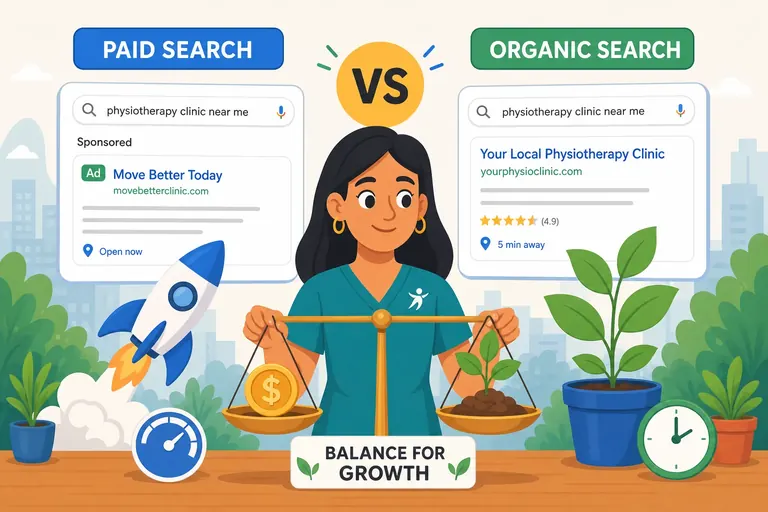
Cheaper is the wrong comparison, because they buy different things. Google Ads buys immediate access to people already searching for what you sell. SEO buys compounding traffic that costs nothing per click but takes months to arrive — I break that trade-off down in Google Ads vs SEO.
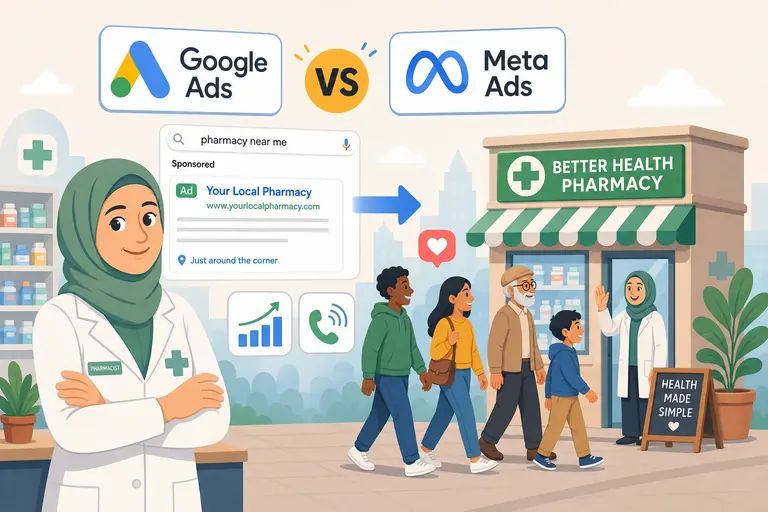
Meta Ads usually deliver cheaper clicks, sometimes ten times cheaper, but those people were not looking for you when the ad appeared, so a larger share of them never convert. The full comparison is in Google Ads or Meta Ads for local business.
The honest answer is that Google Ads is often the most expensive channel per click and the cheapest per customer, precisely because of that intent.
How Much of Your Revenue Should Go to Ads?
The U.S. Small Business Administration's guidance for managing your business points small business owners toward treating marketing as a planned, recurring line item rather than a reaction to slow months. In practice, most established local businesses I work with land somewhere between 5 and 10 percent of revenue on total marketing, with paid ads taking part of that. If you are trying to grow quickly or you are new in your market, the number goes higher.
I go deeper into how to set that figure in how much of your revenue should go to marketing.
When Is Your Business Not Ready for Google Ads?
Be honest with yourself before you spend anything. Hold off if:
- You have no website, or your site loads slowly and looks dated. Traffic will not fix that. See do you need a website before running Google Ads.
- Nobody answers the phone during business hours. Paid leads go cold in minutes.
- You cannot commit at least $1,000 a month for three months. One month of ads proves nothing.
- You have no way to tell where a customer came from.
Fix those first. They are cheaper to fix than they are to pay for in wasted clicks.
How to Start Without Burning Money
If you are launching your first campaign, keep it deliberately small:
- Pick 10 to 20 high-intent keywords, the ones with "near me," your city, or "hire" and "cost" in them.
- Set your location targeting to the area you actually serve, and set it to people in that area, not people interested in it.
- Build one landing page per service, not one page for everything.
- Install conversion tracking and confirm a test lead registers.
- Review the search terms report weekly for the first month, and add negatives every time.
- Give it 60 to 90 days before judging results.
That is a boring plan, and it works far more often than a big launch does. If you want the longer version, how to get more customers with Google Ads covers the campaign structure I use.
The Question Worth Asking
"How much do Google Ads cost?" has no useful answer on its own. The useful question is: what does one new customer cost me, and how much is that customer worth over a year?
If you spend $2,000 and get five customers worth $5,000 each, you did not spend $2,000 — you bought $25,000 for eight percent of its value. If you spend $2,000 and get nothing, the platform is not broken. Something in the chain between the search and the sale is, and it can be found.
Want a realistic cost projection for your specific business and service area? Book a free strategy call and I will walk you through expected click costs, lead volume, and whether the numbers work for your budget.
Ready to bring in more customers?
Get a free 30-minute marketing review. We'll look at what you have today and identify the one or two changes that could make the biggest difference.