
Landing Page vs. Homepage: Where Your Google Ads Should Go
July 28, 2026 · By Miro Giovannini
If you're asking yourself, "Should I send Google Ads traffic to my homepage or a landing page?", you're already asking the right question. Many local businesses running Google Ads are making one costly mistake before anyone even sees their ad. They spend hours picking keywords, writing ad copy, and setting budgets. Then they send every click to their homepage and wonder why the phone isn't ringing. Anecdotally, this is one of the most common and most expensive habits I see among San Fernando Valley business owners who come to Miro Giovannini Blog looking for answers. You may not be losing money on bad ads. You may be losing it on where those ads land.
The fix requires understanding why your homepage is working against you and what to build instead. This article gives you that answer directly, with a real example, the numbers to back it up, and a straightforward way to test it yourself.
Why your homepage is the worst destination for paid ad traffic
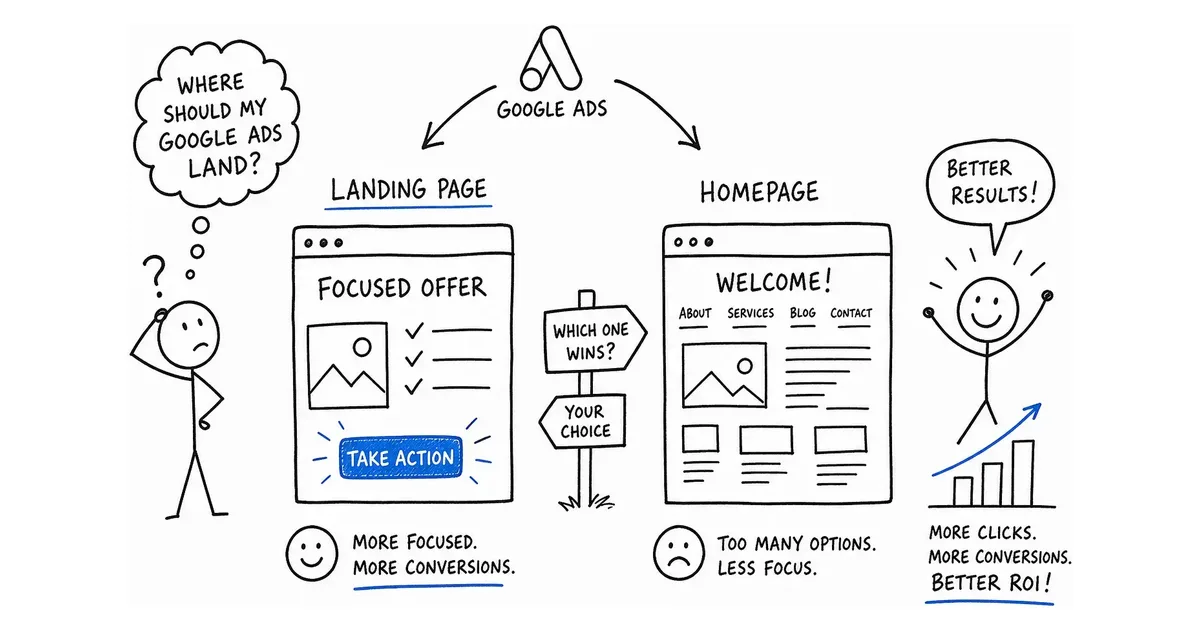
A homepage is designed for everyone. A paid ad is designed for one person searching for one specific thing. That mismatch is where money disappears. When someone searches "emergency plumber Reseda" and clicks your ad, they want confirmation fast. They want to know you can help them right now. Your homepage, built for every kind of visitor, rarely delivers that confirmation quickly enough.
Too many doors, not enough direction
When a visitor lands on a page with eight navigation links, three different buttons, and a footer full of options, friction multiplies and decision-making stalls. That's the core problem with homepage-directed ad traffic. Decision paralysis is real and measurable: homepage conversion rates for paid search typically sit between 2% and 3%, while dedicated landing pages for local service businesses convert at 5.5% to 7.8%. In some contractor verticals, that figure climbs as high as 11.5%. That gap represents real leads you're paying for but not capturing.
The message gap between your ad and your page
If your ad says "same-day plumber in Reseda" and your homepage says "Your Trusted Plumbing Company Since 2008," the user feels like they landed in the wrong place. Research on bounce behavior consistently shows visitors make that judgment within a few seconds, and it costs you the click you already paid for. The ad made a specific promise. The homepage doesn't keep it. Every visitor who bounces because of that gap is money you can't recover.
No single CTA means no single outcome
Homepages typically have a "Contact Us" in the navigation, a "Learn More" button mid-page, and a contact form buried in the footer. None of them are prominent. None of them are specific. When everything is a call to action, nothing is. Paid traffic needs one clear next step, and a homepage almost never provides it.
Should I send Google Ads traffic to my homepage or a landing page?
A dedicated landing page strips everything away except one focused offer and one action. No navigation bar. No exit links. No blog sidebar or "About Us" section. The user arrived from an ad promising one specific thing, and the page delivers exactly that. This isn't a design philosophy, it's a business math argument. If you're paying $8 per click and your homepage converts at 2%, you need 50 clicks to get one lead, which works out to $400 per lead. Improve that rate to 6% and you're at roughly $133 per lead. Same budget. Same traffic. Different destination.
Focused pages, focused results
A properly built landing page for Google Ads follows a clear structure: a headline that mirrors the ad, a short paragraph with the key benefit, a phone number or form above the fold, and social proof directly below. Nothing else competes for attention. The user knows exactly what the page is for and exactly what to do. That clarity is what drives the conversion rate difference.
How page relevance affects your ad costs
Google evaluates your landing page as part of your Quality Score, which directly affects your cost per click. A page that closely matches what the user searched for signals high relevance, and Google rewards that with lower costs for the same ad position. A generic homepage that doesn't reflect the specific search query signals low relevance, which pushes costs up. Sending paid traffic to a well-matched landing page isn't just good for conversions, it can reduce what you pay for every click you receive.
A real example: two pages, very different results
Here's a scenario that plays out constantly for local service businesses. A plumber in the San Fernando Valley runs Google Ads targeting emergency calls in Reseda and surrounding neighborhoods. The campaign is set up correctly. The ads are solid. But every click goes to the homepage. Here's what changed when the destination did.
What the homepage version looked like
A user searches "emergency plumber Reseda," clicks the ad, and lands on a homepage with a company logo, a hero image of smiling technicians, six navigation links, and a footer contact form. Nothing on the page confirms same-day service. Nothing answers "can you help me right now?" There's no phone number above the fold. There's no urgency. The user bounces within seconds, finds another result, and calls someone else.
What the landing page version looked like
Same ad, different destination. The user lands on a page with a headline that reads "Same-Day Plumbing in Reseda and Surrounding Areas." A phone number in large text sits above the fold. Three trust signals appear directly below: licensed, insured, 4.9-star rating. A two-field form asks for name and phone number, nothing else. No navigation. No exit links. One job: get the call. The page delivers exactly what the ad promised.
What the numbers showed
In controlled tests comparing a homepage destination versus a dedicated landing page for local service campaigns, cost per acquisition dropped from $287 to $144 while conversions increased by roughly 1.7 times. The ad budget didn't change. The traffic didn't change. The keyword targeting didn't change. Only the destination changed. Same dollars, nearly twice as many leads, just by fixing where the clicks landed.
Landing page best practices for PPC: five things every local business page needs
Building a landing page that converts paid traffic requires getting five elements right. The order matters because each one builds on the last.
Start with headline and CTA alignment
The headline is not your tagline. It's the answer to what the user just searched for. If your ad said "affordable Botox in Sherman Oaks," your headline should say almost exactly that. One CTA follows, not three. One button, one action, placed above the fold where it's visible before the user scrolls. Pages with a single focused action consistently outperform pages with multiple competing options.
Cut the form, add the proof
Every extra field on a form reduces completions. For local service businesses, ask for name and phone number and nothing else. Cutting form fields from 11 to 4 has repeatedly produced significant jumps in completions across multiple published tests. Put your trust signals immediately below the form: star ratings, years in business, license numbers, a photo of your team. That's exactly where a skeptical visitor needs reassurance, right at the moment of decision. Miro Giovannini Blog walks through the full landing page build process step by step, written specifically for local business owners who want results without an agency budget.
Speed matters more than you think
A one-second delay in mobile load time costs roughly 7% in conversions. More than half of mobile users leave a page that takes longer than three seconds to load. On mobile, where most local searches happen, slow pages are effectively invisible. Compress your images, cut unnecessary scripts, and test your page speed before sending any paid traffic to it. Google's benchmark for a "good" mobile load is 2.5 seconds or faster, and for paid landing pages, getting under 2 seconds is worth the effort.
Match the destination URL to the ad's promise
The destination URL for your Google Ads should reflect the specific offer in the ad, not just drop users on a generic page. If your ad targets "HVAC repair in Woodland Hills," the page at that URL should open with exactly that topic. URL-to-ad alignment reinforces message match, supports Quality Score, and keeps the user confident they clicked the right result.
Remove every exit that isn't the conversion
Navigation menus, social media icons, internal blog links, all of them give the user a reason to leave before converting. Strip them from your landing page. The only clickable elements should be your phone number, your CTA button, and your form submit. Every additional link is a leak in the funnel you're paying to fill.
The one situation where your homepage is actually fine
Not every Google Ads campaign needs a dedicated landing page. There is one clear exception, and it's worth knowing so you don't over-engineer campaigns that don't need it.
When the searcher already knows you
Branded keyword campaigns, where someone types your business name directly, signal a fundamentally different intent. That user isn't comparing options or discovering you for the first time. They're returning. They want your site specifically. Sending them to your homepage is appropriate because the message match problem doesn't apply. They already know you. The navigation helps them find what they're looking for.
Awareness campaigns without a conversion goal
If you're running an upper-funnel display campaign with no expected call or form fill, a homepage is acceptable as the destination. But for most non-branded, lead-driven campaigns where you're paying per click and expecting a conversion, a dedicated landing page is almost always the right move. The homepage exception is narrow. The landing page rule is broad.
How to stop guessing and actually test this
You don't need a conversion rate optimization agency or a $5,000 redesign to test this. The simplest version takes two weeks and costs nothing beyond your existing ad budget.
The simplest version of an A/B test
Create two final URLs for the same ad group: one pointing to your homepage, one pointing to a stripped-down landing page built around the specific offer in your ad. Run both with equal budget for two to four weeks. At the end, compare two numbers: conversion rate and cost per lead. Keep the winner. Pause the loser. Tools like Leadpages, Landingi, or even a basic WordPress page are enough to build the landing page version. You don't need a more advanced platform to get started, though built-in A/B testing features become useful once you're ready to optimize further.
Where to go from here
Miro Giovannini Blog has a step-by-step landing page setup guide built specifically for local Google Ads campaigns. It covers page structure, headline formulas, form setup, and how to connect your landing page to Google Ads conversion tracking, written without assuming any technical background and without the agency upsell. The goal is simple: stop paying for clicks that go nowhere and start knowing exactly which page earns your next call.
The bottom line: should I send Google Ads traffic to my homepage or a landing page?
Many local business owners send Google Ads traffic to their homepage because it's the default, not because it works. A dedicated landing page isn't a complicated or expensive thing to build. It's specific. One focused offer, one user, one clear action. The plumber example makes it plain: same budget, same ads, completely different outcome when the destination changed.
If you're running Google Ads right now and sending clicks to your homepage, the first thing to fix isn't your keywords, your bids, or your ad copy. It's where those clicks land. Fix that first, measure for two weeks, and the numbers will tell you everything you need to know. So if you've been wondering whether to send Google Ads traffic to your homepage or a dedicated landing page, now you have your answer.
Ready to bring in more customers?
Get a free 30-minute marketing review. We'll look at what you have today and identify the one or two changes that could make the biggest difference.