
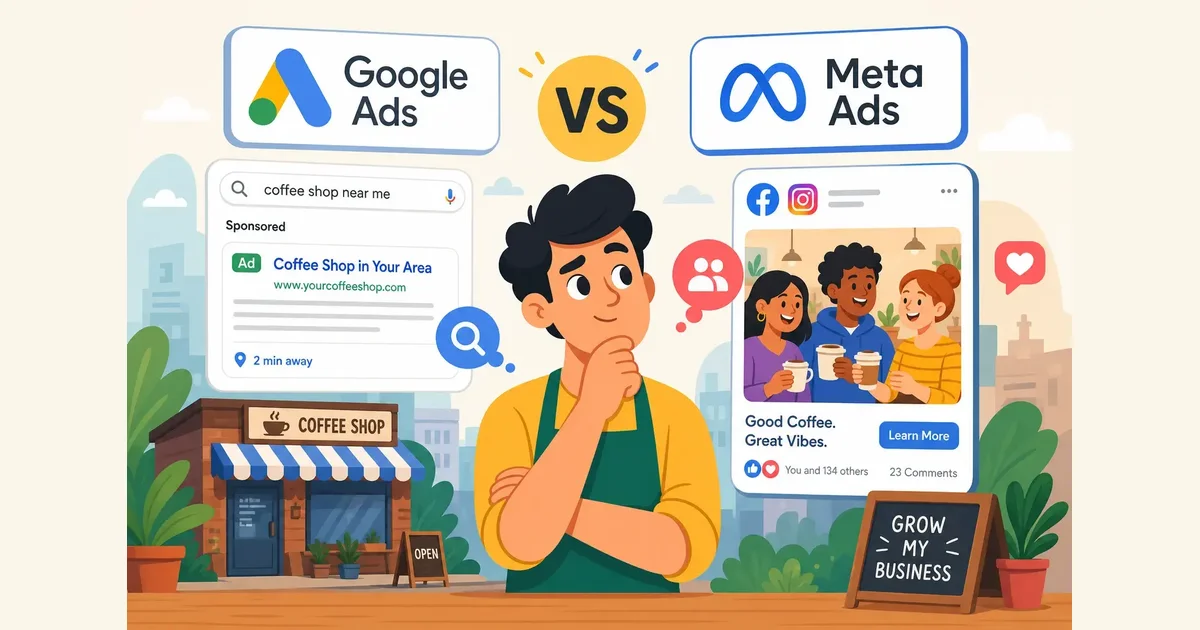
Google Ads or Meta Ads: Which Is Better for Local Business?
August 16, 2026 · By Miro Giovannini
Picture two local business owners in the San Fernando Valley, both with a $1,500 monthly ad budget. The first is a plumber who needs the phone ringing by noon. The second runs a boutique clothing shop and wants people to recognize her brand before they ever set foot inside. Both need advertising to work. But put them both on the same platform and one of them will burn their budget with almost nothing to show for it.
This scenario comes up regularly in my work with local businesses across Southern California, dozens of clients over the past several years facing the same fork in the road. Which works better for local businesses, Google Ads or Meta Ads, is not a question with a universal answer. It's a matter of which platform matches the buying behavior of your specific customer. This breakdown covers the core logic behind each platform, the industry scenarios where one clearly outperforms the other, real 2026 cost benchmarks, and a practical framework for picking a starting platform and measuring results within 30 to 60 days.
Which Works Better for Local Businesses: Google Ads or Meta Ads?
Pull vs. push: why Google and Meta reach local customers differently
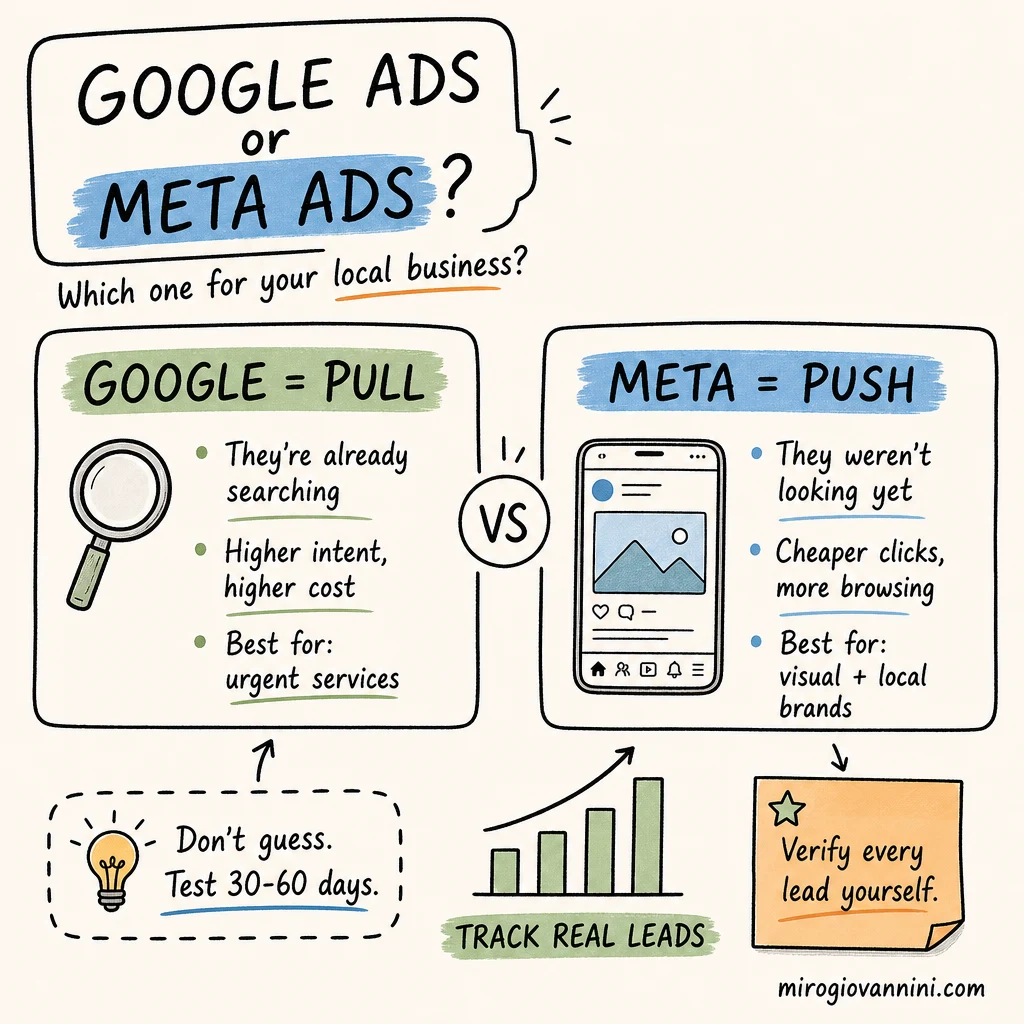
The simplest way to frame the Google Ads vs. Meta Ads decision for local businesses is pull versus push. Google pulls in customers who are already searching. Meta pushes your brand in front of people who weren't looking yet. Understanding which dynamic fits your business tells you where to spend first.
Google catches people who are already looking
Google Search and Google Local Services Ads operate on a pull-marketing model. When someone types "emergency plumber Burbank" or "HVAC repair near me," they already have a problem and are actively hunting for a solution. Your ad shows up at exactly that moment. You're not interrupting anyone. You're meeting them at the point of highest intent. That's why conversion rates on local search campaigns tend to run higher and lead-to-close cycles stay shorter than almost any other paid channel.
This dynamic makes Google a natural fit for service businesses where timing matters. The customer has a defined need, they know what they want, and they're ready to call or book. Your ad either shows up or it doesn't.
Meta interrupts people who weren't looking yet
Meta Ads work on a completely different logic. Facebook and Instagram serve ads based on demographic data, interests, location, and behavior patterns, not search intent. Your ad appears in someone's feed while they're scrolling through photos or Reels, and they weren't thinking about your business a second ago. That's a push-marketing model: you're generating awareness and desire before a need is fully formed.
For some business types, that's exactly the right approach. A boutique promoting a new collection or a med spa building neighborhood-level recognition both benefit from the visual, discovery-based format Meta provides. The platform rewards businesses that can make someone stop scrolling and think, "I want that." In the San Fernando Valley, where consumer businesses compete in dense, image-conscious markets, that ability has real value.
When Google Ads Works Better for Local Businesses
The industries where Google consistently wins
For high-intent, urgency-driven service categories, paid search on Google is almost always the stronger starting point. Plumbing, HVAC, roofing, pest control, electrical, and legal services all share one trait: the customer has an immediate problem and searches with clear purchase intent. They are not browsing. They are buying.
The benchmark data backs this up. Legal services show roughly 8.2x ROAS on Google versus 3.0x on Meta (per 2026 industry benchmarks from Adamigo). For local home services, Google Search CPL runs approximately $25 to $120, with conversion rates between 4% and 10% (GrowWithBA 2026 local-services benchmark). A San Fernando Valley plumber running Google Ads on a keyword like "water heater replacement Reseda" can often start generating calls within the first few days of a campaign going live. That same budget on Meta would build impressions and reach, but not calls. The 2026 Google Search average CPC for plumbing sits around $8.45, with a non-branded CPL of roughly $183, figures that sound high until you consider that many plumbing jobs carry average ticket values well above that threshold.
Google Local Services Ads as a trust multiplier
Local Services Ads deserve special mention for contractors and home service providers. Unlike standard Search campaigns, LSAs charge per lead rather than per click, appear above standard Search results, and carry the Google Guaranteed badge, which signals credibility to homeowners who might otherwise hesitate. You're not paying for curiosity; you're paying for contact.
LSAs are often the smartest starting point for contractors on limited budgets because they require less keyword management expertise than standard Search campaigns. The trade-off is less control over ad copy and landing page experience, but for a plumber or electrician just getting started with paid search, that simplicity is an asset. I have a full breakdown of Google Ads setup for local service businesses if you want the step-by-step configuration.
When Meta Ads Works Better for Local Businesses
Brand awareness, visual products, and discovery-phase customers
Meta's real strength is for businesses where the product or service creates desire when seen. A restaurant posting food photography or a yoga studio showing a morning class, these businesses sell through visual storytelling. The customer doesn't search for them; they stumble across them, and that moment of discovery is where the sale begins.
Meta's location-based targeting also gives local businesses the ability to narrow campaigns to specific zip codes or neighborhoods, which is especially useful in densely populated markets. A boutique in Sherman Oaks doesn't need to reach all of Los Angeles; it needs to reach women aged 25 to 45 who live within five miles and have shown interest in fashion. Meta offers very granular location and demographic targeting that is cost-effective for many local prospecting use cases, making it a strong option when your goal is precise audience reach rather than capturing active search intent.
Retargeting and lower-funnel use cases for Meta
Meta becomes particularly effective when layered on top of Google as a retargeting channel. Someone searches on Google, clicks your ad, visits the website, but doesn't book. A Meta retargeting ad that shows up two days later can close that gap. This mixed-channel approach, where Google captures intent and Meta reinforces it, often improves results significantly compared to either platform running in isolation, and multiple agency case studies and 2026 benchmarks support the pattern.
One important caveat on Meta for local services: the 2026 cross-industry average conversion rate on Meta is 9.21%, but home services specifically comes in around 1.87%. Meta's role in local service businesses is awareness and retargeting, not primary lead capture. If you run a plumbing company and expect Meta to generate calls the way Google does, the numbers will disappoint you. If you use Meta to stay visible to people who've already seen your Google ad, the numbers look much better.
2026 Cost Benchmarks: What Local Businesses Actually Pay
Google Ads cost ranges for local service campaigns
For local service industries in 2026, expect a CPC range of $4 to $18 on Google Search, with CPL ranging from $25 to $120 depending on the vertical and how competitive the market is. LocaliQ's 2026 dataset across 13,000-plus U.S. campaigns shows an all-industry average CPC of $5.42 and an average CPL of $66.69, a useful cross-check even if your specific vertical runs higher.
The minimum viable budget to collect measurable data on Google Search is $1,000 to $2,500 per month for most local businesses. Lower-competition markets can sometimes generate usable signal at $500 to $1,000 per month. Below $500, the algorithm rarely collects enough conversions to optimize effectively. Smart Bidding strategies like Target CPA need at least 15 to 30 conversions per month to work properly, a threshold Google's own guidance reinforces.
Meta Ads cost ranges and minimum viable budgets
Meta has no meaningful hard floor, but realistic minimums for measurable local results land at $300 to $1,500 per month depending on lead cost and audience size. For home services and local service businesses in 2026, the Meta CPL benchmark runs approximately $40 to $45, with lower-ticket trades like landscaping often coming in below that range and higher-ticket trades like roofing running above it.
The lower entry cost on Meta looks attractive compared to Google, but the real comparison is CPL and lead-to-close rate, not just ad spend. A $40 Meta lead that takes five follow-up calls to qualify costs more in real terms than a $120 Google lead that books on the first call.
One more practical note on attribution: iOS privacy changes and GA4 conversion modeling mean both platforms now underreport cross-platform conversions. Neither platform dashboard gives you the full picture in 2026. First-party tracking, call recording, and CRM data matter more than ever for understanding what's actually working, and that's true whether you're running paid search, paid social, or both.
How to Choose Your Starting Platform and Measure It in 30 to 60 Days
A fast decision framework: Google Ads or Meta Ads for your business type
If customers search for your service when they urgently need it, plumbers, roofers, locksmiths, attorneys, HVAC contractors, start with Google Search or Local Services Ads. If your product or service creates desire through visuals or lifestyle appeal, boutiques, restaurants, gyms, med spas, start with Meta. If you already have website traffic and want to re-engage visitors who didn't convert, start with Meta retargeting alongside any existing Google campaign.
The mistake Miro sees repeatedly with San Fernando Valley contractors is spending three months on Meta before ever running a single Google Search campaign. A $1,000 per month Google Search campaign targeting local service keywords would have produced calls in week one for most of them. Meta looked familiar and felt easier to start, but it was the wrong tool for the job.
What to track in your first 30 to 60 days
Three numbers matter at this stage: cost per lead, lead-to-appointment rate, and cost per booked job. Set your baseline before you spend a dollar. Know your average job value, your target CPL, and the minimum number of leads per month you need to break even. Without that math done upfront, you have no reliable way to judge whether the platform is working or simply burning budget.
Do not rely on platform dashboards alone. Google and Meta both over-credit their own conversions, especially in 2026 with modeled attribution filling in gaps left by iOS privacy restrictions. Cross-check every lead source with a dedicated call tracking number and your CRM or booking system. A lead that shows up in the Google Ads dashboard but never appears in your CRM didn't happen. Platforms that reward honest measurement keep earning your budget over time, but only if you're measuring honestly in the first place. My guides on Google Ads setup and Meta Ads for local businesses walk through the full campaign and tracking configuration if you want the complete walkthrough.
The Bottom Line: Which Works Better for Local Businesses, Google Ads or Meta Ads?
Google Ads wins when customers search with urgency and intent. Meta Ads wins when customers need to discover you first. Neither platform is universally better for local businesses, the right answer depends entirely on how your specific customer behaves at the moment they're closest to buying.
The strongest local advertising setups eventually use both platforms together, with Google capturing high-intent leads and Meta reinforcing the brand for people who've already shown interest. But most small local businesses should commit to one platform first, spend 30 to 60 days measuring it properly, and expand from a position of real data rather than gut instinct or whatever a salesperson told them to try.
Decide which works better for your local business, Google Ads or Meta Ads, by running a focused 30-day test using the benchmarks above as your baseline. If you want practical, no-agency-speak guidance on setting up either platform for a local business in Southern California or anywhere else in the U.S., book a free call and we'll figure out the right starting platform for your business — or browse the rest of the blog for the step-by-step resources.


Ready to bring in more customers?
Get a free 30-minute marketing review. We'll look at what you have today and identify the one or two changes that could make the biggest difference.