

How to Know When It's Time to Hire a Marketing Expert
August 10, 2026 · By Miro Giovannini
You should hire a marketing expert when marketing has become the most important unsolved problem in your business and you no longer know what to do next. Not when things break. Most owners who call me are not in crisis — they have seen marketing work, they know it could work better, and they have run out of ideas about how.
That is the pattern almost every time. The business needs to grow. They have already tried some form of digital marketing, themselves or through someone else. They have seen it make an impact, so they know it is real. What they do not have is a clear idea of what to do next.
If that sounds like your situation, this article is for you. I want to walk you through what I actually see when business owners handle their own marketing, what changes when they bring in help, and how to tell whether now is the right moment.
What Are the Signs You Need to Hire a Marketing Expert?
Run through these honestly. They are the same questions I ask on a first call.
- You cannot say, in numbers, how many leads you got last month or what each one cost.
- You are boosting posts rather than running structured campaigns.
- Your ad spend has grown past a few thousand a month with nobody accountable for it.
- The hours you spend on marketing are hours you should be spending on billable work.
- Marketing is the bottleneck in your business this quarter, not a side project.
- You expect a different outcome in six months while planning to do exactly what you are doing now.
Three or more of those and you are past the point where guessing helps.
Why Is the Boost Post Button a Problem?
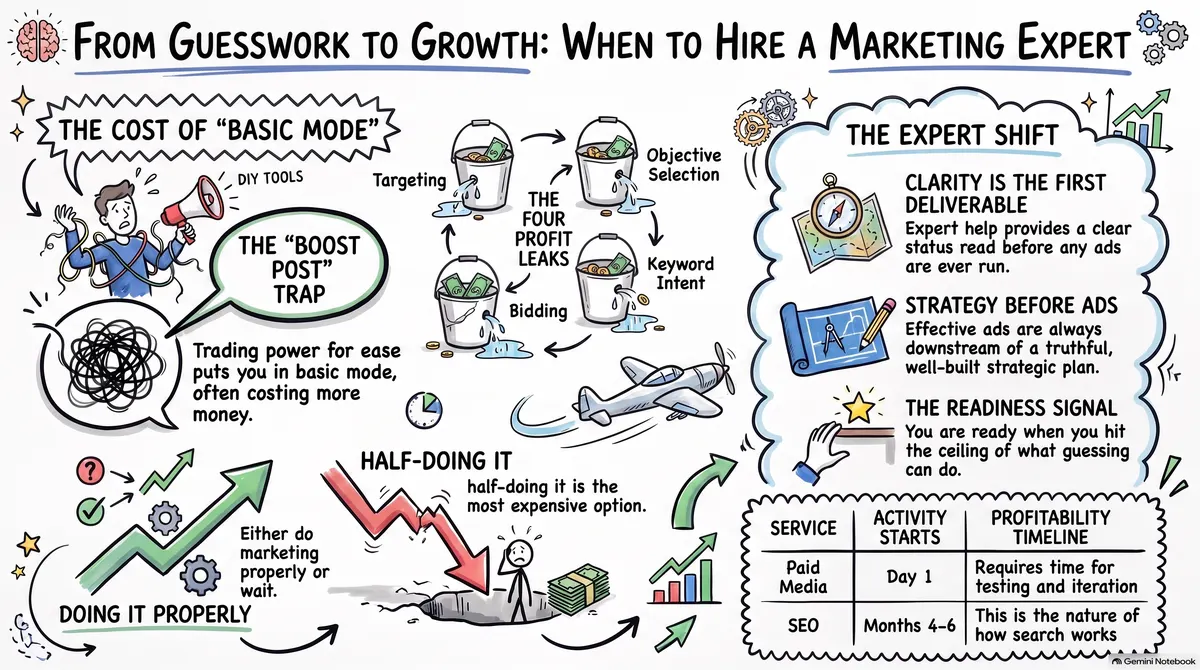
When a business owner is managing their own marketing, there is one move that shows up over and over: the "Boost Post" button on Meta.
I understand why. It is fast and simple. The platform designed it to be effortless, and you save real time by using it. But here is the trade-off nobody explains: boosting a post puts you in basic mode. Meta Ads has an expert mode, and it is a completely different tool. When you boost, you give up almost everything that makes the platform powerful.
What Do You Give Up When You Boost a Post?
You give up the choice of what the campaign is actually optimizing for. Meta's own documentation on choosing an ad objective explains that the objective determines who the system shows your ad to. Boosting defaults toward engagement — likes, comments, reach — which is not what you want if you want customers.
You also give up granular audience control, placement control, proper conversion optimization, and the structure needed to test one creative against another and learn something from the result.
So you save time, and it ends up costing you money. I compared the two modes properly in Facebook and Instagram ads for local businesses, if you want the detailed version.
Is Google Ads Harder to Run Yourself Than Meta?
Yes. The setup is considerably more complex and it demands a different kind of technical expertise. It is not something you learn by clicking through the interface for an afternoon.
Google decides what you pay per click partly through Quality Score, which weighs expected click-through rate, ad relevance, and landing page experience. That means two advertisers bidding the same amount can pay very different prices for the same position. Most self-managed accounts I audit are on the wrong side of that.
What Goes Wrong in Self-Managed Ad Accounts?
When I audit an account that has been managed in-house, the problems are almost always in the same four places:
- Targeting. The campaign is reaching people who will never buy.
- Objective selection. The campaign is optimized for the wrong outcome, so the platform delivers the wrong results very efficiently.
- Bidding. Money is going out at the wrong price per result.
- Keywords. In Google Ads, the wrong keywords mean you are paying for searches with no intent to purchase.
It is rarely one of these. It is usually a combination, and that is exactly why it is hard to diagnose from the inside. Each individual setting looks reasonable on its own screen.
Why Is Conversion Tracking the First Thing to Check?
Because everything downstream depends on it. Automated bidding cannot optimize toward a result it cannot see — Google's Smart Bidding works from conversion data, and Meta's delivery system needs conversion events to leave the learning phase and stabilize.
An account with broken or missing conversion tracking is not being optimized at all. It is spending. That is the single most common thing I fix first, and it costs nothing but attention.
What Actually Changes When You Hire a Marketing Expert?
People expect the first change to be results. It is not.
The first thing my clients see is clarity.
Working with someone who knows the ecosystem gives you a clear read on where your business actually stands right now, and a plan to get from there to where you want to be. That is it. That is the real deliverable in the beginning, and it is the thing that makes the difference.
That plan is what we call strategy. Once it is drawn up and implemented, growth is what you see in the medium and long term. A good strategy well executed always brings good results.
I am deliberate about that order, because it is the opposite of how most people shop for marketing help. They are looking for someone to run ads. What they actually need first is someone to tell them the truth about their current situation and build a plan around it. The ads are downstream of that.
If you want a practical starting point before you talk to anyone, read how to know if your digital marketing is actually working. Knowing your own numbers changes the conversation completely.
What Should You Expect in the First 90 Days?
Month one is diagnosis and repair: tracking fixed, waste cut, structure rebuilt, the obvious leaks closed. You should see cleaner data and often lower cost per lead simply from stopping the spend that was never going to convert.
Month two is where testing starts producing signal — which offer, which audience, which landing page. Month three is when a picture emerges that you can make decisions from. If someone tells you the account will be transformed in week two, they are describing a launch, not a result.
Should You Ever Keep Doing Your Own Marketing?
I get asked this constantly, and my answer is probably not what you will read elsewhere.
Under no circumstance would I recommend running your own paid campaigns as a long-term plan. You will lose money doing it. Not "you might not get optimal results" — you will lose money, because the platforms are built to spend your budget whether or not it is set up correctly.
But that does not mean the answer is always "hire someone today."
If your business has other priorities that genuinely need your attention first, deal with those. Then come back and do the marketing properly. There is no rush that justifies doing it badly, because the cost of doing it badly can be very high.
So the real choice is not between hiring an expert and doing it yourself. It is between doing it properly and waiting until you can do it properly. Those are your two good options. Half-doing it is the expensive one.
What Can You Reasonably Keep In-House?
Plenty, and it is worth keeping. Your Google Business Profile, replying to reviews, taking real photos, posting updates, and answering leads quickly are all things you or your team can do better than any outside vendor, because you are the one who knows the business and the customer.
The line I would draw is around anything that spends money automatically or requires technical configuration. Paid campaigns, tracking setup, and feed or landing page work are where inexperience costs real money instead of just time.
How Much Should You Budget Before Hiring Help?
There is no universal number, but there is a useful test: hiring help should be paid for by the waste it removes plus the growth it creates. If your ad spend is small enough that a management fee dwarfs it, fix the free things first — your profile, your reviews, your website, your response time — and grow into paid help.
The SBA's guidance on marketing and sales makes the same basic point: marketing budget follows from knowing your customer acquisition math, not from a percentage someone quotes you. I went deeper into the numbers in how much of your revenue should go to marketing.
What Is the First Red Flag When Choosing Who to Hire?
Once you decide to get help, the decision shifts to who. And there is one warning sign I would tell any business owner to watch for above all others.
Be careful with anyone who over-promises results.
Someone who genuinely understands how a digital ecosystem works knows that building one is a process that takes time. If they are promising you a specific outcome on a specific date before they have looked at your account, your website, your market, or your numbers, they either do not know that — or they know it and are telling you what you want to hear anyway. Neither one is who you want managing your budget.
An honest answer to "what results will I get?" sounds more like a range, a timeline, and a set of conditions than a guarantee. It is worth knowing that performance claims in advertising are regulated: the FTC's guidance on online advertising requires claims to be truthful and substantiated. A guarantee nobody could substantiate is a signal about how that person works.
What Questions Should You Ask Before Hiring?
Ask who owns the ad account and the data — it should be you, on your own account, not theirs. Ask what happens to your campaigns if you stop working together. Ask what they will report on and how often, and listen for whether the answer is leads and cost per lead or impressions and reach. Ask what they need from you, because anyone who says "nothing" has not thought about it. And ask what they would look at first, before touching anything.
How Long Does It Take to See Results?
This is where I would rather set expectations properly than sell you something, because the honest answer depends entirely on what you are buying.
SEO: results start showing from month four to six. That is not a hedge, that is how search works. If you need customers next week, SEO is not the tool for that job.
Paid media: results are immediate, but not necessarily ideal. That distinction matters more than anything else in this article.
The moment you turn on campaigns, you get clicks, impressions and conversions. Data starts flowing on day one. That part is genuinely fast, and it is why paid media is usually where I start with a business that needs traction.
But volume is not the challenge. The challenge is getting those results at the right cost, so the return on ad spend is actually positive for you. Getting conversions is easy. Getting conversions at a price that makes your business more money than it spends is the whole job — and that part takes iteration, testing and time.
So when someone asks me how long until they see results with Google Ads management, the truthful answer is: you will see activity immediately and you will see profitability later. Anyone who collapses those two into one number is selling you something.
How Do You Know If It Is Your Time?
Pull it together into a few honest questions:
- Do you know where your business actually stands right now, in numbers?
- Are you boosting posts or running structured campaigns?
- Is marketing the most important unsolved problem in your business this quarter?
- If you keep doing exactly what you are doing for six more months, do you expect a different outcome?
If you do not know your numbers, you are in basic mode, marketing is your real bottleneck, and nothing about your current approach is changing — that is your signal. Not because something is on fire, but because you have hit the ceiling of what guessing can do for you.
And if marketing genuinely is not your top priority right now, that is a legitimate answer. Handle what matters, then come back and do this right.
If you would like a clear read on where your business stands and what a real plan would look like, book a call and we will talk it through. No pitch, no promises about numbers I have not seen yet.
The businesses that grow are not the ones that started marketing earliest. They are the ones that started doing it properly.

Ready to bring in more customers?
Get a free 30-minute marketing review. We'll look at what you have today and identify the one or two changes that could make the biggest difference.