
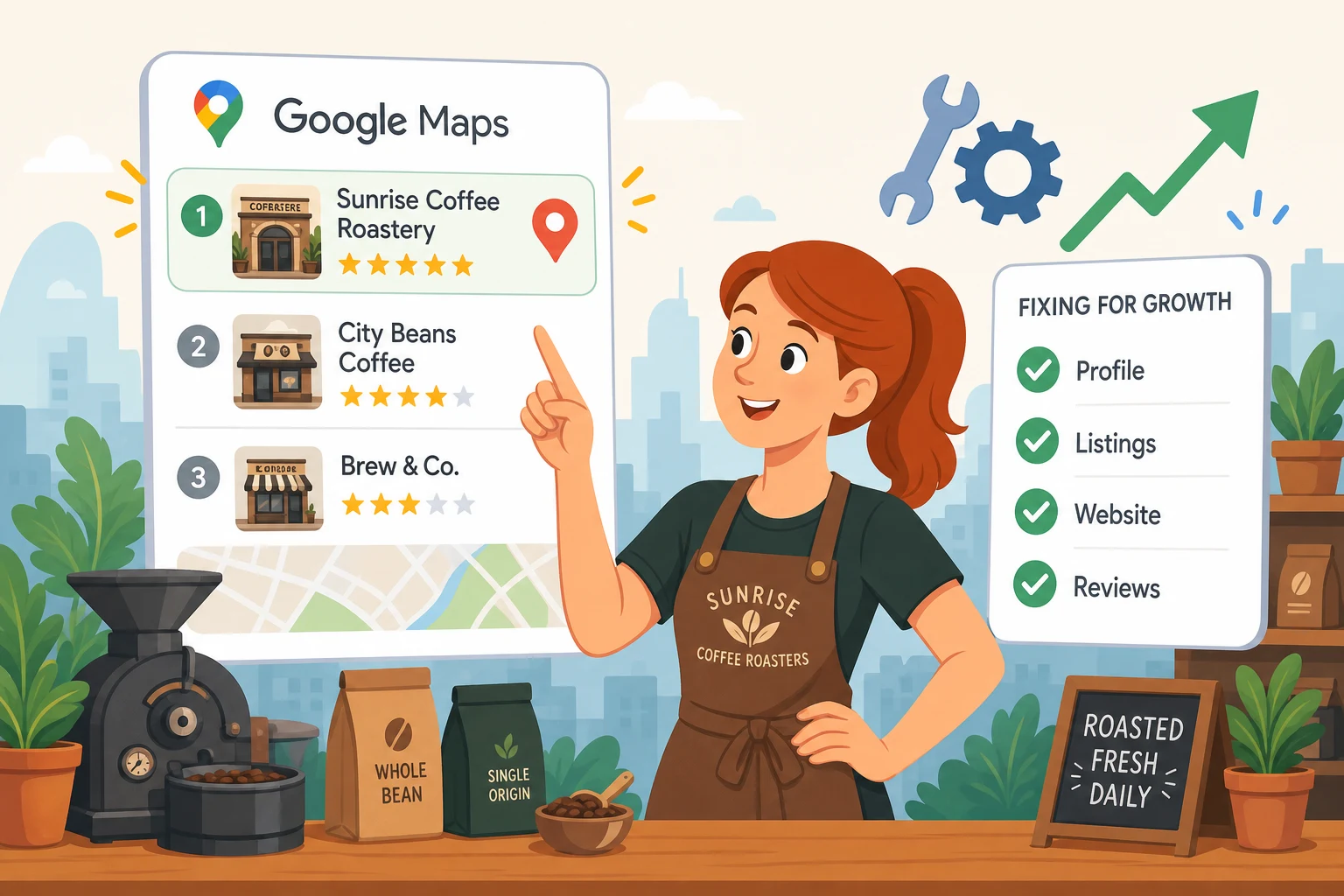
Fix Your Local SEO Fast: A Step-by-Step Repair Guide
August 18, 2026 · By Miro Giovannini
If you're trying to fix local SEO and not sure where to start, the problem is almost never as complicated as it looks. Most small businesses struggling with local search visibility are losing ground on just three or four fixable issues, not a dozen. You built a real business, claimed your Google listing, and still watch competitors show up above you every time a local customer searches. If Google barely surfaces you at all, start with why your website is not showing up on Google. That's a frustrating place to be, and it's one you can get out of.
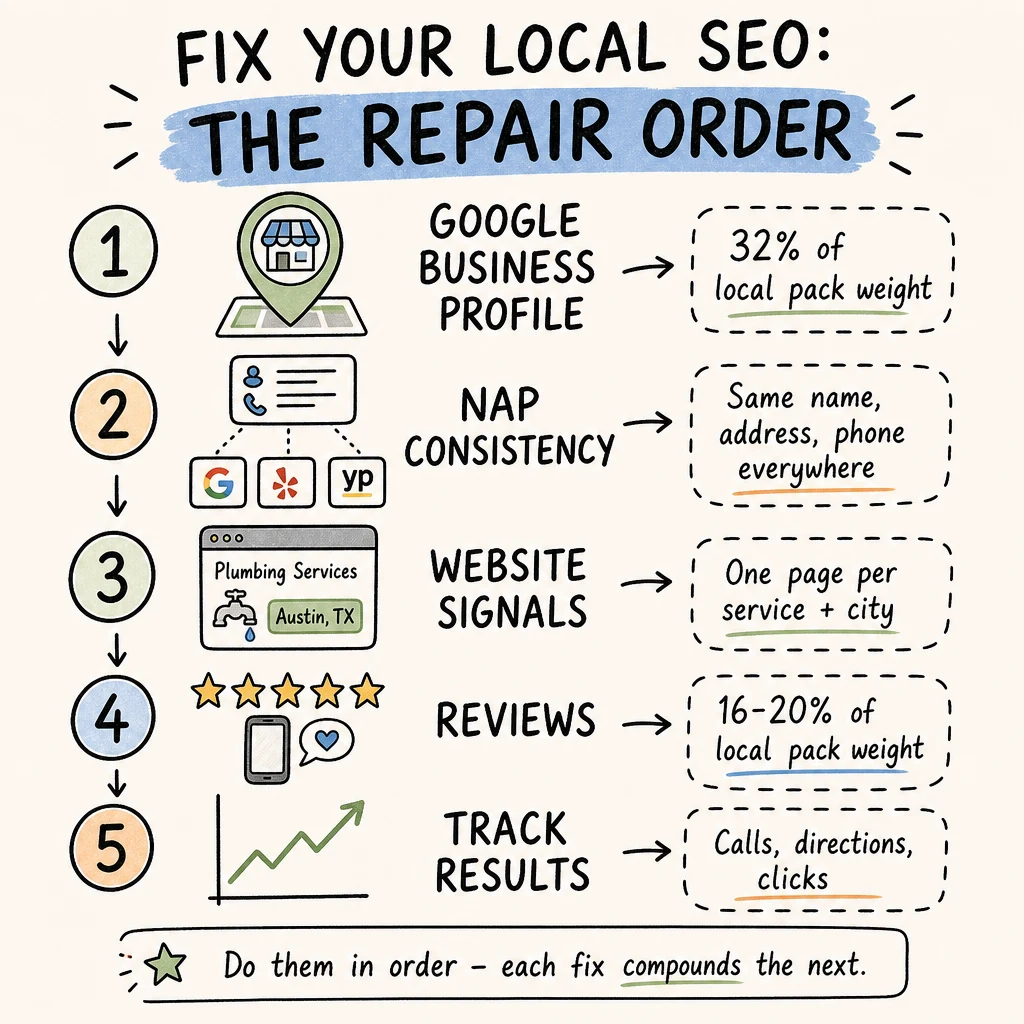
Google ranks local results using three factors: relevance, distance, and prominence. Distance is largely out of your hands, but the other two are entirely within your control. In 2026, your Google Business Profile accounts for roughly 32% of local pack ranking weight, and reviews contribute another 16–20%. (According to Whitespark's Local Search Ranking Factors research, these two signals alone represent nearly half of what determines local visibility.) That means nearly half of what determines your local search position comes down to two things you can improve starting today.
This guide follows the prioritized repair sequence I use with San Fernando Valley business owners, and it's ordered on purpose. The order matters: GBP first, then NAP consistency, then website signals, then reviews, then tracking. Work through it in sequence and you'll eliminate compounding problems before they spread.
The four local SEO problems holding most small businesses back
Most businesses aren't failing at local search because they're doing complicated things wrong. They're failing because four basic things were never set up correctly in the first place. Identifying which ones apply to your business is the entire point of a local SEO audit, and Google's own guidance on improving local ranking confirms which signals to check first, and completing that audit is step one of any serious repair effort.
What Google actually looks at when ranking local results
Relevance means Google needs to understand what your business does and who it serves. Prominence refers to how well-known and trusted your business appears based on reviews, links, and citations. Distance is self-explanatory, and it's the one factor you can't change by optimizing anything.
The controllable levers are your primary GBP category, review velocity, website relevance to local queries, and NAP consistency across the web. These are the ranking factors where focused effort produces measurable results. Everything in this local SEO checklist is built around those four levers.
The common problem pattern in small business local SEO
The four recurring issues are: an unclaimed or incomplete Google Business Profile, mismatched name/address/phone data scattered across directories, thin or missing local content on the website, and few or stale reviews. These aren't rare edge cases, they show up consistently in nearly every local SEO audit of a small business that isn't ranking where it should.
Set realistic expectations before you start. Some fixes show results in days, particularly GBP completeness updates. Citation cleanup and review velocity typically take one to three months to reflect in rankings. The fixes compound each other, which is why the order of operations matters.
How to Fix Local SEO: Google Business Profile First
Your Google Business Profile carries more local pack weight than any other single factor you can control. Work through how to optimize your Google Business Profile alongside this section. If your profile is incomplete, has duplicates floating around, or hasn't been updated in months, every other optimization effort you make will underperform.
Claim, verify, and close the obvious gaps
Start by confirming the profile is claimed, verified, and free of duplicate listings under old addresses or phone numbers. Duplicate profiles split your review equity and confuse Google about which listing to surface. Merge or remove any duplicates before moving on to anything else.
Then audit every core field for completeness:
- Business name, exact match to your real-world name, no keyword stuffing
- Primary category, the single most important ranking lever you have
- Secondary categories, add all relevant ones
- Address or service area, consistent with every other directory
- Phone number, local number, not a call center line
- Hours, current and updated for holidays
- Website link, pointing to the right page
- Business description, what you do, who you serve, what sets you apart
Every empty field is a missed signal, and Google notices.
Photos, posts, and the activity signals Google notices
Add exterior, interior, team, and work-in-progress photos, then keep adding new ones monthly. A profile that went stale after an initial upload tells Google the business isn't actively maintained. Set a cover photo and logo that match your current branding so the profile looks credible to customers clicking through.
Publish posts consistently: offers, project updates, seasonal announcements, and service highlights all count as engagement signals. Turn on messaging if your business can respond within a few hours. It's a visible trust indicator for customers and signals active profile management to Google, which matters for both Google Maps SEO and broader local pack visibility.
Fix Local SEO: NAP Consistency Across the Web
Your name, address, and phone number signal to Google that your business is exactly who you are and where you operate. When that data conflicts across directories, it quietly erodes your local trust signals, even if your GBP looks perfect.
How to audit your citations in under an hour
Start by defining your master NAP exactly: full business name, address format including suite or unit style, and your local phone number, written the same way every time. Then search your business name, old phone numbers, and any former addresses in an incognito browser to surface inconsistent or outdated listings you may not know exist.
Log every listing in a simple spreadsheet with the platform, URL, what's wrong, and whether you can edit it directly. Prioritize Google Business Profile, Apple Maps, Bing Places, Yelp, and Facebook first. These carry the most weight, and getting them aligned is the fastest path to rebuilding citation trust.
Step-by-step cleanup process for conflicting listings
Fix top-tier directories by logging in and editing directly through each platform's dashboard. For directories where you can't access the listing, contact support or flag the entry for correction. Pay attention to data aggregators like Data Axle and Neustar Localeze. If a single upstream source is feeding wrong data to dozens of sites, correcting it there can propagate fixes widely without you having to manually update every individual directory.
Remove or merge duplicate profiles wherever the platform allows it, then revisit your listings three to four weeks later to confirm changes stuck. Some directories are slow to update, and following up is the only way to catch corrections that didn't take.
Strengthen your website's local relevance signals
Your website is the second proof point Google checks after your GBP. Thin content with no geographic or service context tells Google very little about where you operate or what you actually do for customers.
Local content that actually signals relevance
Each core service needs its own dedicated page, not a bullet point on the homepage. The same logic applies to paid traffic, which is why a dedicated landing page beats your homepage for ads. That page needs a clear title tag that includes the service and the city or area you serve. Review your H1s and page copy for natural use of service and location terms. Forced repetition reads poorly to both Google and real humans, so write for the customer first.
Make sure your address or service area appears in the footer or contact section of every page, consistent with your GBP. For a single-location business, the GBP website link should point to your homepage unless you have a stronger dedicated location page that better matches local search intent.
Adding local schema markup without a developer
LocalBusiness schema tells Google structured facts about your business: name, address, phone number, hours, and service area. It won't directly move your map pack ranking, but it reinforces the same signals you've built everywhere else and reduces the chance of data mismatches between your site and your GBP. Here's a minimal example of what that markup looks like:
{ "@context": "https://schema.org", "@type": "LocalBusiness", "name": "Your Business Name", "address": { "@type": "PostalAddress", "streetAddress": "123 Main St", "addressLocality": "Your City", "addressRegion": "CA", "postalCode": "91XXX" }, "telephone": "+1-818-555-0100", "openingHours": "Mo-Fr 08:00-17:00", "url": "https://yourbusiness.com" }
Tools like Google's Structured Data Markup Helper or a plugin like Rank Math for WordPress sites make this non-technical. Once you've added it, test your schema with Google's Rich Results Test to confirm it's reading correctly. Think of schema as a supporting layer, not a standalone fix.
Fix Local SEO with a Review Strategy That Keeps Working Every Month
Reviews account for roughly 16–20% of local pack weight, and review velocity matters as much as total count. (BrightLocal's Local Consumer Review Survey shows how heavily customers weigh review recency.) For the full request system, see how to get more Google reviews for your business. A business with 40 reviews earned over the past six months will often outrank one with 200 reviews that are two or three years old. Recency signals active, engaged customers, and Google treats that as a trust indicator.
How to ask for reviews without it feeling awkward
Ask immediately after a positive experience, while the interaction is still fresh. Use multiple channels: a short text or email with a direct review link, a QR code on receipts or invoices, and a verbal ask from staff at the end of the job. Keep the request frictionless, one link, one instruction, no extra steps. The more effort you require from the customer, the fewer reviews you'll get.
Spread requests out naturally over time rather than batching a large number all at once. Batching risks review filtering, where Google flags clusters of sudden reviews as potentially inauthentic. Steady, consistent flow beats occasional bursts every time.
Responding to reviews the right way
Respond to every review, positive and negative, within 48 hours. For positive reviews, thank the customer by name and mention the service or project naturally. For negative reviews, acknowledge the issue calmly, apologize if appropriate, and move the conversation offline. Never argue publicly; it signals poor customer service to every future customer who reads the exchange.
Consistent, thoughtful responses signal active profile engagement. Both customers and Google notice when a business pays attention to its reviews. It's one of the simplest ways to differentiate yourself from competitors who post an occasional response and call it done.
Track your results so you know what's actually working
Trying to fix local SEO without tracking results leaves you guessing. You need simple benchmarks to know whether the changes you made are producing movement, and which problem to tackle next.
The KPIs worth watching for local businesses
GBP Insights gives you calls, direction requests, website clicks, and profile views on a monthly basis. These are the clearest signals that your profile is surfacing for real searches, not just getting views from people who already know your name. Track them month over month and look for upward trends in the weeks after you make changes.
Also monitor local pack visibility directly: search your primary service and city keywords in an incognito window and record where you appear. Repeat every four weeks. Use Google Search Console to track clicks and impressions for location-based queries, the same discipline covered in how to know if your digital marketing is actually working, and log your review count monthly to measure velocity. These four data points tell you most of what you need to know.
Simple tools that don't require a technical background
Your GBP dashboard and Google Search Console are both free and built for non-technical users. Start there before spending money on anything else. For citation auditing and local rank tracking, tools like Whitespark or BrightLocal are affordable and worth a monthly subscription once you've completed the foundational fixes covered here.
For San Fernando Valley business owners who want local benchmarks and context on which metrics actually matter, Miro Giovannini Blog breaks down each of these tools with a non-technical owner in mind, so you're measuring what's useful instead of drowning in data that doesn't connect to revenue.
Start with one fix and measure before moving on
The repair sequence is GBP first, then NAP consistency, then website signals, then reviews, then tracking. That order exists because GBP and NAP problems compound every other optimization you attempt. Fixing your schema while your NAP is still inconsistent across the web is like painting over a cracked wall.
Expect GBP-related improvements to show up in your profile insights within two to four weeks. Citation cleanup and review velocity changes take one to three months to reflect in actual rankings. Local SEO is not a one-time project. The businesses that hold map pack positions treat it as an ongoing system: monthly photo updates, consistent review requests, and quarterly audits of citations and on-page content. Use this guide as your standing local SEO checklist and return to it every quarter.
If you want the broader on-page and content side too, pair this with small business SEO tips that drive more local customers. Pick the one problem from this guide that you haven't addressed yet, start there today, and measure the result before moving to the next. That's how you fix local SEO in a way that actually holds. Ready to get started? Start with the Google Business Profile optimization guide and identify your highest-priority fix in under an hour.
If you'd rather have someone run the repair sequence for you, that's exactly what my local SEO service does. Book a call and we'll go through your profile, citations and reviews together.
Local search rewards the businesses that stay consistent, not the ones that optimize once and walk away.

Ready to bring in more customers?
Get a free 30-minute marketing review. We'll look at what you have today and identify the one or two changes that could make the biggest difference.