
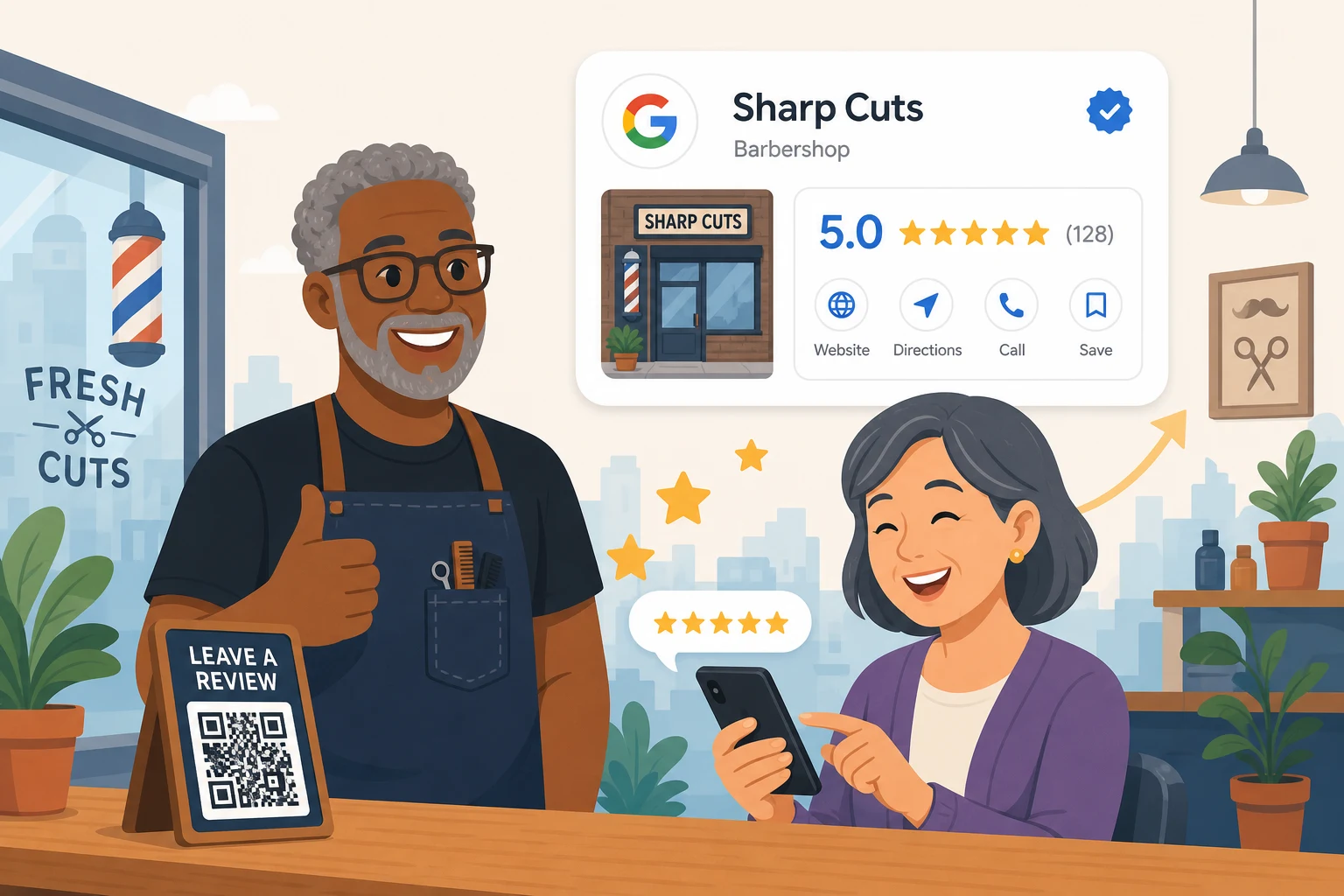
How to Get More Google Reviews for Your Business
June 10, 2026 · By Miro Giovannini
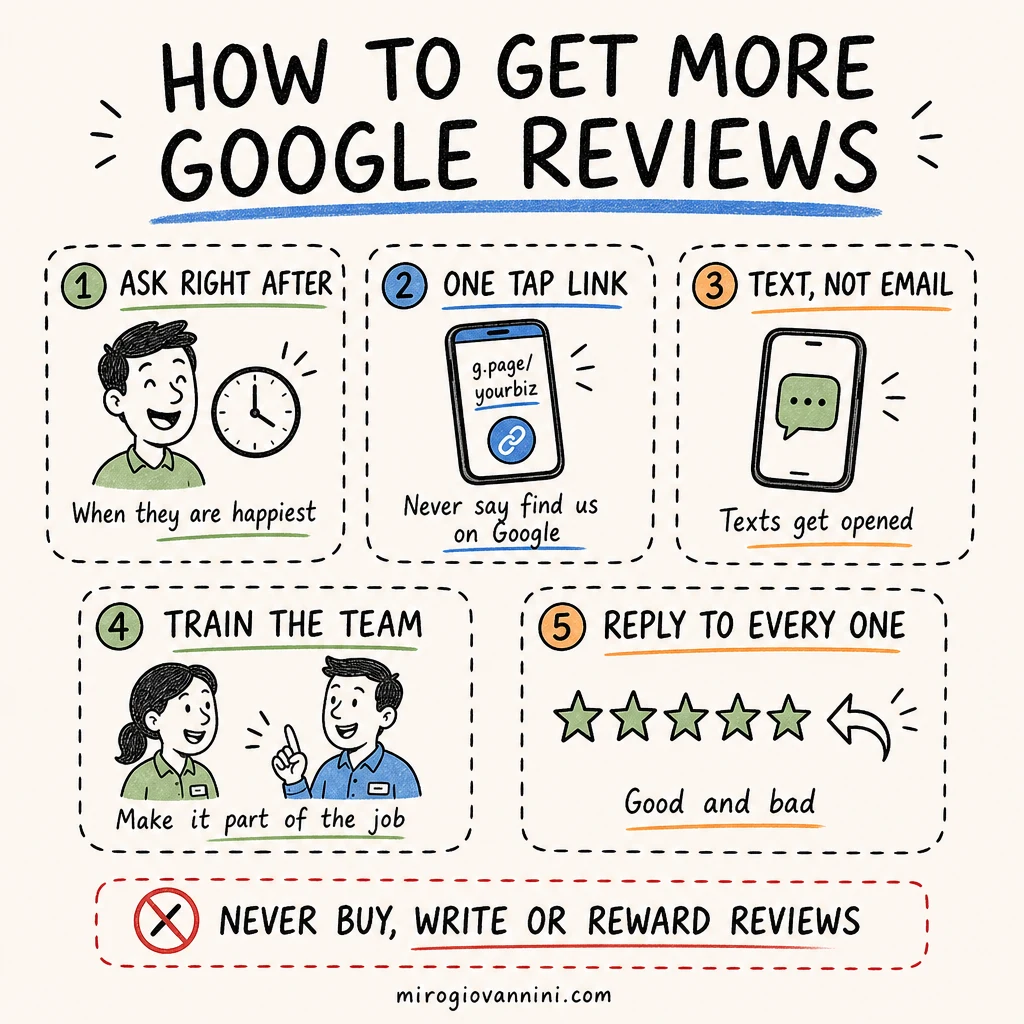
The fastest way to get more Google reviews is to ask every satisfied customer, in person, right after the service, and hand them a direct review link so it takes one tap. Everything else in this article is a variation on that one sentence.
If you run a local business in the San Fernando Valley, your Google reviews might matter more than your website. That is not an exaggeration. When someone in Sherman Oaks searches for "best dentist near me" or a homeowner in Encino looks up "plumber with good reviews," Google shows them a map with three businesses. The one with the most reviews and the strongest rating almost always gets the call.
Reviews are social proof. They tell a potential customer that real people tried your service and liked it enough to say so publicly. No ad, no website copy, and no social post carries the same weight.
Why Do Google Reviews Matter So Much?
Because Google says they are a ranking factor. In its guidance on improving your local ranking, Google lists review count and review score among the signals that influence how prominently your business appears in local results, alongside relevance and distance.
But rankings are only part of it:
- Trust at first glance. A business with 47 reviews and a strong average looks more credible than one with three reviews and no responses, even if both do excellent work.
- Click-through. Listings with better ratings earn more clicks from the same search results, which means more calls and more visits without spending more.
- Decision-making. For a lot of people, checking Google reviews is the last step before choosing a service provider. Your reviews are the final sales conversation, and you are not in the room.
- Competitive edge. In markets like Burbank, Glendale, or Woodland Hills, reviews are often the deciding factor between you and the business down the street.
What Is the Right Way to Ask for Reviews?
Directly, at the right moment, with the link in their hand. The biggest reason most businesses do not have enough reviews is simple: they do not ask.
When Should You Ask?
Immediately after a positive interaction, when the customer is happiest. A restaurant in Northridge should ask right after the compliment about the food. A contractor in Tarzana should ask the day the project wraps up and the client is admiring the finished work. Wait a week and the emotion is gone, along with your best chance.
How Do You Make It Effortless?
Do not tell someone "find us on Google and leave a review." That is too many steps. Send a direct link that opens the review form automatically. To get yours:
- Open your Google Business Profile
- Use the "Ask for reviews" option, or search for your business on Google
- Click "Write a review" and copy that URL
- Shorten it with a free tool if the link is long
Send that link by text or email. One tap and they are writing. Google's own tips for getting more reviews make the same point: remind customers that reviews are welcome and make leaving one as easy as possible.
Why Text Beats Email
Text messages get opened almost immediately. Emails sit in inboxes. A simple follow-up text works better than any email template:
"Hi [Name], thanks for choosing us! If you have a minute, we would really appreciate a Google review. Here is the link: [URL]"
Short, personal, no pressure.
How Do You Get Your Team to Ask?
If you have employees who interact with customers, make asking part of the process, not a favor. It does not have to be scripted or awkward. "If you were happy with the service, a Google review would really help us out" works perfectly.
The key is consistency. Asking one customer a week will not move the needle. Asking every satisfied customer will.
What Are You Not Allowed to Do?
This is where businesses get themselves in trouble, so it is worth being precise.
You cannot buy reviews, write them yourself, or trade them with other businesses. Google's prohibited and restricted content policies treat fake engagement and content posted on behalf of someone else as violations, and enforcement includes removing reviews and, in serious cases, restricting the profile.
You also cannot offer a discount or a gift in exchange for a review. Beyond Google's rules, incentivized endorsements fall under the FTC's endorsement guidance, which requires that any material connection between you and the reviewer be disclosed clearly. A five-star review that was paid for with a free oil change and no disclosure is a legal problem, not just a policy one.
And you cannot filter. Asking only the customers you expect to be happy, or routing unhappy ones to a private form instead of the public listing, is review gating. Ask everyone, and fix the reasons people are unhappy instead.
What Should You Do With Negative Reviews?
Respond within a day or two, professionally, and take it offline. A one-star review is not the end of the world. How you respond matters far more than the review itself.
How Should You Word the Response?
Acknowledge the issue, apologize where appropriate, and offer to make it right by phone. Potential customers reading your reply are judging your character, not the complaint. Something like: "We are sorry your experience did not meet expectations. We take this seriously and would like to make it right. Please call us at [number] so we can address this directly."
Should You Ever Argue?
Never publicly. Even when the review is unfair or inaccurate, arguing in a reply makes you look worse than the review did. Take it offline. Other customers are watching, and professionalism is the message.
If a review is genuinely fake, off-topic, or abusive, you can report it to Google rather than fighting it in public. That is the correct channel, and it works more often than owners expect.
What If the Same Complaint Keeps Appearing?
Then it is not a review problem, it is an operations problem. If several reviews mention long wait times, unclear pricing, or rude staff, fix the root cause and the reviews change on their own. Reviews are the cheapest customer research you will ever get, which is the same argument I make in how to know if your digital marketing is actually working.
Should You Respond to Positive Reviews Too?
Yes, and most businesses do not. When someone takes five minutes to write something nice about your business, a quick thank-you shows you pay attention. Responding also signals to Google that your profile is active.
Keep it genuine and avoid pasting the same reply everywhere. Mention something specific: "Thanks for the kind words about the kitchen remodel, Maria. It was a great project."
What Systems Build Reviews Over Time?
The businesses that end up with hundreds of reviews are not the ones that tried harder. They are the ones that built the ask into a routine.
A Review Station at Checkout
If you have a physical location, a salon in Van Nuys, a repair shop in North Hollywood, a clinic in Thousand Oaks, put a tablet or a QR code at the counter. Customers can leave a review before they walk out.
Review Links on Receipts and Invoices
Digital receipts and invoices are a natural place for your link. One line at the bottom, "Happy with our service? Leave us a Google review," costs nothing and runs forever.
A Follow-Up Two Days Later
For service businesses, a message two or three days after the job lands well. It reads as care about the outcome, not just the sale, and it catches people once they have lived with the result.
Reviews on Your Own Website
Pull your best reviews onto your site, especially your service pages and landing pages. The same social proof that wins you the click in Maps also wins you the form fill, which matters if you are sending paid traffic to those pages. That is part of why a dedicated landing page usually beats your homepage for ad traffic.
How Many Reviews Do You Actually Need?
Enough to be credible against the three businesses you compete with in the map pack, and recent enough that the last one is not from two years ago.
Look up your main search term, look at the top three listings, and count. If they sit at 40 and you sit at 6, you know the gap. Freshness matters as much as volume: a steady drip of one or two a week beats twenty in a single push followed by silence, and it looks more natural to both Google and the person reading.
Reviews compound with the rest of your profile. If your listing is thin, the reviews are working alone, and that is a waste. My guide on how to optimize your Google Business Profile covers the other half of the equation, and why your website is not showing up on Google covers what happens when the site behind the listing is the weak link.
What If a Review Disappears?
It happens, and it usually is not personal. Google filters reviews it considers suspicious, and reviews left from the same device, by accounts with no history, or in an unusual burst are the most likely to vanish. That is another argument for a steady drip rather than asking twenty people in one afternoon.
If a genuine review disappears, the customer can often repost it from their own device while signed in. What you should not do is chase it with a batch of new reviews to compensate, because that is exactly the pattern the filter is looking for.
Where Should You Start This Week?
Get your review link, save it in your phone, and ask the next five happy customers before they leave.
That is it. No software, no campaign, no budget. Most businesses that come to me with a review problem do not need a system, they need to start asking. Build the routine first, and worry about tablets and QR codes once asking is a habit.
If you want help turning that habit into something that runs without you, book a call and we will map it out for your business.

Ready to bring in more customers?
Get a free 30-minute marketing review. We'll look at what you have today and identify the one or two changes that could make the biggest difference.