

What Is a Landing Page and Why You Need One
May 26, 2026 · By Miro Giovannini
A landing page is a single web page built around one action — call, book, or request a quote — with everything else stripped out. You need one because your homepage was designed to introduce your whole business, and a visitor who just searched for one specific service does not want an introduction. They want that service, in their city, with a phone number they can tap.
I have watched the same business double its leads without touching its ads, its budget, or its keywords. The only change was where the clicks landed. Here is what a landing page actually is, why it converts better, and how to build one that works for a local business.
What Is a Landing Page in Simple Terms?
A landing page is where someone "lands" after clicking an ad, an email, or a link — built for that one click and nothing else. It has one message, one audience, and one call to action.
Your homepage has a different job. It introduces the company, lists every service, links to your blog, your story, your careers page. That is fine for someone who typed your business name. It is the wrong page for someone who typed "emergency plumber Burbank."
What Is the Difference Between a Landing Page and a Homepage?
The homepage answers "who are you?" The landing page answers "can you solve my problem right now?"
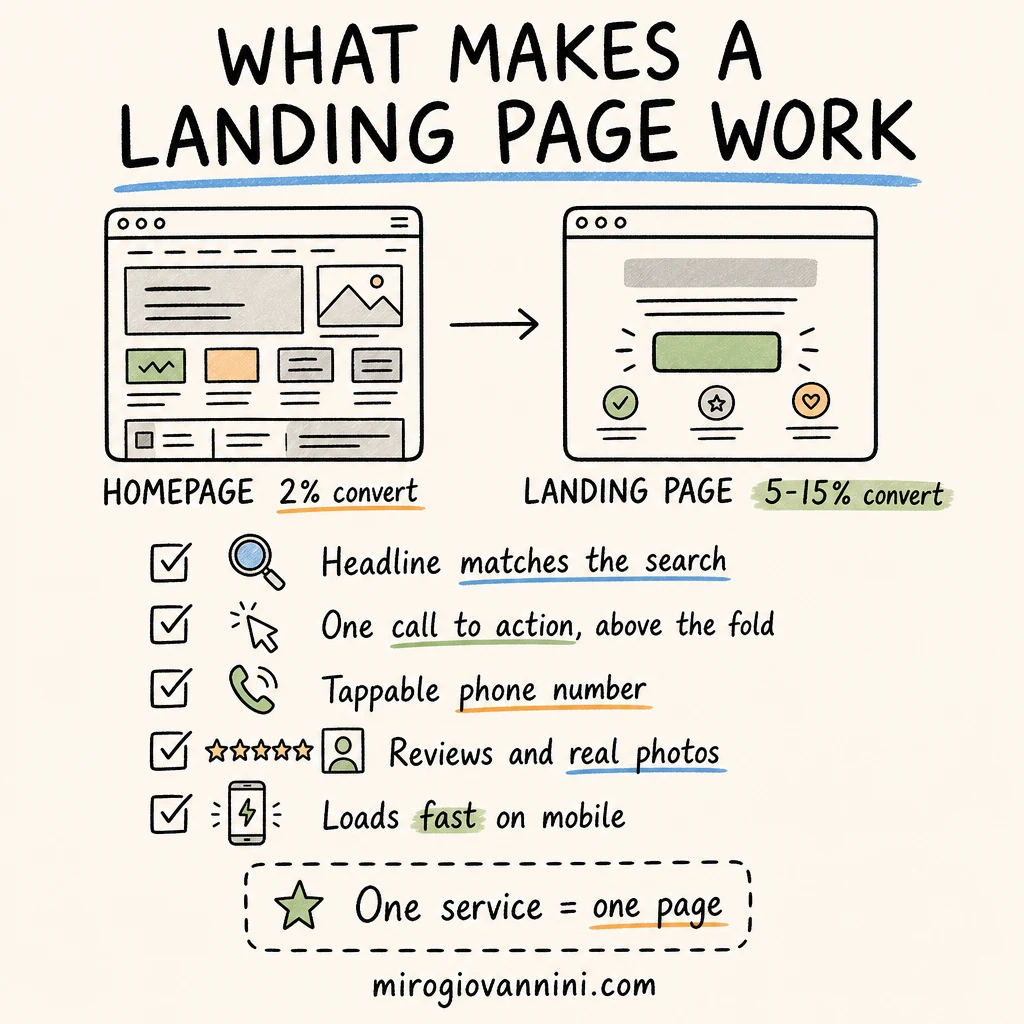
A homepage has ten or more links pulling attention in different directions. A good landing page has one or two, and both of them are the action you want. I go deeper into when to use each in landing page vs homepage for Google Ads traffic.
Why Do Landing Pages Convert Better Than Homepages?
Because they remove the two things that kill conversions: mismatch and choice.
Picture a homeowner in Burbank searching "emergency plumber." They click your ad and land on a homepage covering plumbing, electrical, HVAC, and remodeling. They now have to scroll, scan, and decide whether you even do emergency work. Most leave in a few seconds and click the next result.
Same search, different page: a headline that reads "Emergency Plumber in Burbank — Available 24/7," response times, reviews from Burbank customers, and a phone number big enough to tap with a thumb. Nothing else on the page.
In the accounts I manage, the dedicated page typically converts two to five times better than the homepage for the same traffic. That is not a small optimization. That is the same ad budget producing two to five times the business.
Google measures this too. Landing page experience is one of the components of Quality Score, which means a page that matches the search does not just convert better — it can lower what you pay per click.
What Makes a Good Landing Page for a Local Business?
Does the Headline Match the Search?
If someone searched "AC repair North Hollywood," the headline should say "AC Repair in North Hollywood." Not "Welcome to Our HVAC Company." That single line is what tells a visitor, in under a second, that they are in the right place.
This is called message match, and it is the highest-leverage thing on the page.
Is There One Clear Call to Action?
One. "Call now," or "Get a free estimate," or "Book online" — not all three. Put it above the fold so it is visible without scrolling, then repeat it two or three times down the page. On mobile, the phone number should be a tappable link, not text someone has to copy.
Every extra option you add reduces the odds of the one action you actually want.
Do You Show Proof You Can Be Trusted?
A stranger is about to let you into their house or take their money. Give them reasons:
- Reviews and star ratings, ideally from customers in the same neighborhood
- Years in business and license or certification numbers
- Real photos of your team and your work, never stock images
- "Locally owned and operated," if you are
- A clear service area, so they know you cover their street
Is the Content Specific to That Service?
Describe the service, the process, what it costs or what the range is, and how quickly you can get there. Answer the questions a customer would ask on the phone: how long does it take, do you offer warranties, what happens after I book.
Specific content also gives Google something real to read, which is why a well-written landing page can eventually earn organic traffic on top of the paid clicks.
Is the Form as Short as You Can Make It?
Name, phone, and one line about the job is usually enough. Every additional field costs you leads. Ask for the rest when you call them back.
Does the Page Load Fast on a Phone?
Most local searches happen on a phone, often on a mobile connection. If the page takes five seconds to appear, a large share of the people you just paid for are already gone. Test on your own phone, on cellular data, not on your office WiFi.
How Long Should a Landing Page Be?
Long enough to answer every objection, short enough that nothing on it is filler. For an urgent service like emergency plumbing, short wins: headline, phone number, response time, a few reviews. For an expensive considered purchase like a kitchen remodel, people want detail — process, timelines, price ranges, photos of finished work, warranty terms — and a longer page usually converts better.
The rule I use: keep writing until you have answered every question a customer asks on a first phone call, then stop.
Do You Need a Different Landing Page for Every Service?
Yes, and that is the part most businesses skip. One page per service, per major location if you serve several.
A roofer running ads for roof repair, roof replacement, and gutter installation needs three pages, each speaking to a different problem and a different price point. Sending all three searches to one "Roofing Services" page throws away the specificity you paid for.
If you are on a small budget, start with one page for your highest-margin service, prove it works, then build the next one.
Where Should a Landing Page Live?
On your own domain, as a normal page — for example, yoursite.com/emergency-plumber-burbank. You do not need a separate landing page tool to start. Most website platforms let you build a page and hide it from your main navigation, which is all you need.
Keeping it on your domain means it benefits from your site's credibility, and it can rank organically over time instead of disappearing when a subscription ends.
If you do not have a website yet at all, that is the first problem to solve — see do you need a website before running Google Ads.
How Do You Know if Your Landing Page Is Working?
Measure conversion rate: the percentage of visitors who call or submit a form. For local service businesses, a well-built page usually lands somewhere between 5 and 15 percent. Under 2 percent and something is broken — usually message match, load speed, or a hidden phone number.
To measure it at all, you need conversion tracking installed, which Google's conversion measurement guide walks through. Without it you are guessing, and guessing is expensive. More on the numbers worth watching in how to know if your digital marketing is actually working.
What Should You Test First?
In order of impact: the headline, the offer, the position of the call to action, then the form length. Change one thing at a time and give it enough traffic to mean something — a few hundred visitors, not twenty.
What Are the Most Common Landing Page Mistakes?
Sending ad traffic to the homepage. Still the most common and most expensive mistake in local advertising, and the usual reason behind clicks that never turn into customers.
Full site navigation across the top. Every menu item is an exit. Strip the nav down to your logo and phone number.
Writing about yourself. "Founded in 1998 with a passion for excellence" helps nobody. Lead with what the visitor gets.
Burying the phone number in the footer. On mobile it should be visible immediately and tappable.
Stock photography. People recognize it instantly, and it quietly undermines everything else on the page.
Long forms. Nine fields for a free estimate is a wall, not a form.
Should You Send Ads to a Landing Page or Let People Call Directly?
Do both. Add call assets to your ads so someone in a hurry can tap and call without ever loading a page, and send everyone else to the landing page. Urgent services get more direct calls; considered purchases get more form fills. Tracking both is what tells you which half of your audience you are actually serving.
Is a Landing Page Worth Building if You Are Not Running Ads?
Yes, for anything you actively promote — a seasonal offer, a service you want more of, a partnership, a flyer with a QR code. The value of a landing page is focus, and focus helps any campaign that sends people somewhere specific.
That said, the return is biggest when you are paying per click. If you are spending $2,000 a month on ads, a page that lifts conversion from 3 to 8 percent is worth more than any bid adjustment I could make. The U.S. Small Business Administration's marketing and sales guidance frames advertising as one part of a connected system, and the landing page is the joint where the advertising meets the sale.
Fix the page before you raise the budget. It is the cheapest lever you have, and it is almost always the one that has not been pulled.
Not sure whether your ads are landing on the right page? Book a free strategy call and I will review your current setup and show you exactly where the leads are leaking out.
More from the blog
Ready to bring in more customers?
Get a free 30-minute marketing review. We'll look at what you have today and identify the one or two changes that could make the biggest difference.