
What to Look for in Professional Website Design Services
A good website is easy to use on a phone and makes it obvious how to contact you. Here's what professional web design should include, and what it costs.
 Miro GiovanniniDigital Marketing ConsultantNovember 24, 2026 · 10 min read
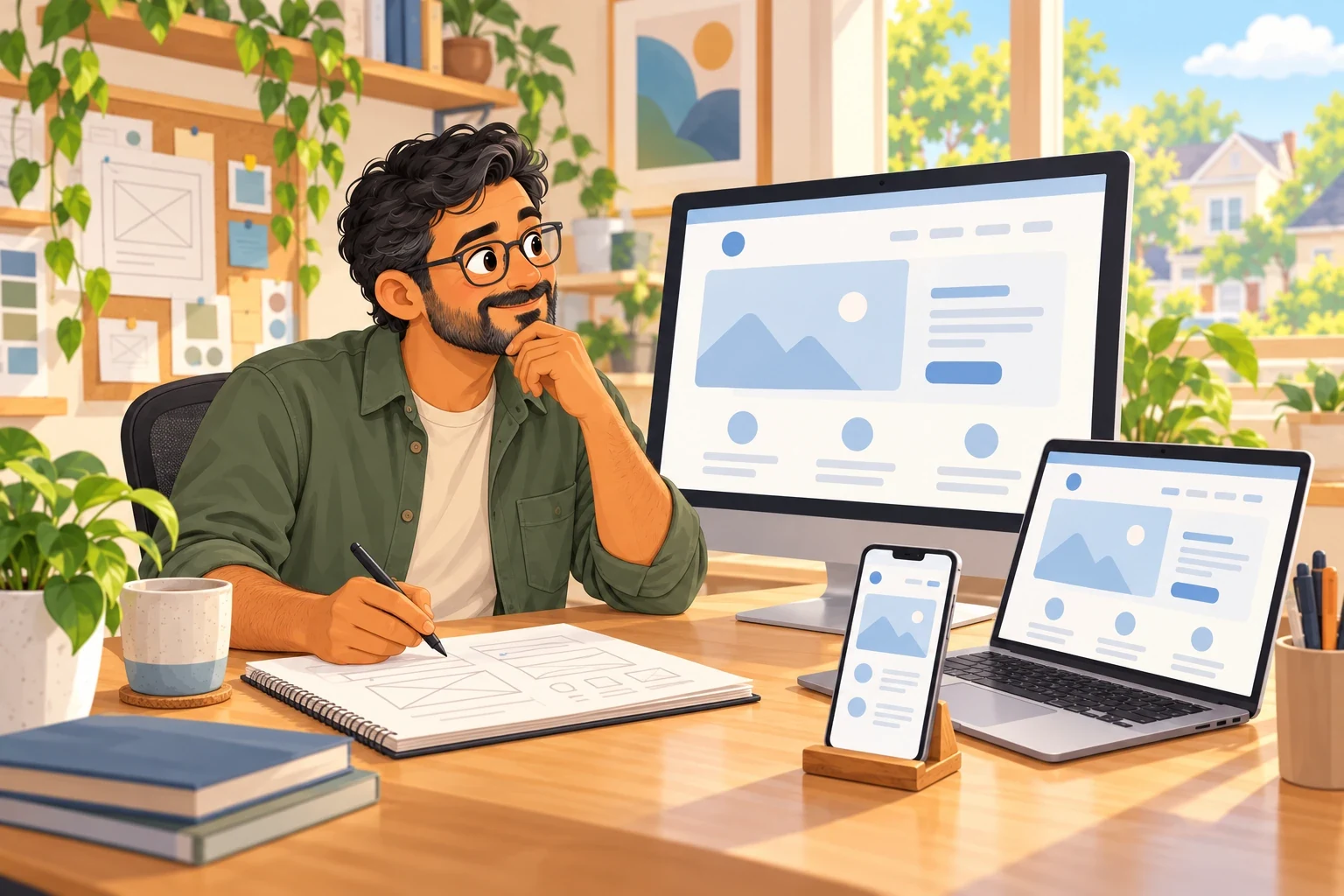
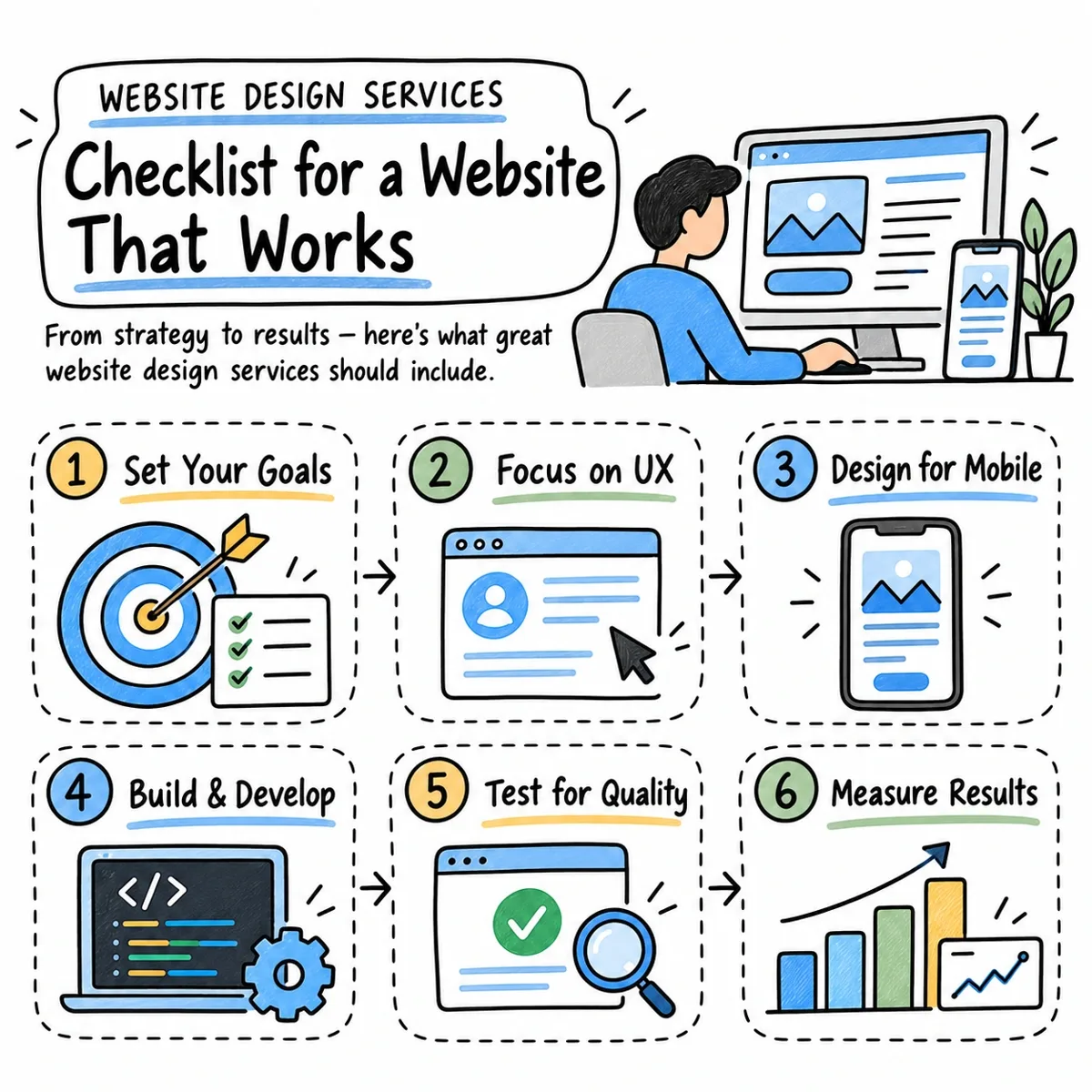
Website design services should give your business a site that is easy to use, works well on phones, and helps visitors contact you or make a purchase. When comparing providers, ask to see relevant work, check what the price includes, and find out how they will measure results. If you serve customers in English and Spanish, ask how both languages will work across the site.
Good design is more than a polished homepage. It brings together clear writing, useful layouts, fast performance, accessibility, and a path from search or ads to your business. This guide covers what those services involve and how to choose the right fit.
What Web Design Encompasses: Roles, Evolution, and Architecture
Your website is your storefront that never closes. It's where potential customers judge whether you're credible, look at what you offer and decide whether to get in touch. Web design is the planning, visual communication and technical work behind it: layout, structure, graphics and code working together to turn visitors into customers.
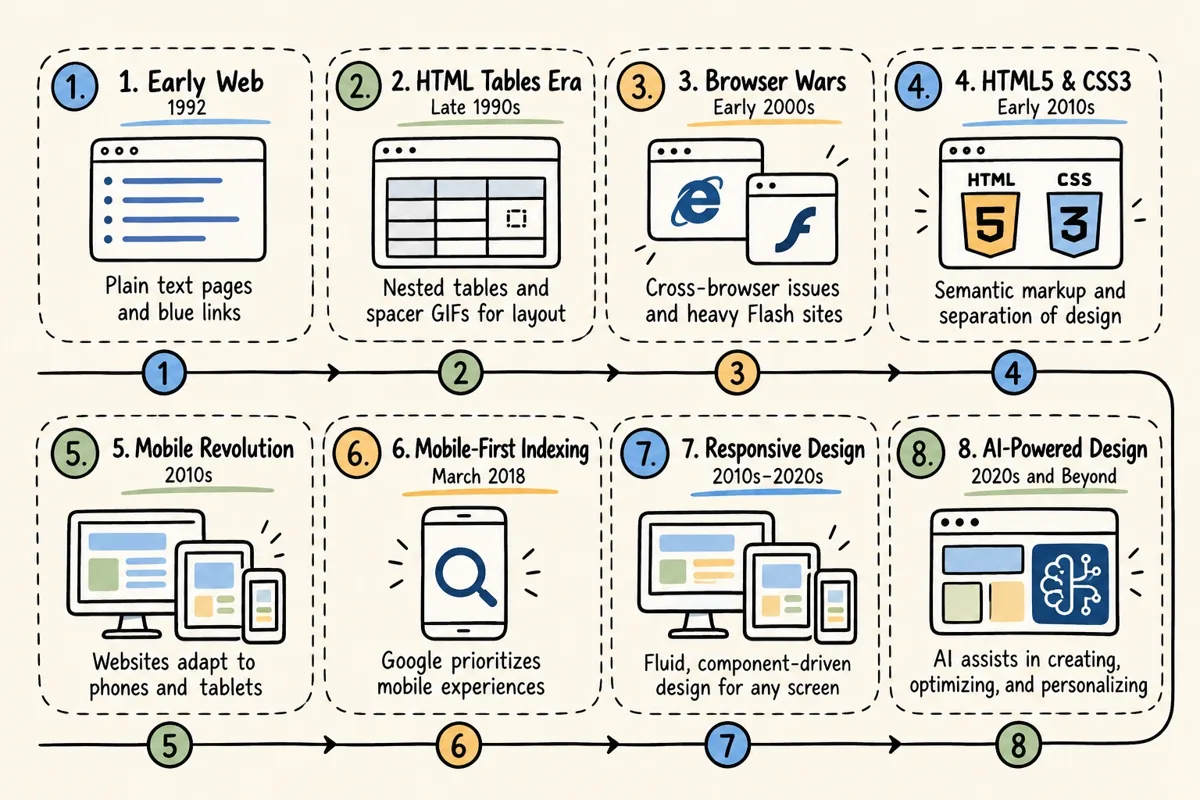
Websites have come a long way since the first page went live at CERN in 1992: from plain text, to layouts held together with tables and Flash, to today's sites built from flexible pieces that adapt to any screen. Since Google switched to mobile-first indexing, the phone version of your site is the one Google looks at first.
Understanding today's websites starts with knowing who does what.
Web Designer vs. Web Developer: Key Differences
People often use the two terms interchangeably, but they cover different stages of building a website.
A web designer focuses on how the site looks and how people move through it: layout, visual hierarchy, colors and typography. Designers build wireframes and clickable prototypes to make sure the site is easy to use and accessible.
A web developer turns those designs into working code. Front-end developers build what visitors see with HTML, CSS and JavaScript; back-end developers handle servers, databases and the content management system (CMS).
| Feature / Role | Web Designer | Web Developer |
|---|---|---|
| Primary Focus | User experience, visual layout and brand look | How the site works, clean code and data |
| Core Deliverables | Mood boards, wireframes, style guides and Figma prototypes | Production-ready pages, scripts, integrations and CMS setup |
| Essential Tools | Figma, Adobe XD, Sketch, Photoshop, Canva | HTML5, CSS3/Sass, JavaScript, PHP, Python, Git |
| Key Metric | Usability, visual clarity, conversion flow, user satisfaction | Page speed, error-free code, security, uptime |
When one person or team handles both, nothing gets lost between the design and the code: the site looks right and works right.
Static vs. Dynamic Website Design Architectures
Behind every website there's a model that decides how pages load:
- Static websites: deliver ready-made pages directly from a server or content delivery network (CDN). Nothing has to be looked up in a database when someone visits, so they load fast and have fewer security risks. They're a great fit for landing pages and portfolio sites.
- Dynamic websites: build each page on the spot from a database (WordPress, for example). You need this for online stores, member areas and blogs with search and filters.
Many modern sites combine both: pages that load as fast as a static site, with an easy editor so you can update the content yourself.
Core Principles of Effective Website Design
A beautiful website means very little if visitors can't find what they need. People decide in seconds whether a business looks trustworthy, and a clear layout makes it much easier for them to call, book or buy.
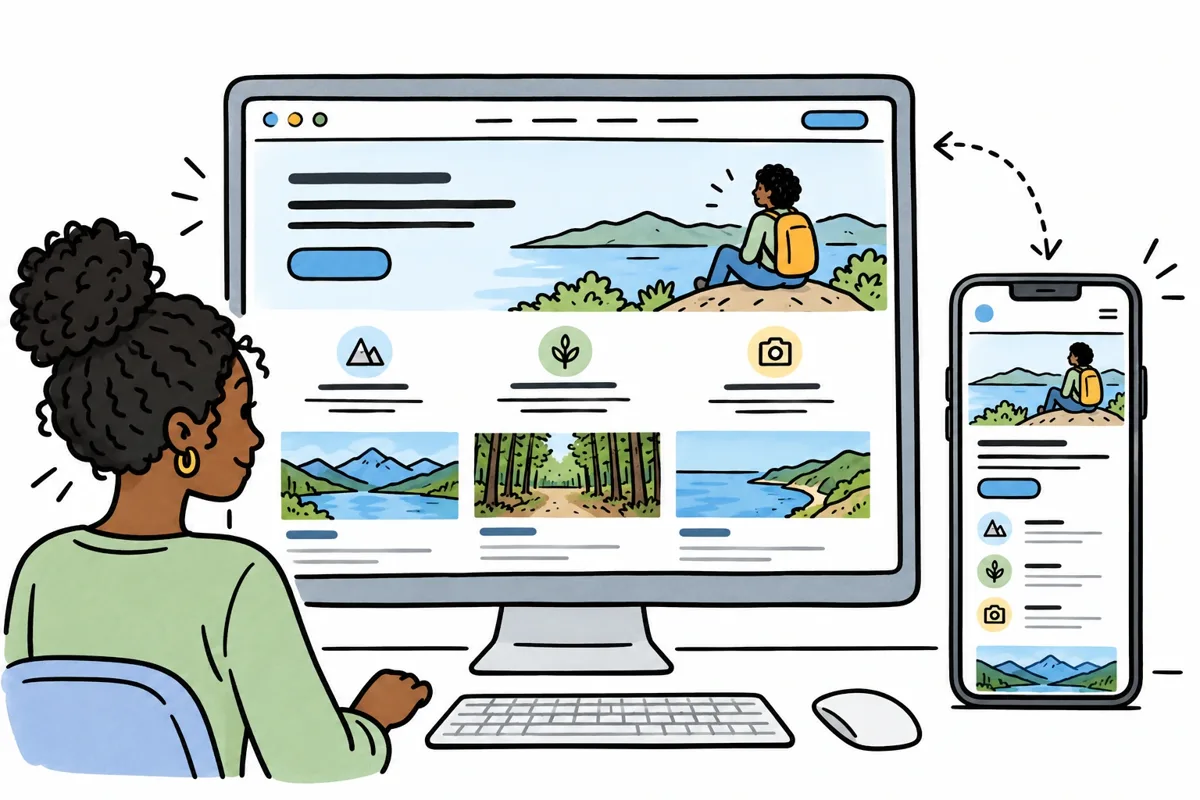
Great design relies on a few timeless principles:
- Visual hierarchy: guiding the eye to the most important message first, through size, weight and contrast.
- Generous whitespace: giving content room to breathe so visitors can scan without feeling overwhelmed.
- Color with intention: a brand palette where the main buttons stand out against neutral backgrounds.
- Grids: lining up text and elements on a consistent grid so the page feels organized.
- Accessibility (WCAG): readable color contrast, navigation that works with a keyboard, and image descriptions (alt text) so every visitor can use your site.
If your visitors leave quickly or leads have dried up, check these 5 signs your website is costing you customers to see where your current site might be missing the mark.
User Experience, Typography, and Visual Hierarchy
Don't make visitors think too hard. When someone lands on your site, they should understand what you do, who you serve and how to take the next step within seconds.
Many modern sites pair a clean sans-serif for body text with large serif headlines: it feels editorial and stays easy to read. The best hero sections place the main call-to-action (CTA) button where the eye naturally goes, like the top-right of the menu and right below the main headline. Small touches, like buttons that react when you hover over them, make the site feel responsive and polished.
Mobile-First Layouts and Responsive Performance
Phones bring in more than half of all web visits, and for many local businesses, most of them. A mobile-first design treats the phone layout as the starting point, not an afterthought.
A responsive site needs:
- Flexible layouts: content that resizes and reorders naturally on any screen width.
- Easy-to-tap buttons: buttons and links at least 44x44 pixels, so people can tap them without zooming in.
- Speed: compressed modern images (like WebP), lean code and caching, so pages load fast and don't jump around while loading. Google measures this with its Core Web Vitals.
Slow loading and broken layouts on phones can hurt your rankings. If your business isn't getting found, finding out why your website is not showing up on Google often starts with checking how it works on a phone.
Essential Tools, AI Innovations, and Modern Industry Trends
Designing for today's web takes software that connects the creative idea with the technical build.
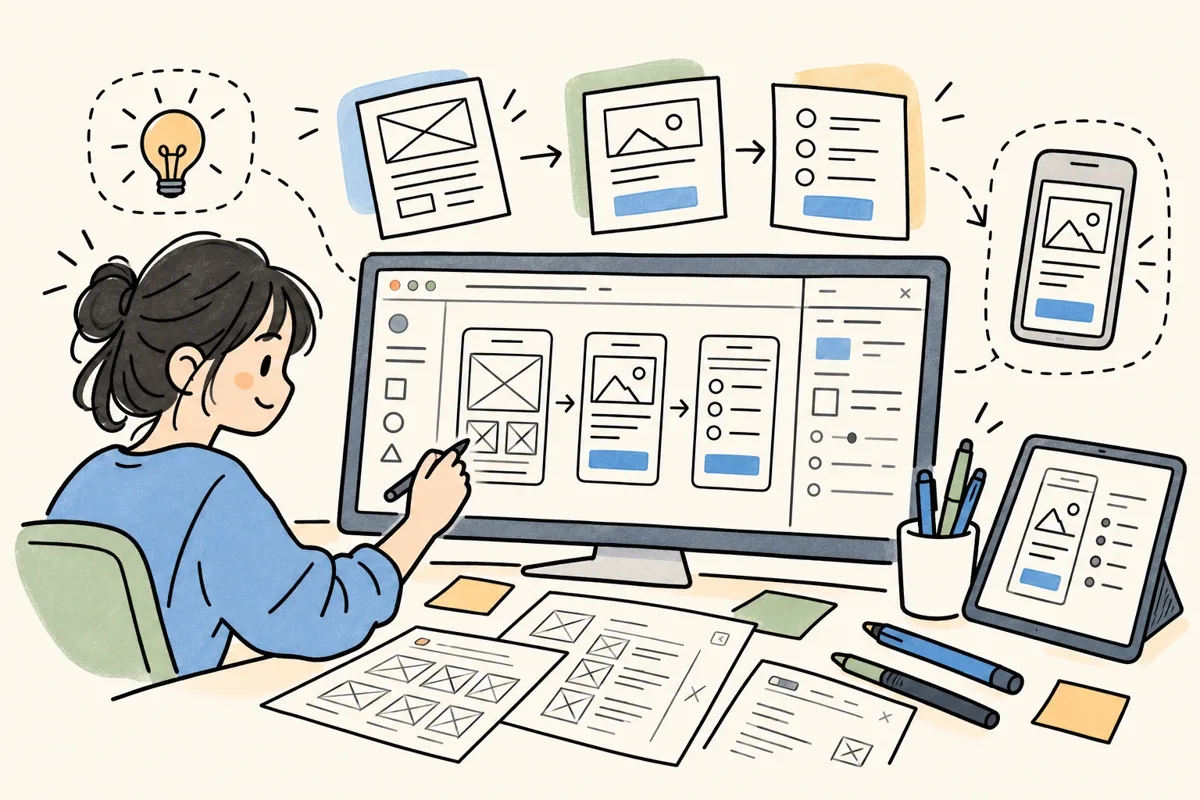
Common tools include:
- Prototyping and interface design: Figma and Adobe XD let designers build layouts, test them on different screen sizes and share clickable prototypes before any code is written.
- Website builders and CMS platforms: tools like Webflow and custom WordPress setups let developers build production-ready sites with flexible content.
- Animation: libraries such as GSAP, Framer Motion and Three.js add smooth scroll animations and light 3D elements that work across browsers.
How AI Is Transforming Modern Website Design
AI is changing everyday design work. Teams now use it for:
- Quick wireframes: first layout ideas based on the type of business and its customers.
- Copy and translation: headline variations and natural English and Spanish versions.
- Personalization: showing different headlines, banners or offers depending on where a visitor comes from.
- Code: faster front-end development with ready-made building blocks.
AI speeds up the technical work, but it doesn't replace strategy. Earning trust, finding the right message for your customers and making sure every image and claim is honest still takes someone who knows your business and your local market.
Current Design Trends: Dark Minimalism and Interactive Storytelling
Today's design trends aim for memorable, tactile experiences:
- Dark minimalism: deep charcoal or black backgrounds with bright accents and soft gradients for a premium feel.
- Glass effects and floating cards: frosted panels with subtle shadows over photos to add depth.
- Interactive cursors: custom cursor effects that grow over clickable elements.
- Physical textures: retro textures, paper collages and rich photography that make a screen feel warm.
Trends are nice, but for a local business, clarity beats novelty. Use them only when they make your offer easier to understand, never when they slow the page down or hide the phone number.
How Professional Design Drives Business Growth and Ad Conversions
Your website is the center of your marketing. When you pay for Google Ads, run social campaigns or invest in local SEO, every click lands on your site. If that page is confusing or slow, the ad money is wasted.
To get the most from your marketing, every page must match what the visitor came for:
- Check the basics before running ads: read whether you need a website before running Google Ads, or if a single dedicated page is a better fit.
- One page, one goal: knowing what a landing page is and why you need one helps you remove distractions and guide visitors to one action.
- Send ad traffic to the right page: choosing between a landing page vs. homepage for your Google Ads makes sure what people see after the click matches the ad.
- Work with your Google profile: Google Business Profile vs. website explains how your listing and your site work together for nearby searches.
- Fit your industry: for a local restaurant, why your restaurant needs a website shows the value of direct online ordering, clear menus and easy reservations on a phone.
I build every website with this in mind. I also run Google Ads, Meta Ads and local SEO, in English and Spanish, so the site and the marketing that sends people to it are planned together and measured together.
Frequently Asked Questions About Website Design Services
How much do professional web design services cost?
It depends on the scope, the design work and the features you need. Template-based sites generally run $1,000 to $3,000, while custom business websites typically cost $4,000 to $10,000 or more. Large builds with complex integrations or big online stores can pass $15,000. Ongoing maintenance and hosting usually cost $50 to $300 a month.
For reference, my websites start at $1,800 and landing pages at $900, including the copy, the design and the first year of hosting. Maintenance starts at $150 a month.
How long does it take to design and launch a new website?
A typical custom website takes 4 to 12 weeks from kickoff to launch, moving through these stages:
- Discovery and strategy: goals, customers and the list of pages.
- Wireframes and design: page layouts, style guide and phone versions.
- Build and content: building the pages and adding the copy and images.
- Testing: speed, browsers, forms and phone layouts.
- Launch and training: going live on your domain and setting up analytics.
With me, you get the plan within 2 days of your approved brief, and the build schedule is in your written proposal. It depends on how many pages you need and when your materials are ready.
What makes an award-winning website design stand out?
Sites recognized by awards like Awwwards and The Webby Awards pair striking visuals with effortless usability. Instead of heavy animations that slow the page down, they use creative typography, thoughtful whitespace and engaging storytelling, and they make it easy to find information and take action. For a local business, though, the award that matters is the phone ringing.
Conclusion
A well-built website is one of the most valuable long-term assets your business can own. Clear structure, fast mobile performance, accessible navigation and an obvious next step turn everyday searchers into customers.
If you want a fast site built for your local customers, in English, Spanish or both, see how my website design service works or book a free 30-minute call. You work directly with me, from the plan to the launch.
Written by
Miro Giovannini
Digital marketing consultant in the San Fernando Valley. 15 years with big brands, now working directly with local businesses on Google Ads, Meta Ads, websites and local SEO.

You’ll talk to me, not a sales team.
Your competitors are buying your customers' clicks today.
Tell me about your business and I'll get back to you personally with what I'd do first. No call needed.
Ready to talk? Call (747) 900-3578, text me, or book a free 30-min call.
A plan before we start · Month to month · You own every account · Max 3 new clients a month
I reply personally. No sales team, no spam.