

Why Your Google Ads Are Getting Clicks but Not Customers
July 20, 2026 · By Miro Giovannini
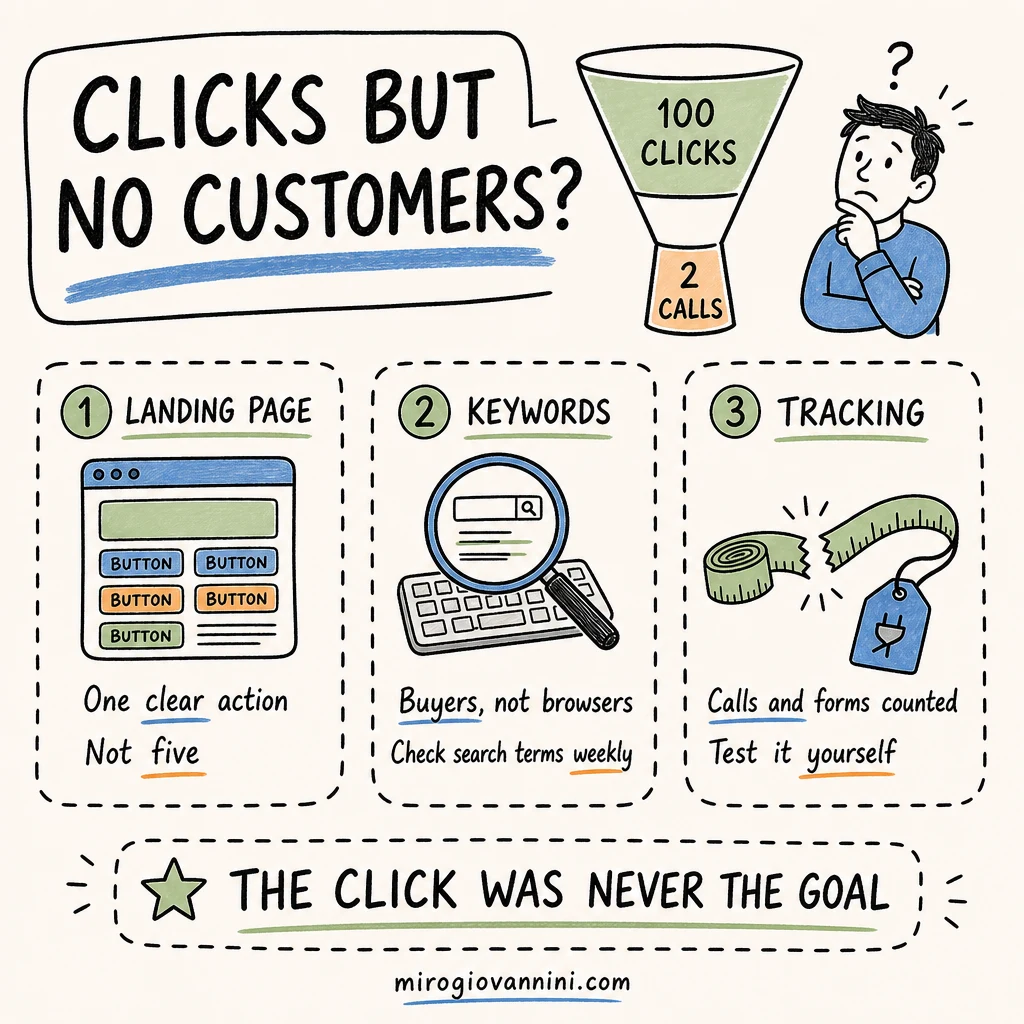
If your Google Ads are getting clicks but no customers, the problem is almost never the ads. It is what happens after the click: an unfocused landing page, keywords that attract browsers instead of buyers, or conversion tracking that is hiding the customers you are already getting.
You are running Google Ads. The clicks are coming in. The budget is being spent. But the phone is not ringing, the inbox is empty, and nobody is walking through the door. This is one of the most frustrating situations in digital marketing, and I see it constantly with local businesses. The good news is that it is almost always fixable. The bad news is that most owners look in the wrong place first.
Why Are My Google Ads Getting Clicks but No Conversions?
Because the click was never the goal, and the chain between the click and the sale has a broken link somewhere. When someone tells me they are getting clicks but no customers, my first instinct is not to look at the ads. I start with something more fundamental: are the business goals and the campaign goals actually aligned?
You would be surprised how often they are not. A business wants phone calls, but the campaign is optimized for website traffic. The goal is bookings, but there is no clear path on the site to book anything. Before touching a single keyword, I need to know that what the campaign is chasing is the same thing the business actually needs.
Once that alignment is confirmed, three areas almost always reveal the real problem: the landing page, the keywords, and the conversion tracking.
Is Your Landing Page Working Against You?
The most common landing page mistake in local businesses is trying to do too much on one page. There are buttons everywhere. Call here, buy here, book an appointment, download this, check out that. It is a wall of options with no priority.
When there is no hierarchy in your calls to action, the visitor's attention scatters. And it is not only the visitor who gets confused. The platform loses its ability to optimize, because there is no single clear conversion to learn from. If you chase two rabbits, you catch neither.
How Do You Fix a Landing Page That Does Not Convert?
Define your primary conversion, the one action you most want a visitor to take, and point the entire page at it. Secondary actions can exist, but they must never compete for the same attention. Landing page experience is one of the three components Google uses to calculate Quality Score, alongside expected click-through rate and ad relevance. A page that scatters attention scores worse, and a worse score means you pay more for the same position.
If you are still sending paid traffic to your homepage, that is worth changing before anything else. I covered exactly why in landing page vs homepage: where your Google Ads should go, and the basics of building a page that converts are in what is a landing page and why you need one.
How Do You Know If the Page Is the Problem?
Look at the conversion rate, not the traffic. If a page gets meaningful traffic and converts under one percent, the page is the suspect. If it converts at three to five percent and you still have no customers, the problem has moved downstream, into lead quality or follow-up speed.
One more test that costs nothing: open the page on your own phone, on cellular data, and try to contact yourself in under ten seconds. Most owners cannot.
Are Your Keywords Attracting Buyers or Browsers?
Broad keywords bring in curious people, and curious people do not buy. I worked with a real estate company in South America that had everything in place: social media, a website, live campaigns on both Google Ads and Meta Ads. The ecosystem looked solid. But they had no idea whether any of it was driving business results.
When I dug into the account, the keywords were far too broad. They were generating clicks from people at the very top of the funnel. Not buyers. Browsers who had no intention of purchasing anytime soon.
What Does a Funnel-Based Keyword Structure Look Like?
The fix was to rebuild the keyword strategy around the customer journey, with separate ad groups for each stage: awareness, consideration, decision, and loyalty. Think of it like a soccer team. Each player passes to the next until someone scores. No single player scores alone.
Your campaigns work the same way. Each ad group and each keyword should have a specific role in moving someone closer to a decision. When you expect every keyword to close a sale by itself, you spend most of your budget on people who were never going to convert.
Which Match Types Should You Use?
Match type is the lever that decides who sees your ad, and broad match without strong negatives is the most common way local budgets disappear. Google's documentation on keyword matching options is worth ten minutes of your time, because the difference between phrase and broad is the difference between "emergency plumber Van Nuys" and "how to fix a sink yourself."
Then pull the search terms report every week. It shows the actual queries people typed, and it is where you will find the waste. Every irrelevant term you see becomes a negative keyword.
Is Your Conversion Tracking Hiding Your Customers?
This one is more common than most people realize, and it is the cruelest, because the campaign may already be working while the report says it is not. I find broken or misconfigured conversion tracking in a large share of the accounts I audit.
The classic case in a local business: someone clicks the ad, visits the site, and then walks into the store or calls from a different phone. If that interaction is not tracked, your data says the campaign failed when it actually succeeded, and you pause the one thing that was bringing people in.
What Should a Local Business Actually Track?
Phone calls, form submissions, bookings, and, wherever possible, what happened after the lead. Google's conversion measurement documentation explains how the platform uses those signals; the short version is that Smart Bidding can only optimize toward outcomes it can see.
The key is keeping at least one digital touchpoint through the whole purchase process so you can trace the path from click to customer. For many businesses that means a simple CRM that centralizes every contact, records the original source, and logs every interaction from the first call to the repeat purchase. When it all lives in one place, you finally get the full picture. My guide on how to know if your digital marketing is actually working covers which numbers to watch once the tracking is right.
What Is the Five-Point Diagnostic Checklist?
If you are getting a hundred clicks a month and two or three calls, this is the order I would work through.
1. Audit the Landing Page
Check usability, layout, and the call to action. One clear primary conversion. Fast, mobile-friendly, obvious how to contact you.
2. Verify Conversion Tracking
Confirm your key events fire correctly. No duplicates, no missing events, no broken tags. Test it yourself by submitting a form and watching it appear.
3. Review Campaign Structure
Are branded terms separated from prospecting? Does the structure give the platform enough volume per campaign to learn, instead of ten campaigns each with two conversions a month?
4. Check Keywords and Targeting
Are the keywords too broad? Is the location targeting set to your actual service area? Run the search terms report and look for queries eating budget with no chance of a sale.
5. Evaluate the Creative
Does the ad match the intent of the search, and does it set the right expectation for the page? An ad that promises something the page does not deliver produces exactly this symptom: clicks, then nothing.
Usually it is not one variable that fails. It is a combination. A slightly broad keyword sends a slightly wrong visitor to a slightly unfocused page with slightly broken tracking, and the result is a lot of clicks and very few customers.
What If Everything Checks Out and You Still Have No Customers?
Then the problem has moved past the ad account and into the business process, and that is worth saying plainly. Leads that sit for two days before anyone calls back are not leads anymore. A quote that takes a week to send loses to the competitor who sent one that afternoon.
I have audited accounts where the campaigns were fine and the real bottleneck was that nobody answered the phone between noon and two. No amount of bid optimization fixes that. If your ads are producing calls you are not converting, the fix is in the follow-up, not the platform, and why most local businesses lose customers goes deeper into that side of it.
How Long Should You Wait Before Judging a Campaign?
Give it at least four weeks and thirty conversions before you draw conclusions, and resist the urge to change something every few days. Smart Bidding needs recent, consistent data to work with, and every significant change to budget, targets, or structure restarts that process.
The pattern I see in struggling accounts is not neglect. It is the opposite: an owner who checks the account daily, panics on a bad Tuesday, and adjusts something. Six weeks of that and the campaign has never had a stable stretch long enough to learn anything. Weekly observation, monthly decisions.
The Clicks Are Not the Problem
Getting clicks means your ads are visible and relevant enough for people to engage. That part is working. The disconnect happens after the click, and it is almost always a combination of landing page focus, keyword intent, and measurement gaps.
Businesses that fix these fundamentals do not just get more customers from the same budget. They get better data, which makes every decision after that a little sharper. That compounds. If you want a sense of what the same budget should be producing, how much do Google Ads cost for small businesses has the benchmarks I use.
If your Google Ads are generating clicks but not customers, something in the chain is broken, and it is probably fixable faster than you think. Book a call and let's find where the disconnect is.
Ready to bring in more customers?
Get a free 30-minute marketing review. We'll look at what you have today and identify the one or two changes that could make the biggest difference.