
Is Your Ad Really Bringing You Customers? Correlation vs. Causation in Paid Media
More sales while your ads run doesn't prove the ads caused them. Learn how to distinguish attributed results from additional business and evaluate your next investment.
 Miro GiovanniniDigital Marketing ConsultantOctober 22, 2026 · 11 min read

To know whether your ads are bringing you additional customers, compare your business results with a credible estimate of what would have happened without those ads.
Picture a hypothetical plumbing business in Van Nuys. The owner launches Google Ads in December, and calls increase. Then January arrives. The campaign is still running, but the phone is quieter. Did the ads stop helping, or did demand change?
The numbers alone don't answer that question. Weather, referrals, seasonal demand, and the campaign could all contribute. Before giving advertising all the credit or blame, you need to understand what you're comparing.
In more than 15 years running campaigns, I've seen business owners confuse two things happening together with one causing the other. Let me explain how that mistake affects your budget and what you can do to make a better decision.
What is correlation vs. causation in marketing?
Correlation means two things vary together. Causation means that changing one produces a change in the other. For paid media, meaning advertising you pay to place, the question is how the ads changed customer behavior.
Imagine ice cream purchases and sunburns increasing during sunny weather. Would you conclude that ice cream caused the sunburns? Weather and time outdoors offer a more sensible explanation for this illustrative pattern.
A factor that influences both the activity you're studying and its outcome can create a misleading relationship. Researchers call this confounding. In your business, seasonal demand might influence both when you increase advertising and when customers buy.
Ask what would have happened without the ad
This is the question I recommend keeping beside your campaign report: what would customers have done if the campaign hadn't run?
Suppose, in a hypothetical example, a business records 30 bookings during a promotion. A credible comparison estimates that it would have received 24 without advertising. The estimated additional contribution is six bookings. Measuring that extra contribution is called incrementality.
Notice that sales could have increased without the campaign and advertising could still have added something. Those six bookings might matter to the business. The difficult part is estimating the baseline, those 24 bookings expected without ads, credibly. That estimate needs evidence beyond your impression of how the campaign performed.
Why attribution doesn't settle the question
Attribution assigns credit for a conversion to marketing interactions. A conversion is an action you've chosen to measure, such as a completed form or purchase. Google's explanation of attribution models describes how credit is distributed among eligible interactions.
A purchase can be real while the question of what caused it remains open. Attribution helps you follow the recorded journey and manage campaigns; estimating the additional effect requires a suitable comparison. Keep both questions in view when reviewing a result.
This distinction also matters across platforms. Imagine someone interacting with an Instagram ad and later a Google ad before buying. Depending on their settings, both reports may credit the purchase. Adding their totals doesn't establish how many unique customers you acquired.
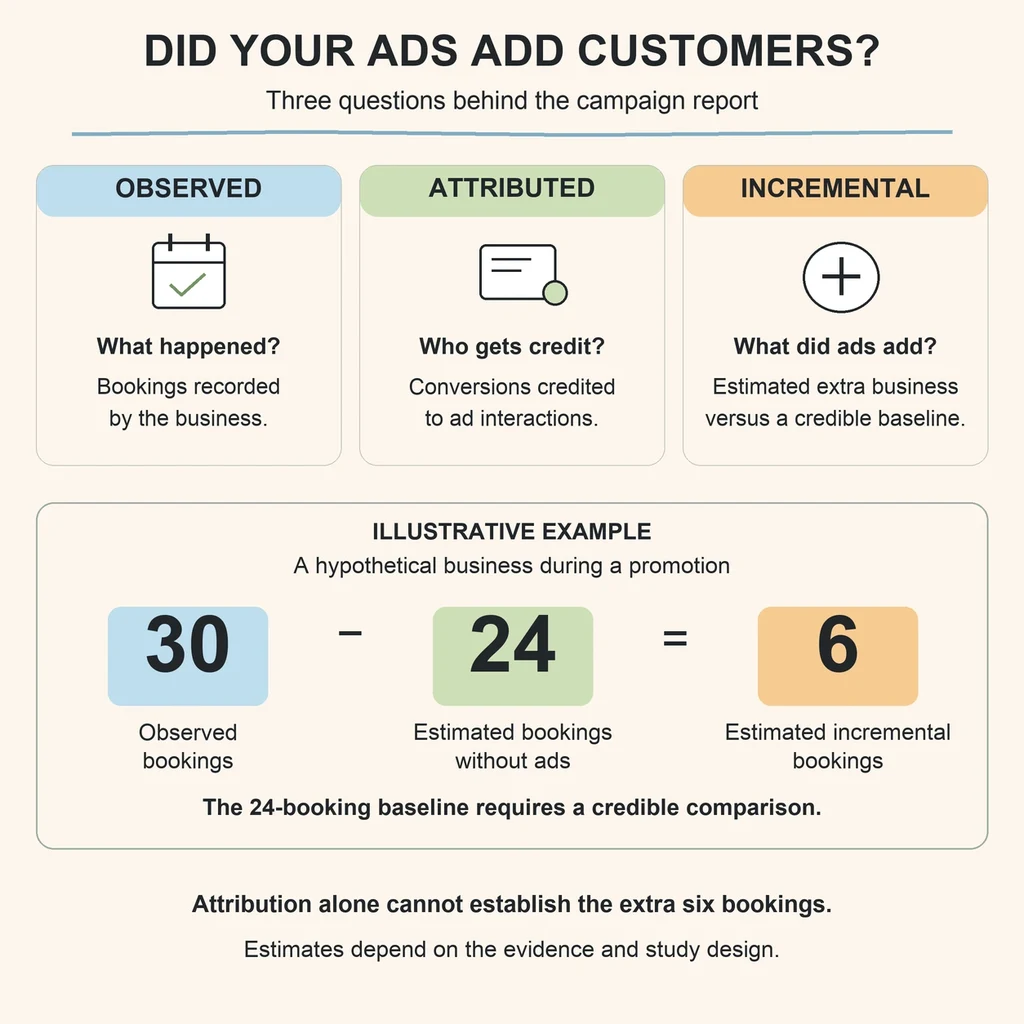
Illustrative example: 30 observed bookings minus a credible estimated baseline of 24 equals six estimated incremental bookings. Attribution alone does not establish this difference.
What advertising research tells us
A 2019 study by Gordon and colleagues compared observational methods with results from 15 Facebook advertising experiments. Observational methods analyze behavior without randomly assigning who can receive the ads. These methods often produced different effect estimates from the experiments, even with extensive customer information.
The useful lesson is about the comparison behind the number. Detailed customer information alone didn't solve the measurement problem in these studies. That gives you a reason to ask how an effect was estimated before using it to justify more spending.
For a small business, the practical implication is to match the conclusion to the evidence. A report can identify promising activity while leaving uncertainty about how much additional business the campaign produced.
Five situations that can mislead your campaign review
Several different problems can make results difficult to interpret. Some involve confounding, others involve how conversions are counted or which customers receive ads. Keeping them separate helps you choose the right response.
1. Seasonal demand changes alongside your spending
Consider a hypothetical restaurant promoting Mother's Day reservations. Reservations increase while its ads run, but the occasion also gives people a reason to book. Advertising might help the restaurant capture that demand; the calendar doesn't prove it did all the work.
The same caution applies to our plumber. Rain is a possible explanation to investigate, not an established cause of the extra calls. Check the dates, services requested, and other changes before deciding why demand moved.
2. People search for a business they already know
Branded searches include your business name. Someone making that search may already intend to contact you, which makes it especially important to distinguish paid clicks from additional customers.
The eBay field experiments by Blake, Nosko, and Tadelis found no measurable short-term benefit from brand keyword advertising in that setting. Most of the traffic and attributed sales lost from paid brand search shifted to organic search, the unpaid results.
Research by Simonov, Nosko, and Rao examined brand searches on Bing and found that competing ads changed how many clicks a brand retained. Together, these studies make the business context important: eBay's result alone doesn't decide whether your local brand campaign is useful.
Review branded searches separately and investigate what appears alongside your business. A strong reported return deserves examination before you assume either that the campaign is essential or that you can safely pause it.
3. Conversion totals hide different business outcomes
A click on a phone number, an answered call, a qualified inquiry, and a completed job represent different steps. If your report calls all of them conversions, ask which actions are included before interpreting the total.
Then reconcile records. One person may submit a form and call afterward. You received two contact events, but that doesn't necessarily mean two prospects. My guide to knowing whether your digital marketing is working develops the broader connection between reporting and business results.
4. Ad exposure reflects customers' existing activity
People who encounter advertising may differ from those who don't. For example, someone already researching a purchase may have more opportunities to see relevant ads. Comparing those groups without addressing the difference can misrepresent the campaign's contribution.
Lewis, Rao, and Reiley documented activity bias: on more active days, people can both encounter ads and perform more brand-related searches for reasons unrelated to those ads. This timing can inflate estimates of advertising's effect. Ask whether the groups differed in activity or purchase intent before attributing their different outcomes to the campaign.
5. Several parts of the business change together
A new website, a different offer, better reviews, and an advertising launch can all happen in the same month. A sales increase then leaves several plausible explanations.
I recommend changing one major element at a time when practical and keeping a dated record of changes. This makes interpretation easier, although it doesn't remove seasonality or other outside influences. If changes must happen together, evaluate the combined initiative and be explicit about what you cannot isolate.
How can a small business evaluate advertising more carefully?
Start with a clear business question and trustworthy records. You can improve both without immediately commissioning a formal experiment. Then assess whether your volume, budget, and service area support a stronger comparison.
Establish a baseline and a meaningful outcome
A baseline is the reference you use to judge change. Compare with the same period last year when useful records exist, and review recent trends too. Check holidays, operating days, price changes, capacity, and promotions. Those checks help you decide how much weight the historical comparison deserves.
For example, if our plumber now answers calls on Saturdays, comparing total bookings with a year when the business closed on weekends mixes advertising with increased availability. Record that change before interpreting the difference. Last year's results provide context, but cannot automatically establish this year's outcome without ads.
Choose the outcome before judging performance. For the plumber, that might be completed jobs, with qualified inquiries tracked as an earlier signal. Keep the time between an inquiry and the eventual job in mind when selecting reporting dates.
For campaign planning, my article on starting with the sale when choosing Facebook ads explains how to connect the digital action with the business outcome. That definition needs to remain consistent during evaluation.
Use customer tracking to improve attribution
Ask customers how they heard about you, connect calls and forms to sales records, and distinguish new customers from returning ones. Dedicated tracking numbers and campaign codes can provide useful clues, although customers may forget earlier interactions or share an offer.
These methods help identify a route to purchase. They do not establish that the purchase would have disappeared without the advertisement.
Returning customers can still generate additional business: an ad might prompt another visit or introduce a different service. Likewise, a first-time customer might have arrived through a referral anyway. Customer status and incremental impact answer different questions, so record both without treating either as proof of the other.
Consider a controlled test when the business supports one
A holdout test reserves a control group that is excluded from the advertising being tested. Outcomes are compared with those of a group eligible to receive it. Google's Conversion Lift overview describes this approach and notes that access depends on the account.
In a randomized test, assignment happens by chance, helping reduce systematic differences between groups. Google's research on geographic experiments describes randomly assigning separate regions to treatment or control. Simply choosing two nearby neighborhoods doesn't provide that protection.
Compare outcomes over the same period and account for different group sizes or baseline demand. Include the business outcomes in both groups, regardless of which channel receives attribution. Counting only ad-attributed sales would miss customers who bought through another route.
Geographic tests also need enough activity and limited spillover between areas. Customers traveling between locations or encountering the tested ads elsewhere can weaken the separation. A business serving only a small area may struggle to form useful groups.
Before running one, define the outcome, test duration, comparison method, and size of change you need to detect. Keep relevant offers and operations consistent, document exceptions, and seek help with the design when necessary. Pausing ads everywhere and comparing next week with last week leaves time-related changes mixed into the result.
An ad-copy experiment answers a narrower question. My guide to testing Google Ads messages focuses on response to different copy. That comparison doesn't by itself measure the effect of advertising versus no advertising.
Allow for inconclusive results
If a test shows little difference, the campaign may have little effect, or the study may lack enough information to detect it. Low volume, unstable conditions, and delayed sales can all make interpretation harder. A few quiet days don't settle the question.
Google's Conversion Lift reporting guidance distinguishes attributed conversions from incremental conversions and includes uncertainty intervals. Review the range of plausible effects and the completed study, rather than selecting an early number that supports your preference.
For a business with few monthly sales, improving records may be the most useful immediate step. You can make cautious budget decisions while acknowledging that the evidence doesn't yet support a precise causal estimate.
Connect the result to revenue and profit
Keep advertising spend, unique customers, completed sales, and associated revenue together. Reconcile them with business records using a consistent reporting period. A bank balance reflects many inflows and expenses, so it cannot identify an ad's contribution on its own.
Return on ad spend, or ROAS, compares attributed value with advertising spend. When that value is actual sales revenue, revenue-based ROAS equals attributed revenue divided by ad spend. A hypothetical campaign with $3,000 in attributed revenue and $1,000 in spend has a reported ROAS of 3:1. If the platform instead uses estimated lead values, label that distinction in the report.
Incremental ROAS uses estimated additional revenue instead of attributed revenue. Profitability also depends on what remains after fulfilling those sales and paying advertising and other relevant costs. Use revenue net of discounts and refunds consistently. Total business revenue divided by ad spend cannot isolate a particular campaign's return.
My Google Ads management service includes conversion tracking and reporting. Those are foundations for informed decisions; interpreting the results still requires the distinctions we've discussed here.
What should you do before changing your ad budget?
Start with one campaign and check what its reported conversions represent. Connect those actions to actual customers, review what else changed, and decide whether your evidence supports a budget adjustment or further investigation.
For our plumber, that means separating unanswered calls from completed jobs, checking seasonal demand, and accounting for the new Saturday opening before interpreting the campaign. If the remaining question justifies a controlled test, plan it around the sales volume the business actually has.
Keep asking what would have happened without the advertising. You may not have a precise answer yet, but you can identify what the records show, what remains uncertain, and which next step would make your budget decision more informed.
If you'd like help understanding what your campaign reports say about your business, book a call. We can review your tracking, your sales process, and the next measurement step that fits your situation.
Written by
Miro Giovannini
Digital marketing consultant in the San Fernando Valley. 15 years with big brands, now working directly with local businesses on Google Ads, Meta Ads, websites and local SEO.

You’ll talk to me, not a sales team.
Your competitors are buying your customers' clicks today.
Tell me about your business and I'll get back to you personally with what I'd do first. No call needed.
Ready to talk? Call (747) 900-3578, text me, or book a free 30-min call.
A plan before we start · Month to month · You own every account · Max 3 new clients a month
I reply personally. No sales team, no spam.