
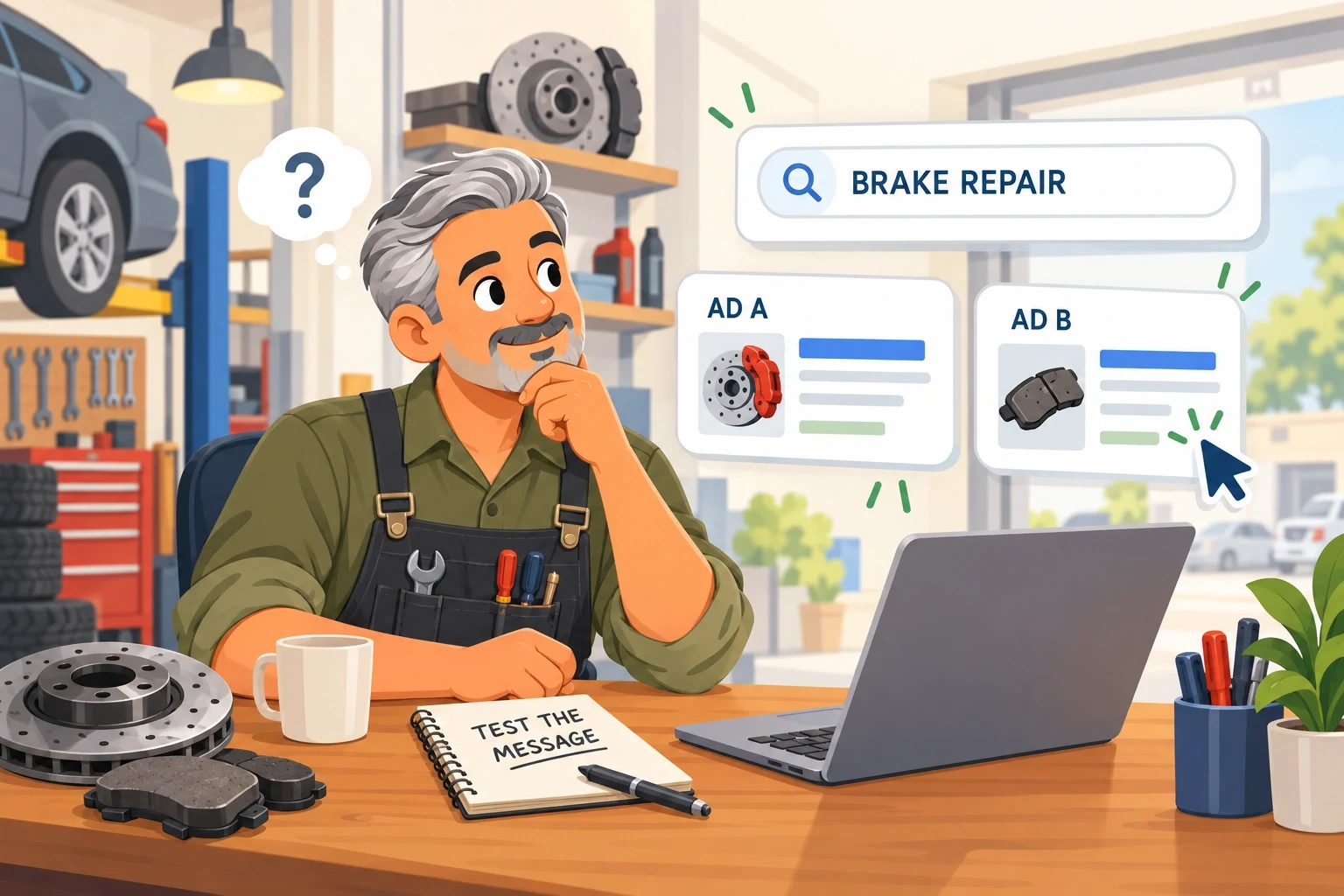
Google Ads Impressions but No Clicks? Test Your Message
October 1, 2026 · By Miro Giovannini
Google Ads can get impressions but no clicks when the message does not answer the searcher's need; check the searches and the amount of data before assuming that is the cause.
In my experience, an ad can appear for a related search while its headline or description misses what the person actually wants. The business sees a relevant keyword. The customer sees another result that seems more useful and chooses that instead.
That is why my starting point is the user's query: the words they searched for. I want to understand the intention behind those words before rewriting the advertisement.
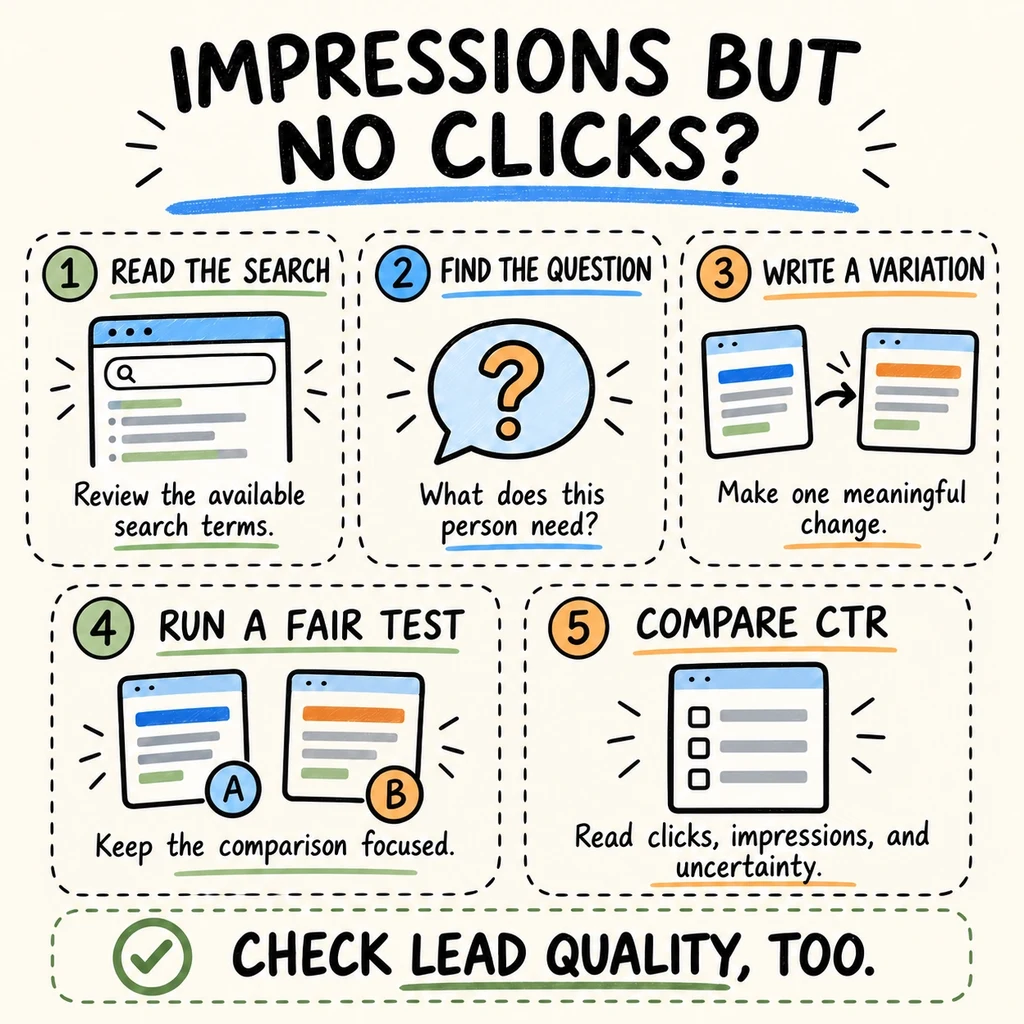
My guiding principle is simple: each ad should answer a specific question, even when the person has not written that question explicitly. From there, I would create a similar ad with a deliberate difference, run an experiment, and measure its click-through rate. Let's work through what that means for a local business.
What do impressions without clicks tell you about a Google ad?
They tell you the advertisement was shown without producing clicks during the period you selected. They do not explain why someone passed over it.
Treat the result as a reason to investigate. Before blaming the headline, check whether the searches fit your service and whether you are evaluating enough activity to make a useful comparison. An early result and a persistent pattern deserve different levels of confidence.
How does CTR measure the response to your search ad?
Google's definition of click-through rate expresses CTR as clicks divided by impressions. Multiply that ratio by 100 to express it as a percentage.
For the experiment I am proposing, CTR is the primary measure: did the revised message earn clicks from a larger share of its impressions? Keep the underlying click and impression counts beside the percentage so you can assess what supports the result.
Does a small number of ad impressions prove the copy is wrong?
No. A short run with little activity gives you limited evidence. You can identify a confusing message by reading it, but that is different from proving its effect on campaign performance.
Document what concerns you and form a hypothesis. That lets you improve the message thoughtfully without presenting an early fluctuation as a confirmed diagnosis.
What should you check before rewriting a Google Search ad?
Confirm the campaign, reporting period, and rows you are reviewing. Are you looking at the whole campaign, one ad, or an individual asset such as a headline? Keep those levels distinct throughout your comparison.
Also keep this diagnosis focused on Search. A campaign spanning different advertising environments needs a more specific review before you combine its results. Write down the starting point: which service you are advertising, where you serve customers, and what action you want them to take.
If clicks already exist but inquiries do not, my article on Google Ads getting clicks but not customers addresses that next stage.
How do search terms help explain why people ignore your ad?
I review users' queries to understand their intent, then review the keywords being used. Google's search terms report documentation explains how to examine searches that triggered your ads and their performance.
Read the wording before rushing to change the copy. Is the person looking for a service you sell, advice they can use themselves, or something outside your offer? An attractive advertisement cannot make an unsuitable search become the right opportunity for your business.
What is the difference between a search term and a keyword?
A search term is what a person enters when searching. A keyword is something you add to an ad group to help target your advertising. They are related, but they are not necessarily identical.
Compare the two. If a keyword is connecting you with searches that do not fit the business, review the targeting before deciding that the message alone needs repair.
Can the search terms report show every customer query?
No. Google explains that some low-activity terms are omitted for privacy. Use the available report as evidence, while recognizing that it is not a complete record of every search behind your impressions.
Avoid filling those gaps with certainty. You can investigate a likely intention without claiming to know what every person was thinking.
How do you find the question behind a search query?
Translate the query into an everyday question. Someone typing “brake repair Encino” might be asking, “Can a nearby shop help with my brakes?” Someone searching “brake replacement cost” might first want to understand the expense.
These are possible interpretations in a hypothetical example, not confirmed thoughts or results from a client account. They help you decide what to investigate and what message to test.
Why does the implied question matter for local ad copy?
Because repeating the service name is only the beginning of an answer. The person may also need to know whether you serve their area, handle their particular problem, or offer an understandable next step.
Think about the conversation you would have at your counter. You would listen to the problem before introducing the business. Apply that same discipline to the advertisement: make the response relevant to the question you believe the searcher is asking.
How can keyword research support your Google Ads review?
I also use tools such as Semrush and AnswerThePublic when reviewing keywords. They complement my examination of user queries and help inform the research behind the message.
Keep the sources separate in your notes. A query observed in the advertising account and an idea explored through a research tool have different evidentiary value. A useful idea is a candidate to investigate, not proof that your own customers searched for it.
How should you rewrite an ad to match search intent?
Start with one service and one question. Then ask whether the headline and description give a direct, truthful answer. Remove wording that occupies space without helping the person decide whether your business fits.
You do not need a dramatic new slogan for every test. Sometimes the useful difference is simply making the relevant service or next step more explicit. The reason for the change should be explainable before you launch it.
What might a clearer local search ad headline look like?
For our hypothetical repair shop, compare “Reliable Auto Care” with “Brake Repair in Encino.” The first introduces a broad promise; the second names the service and location connected to the example query.
That gives us a testable difference, not a guaranteed winner. Use the location only if the business genuinely serves it. Avoid adding claims about availability, prices, certifications, or turnaround times unless the business can substantiate them.
What should the description and call to action add?
Use the description to continue answering the same question. Explain the relevant service and what the person can do next, such as contacting the shop to discuss a repair appointment.
The invitation should match the process the business can deliver. If appointments require confirmation, do not imply that clicking immediately secures one. Before testing, read the ad alongside its destination and check that both describe the same offer.
How do responsive search ads affect your copy test?
An advertisement is not always one fixed headline followed by one fixed description. Google's responsive search ads guidance explains that the system assembles combinations from the headlines and descriptions you supply.
Review whether those assets make sense individually and together. A clear headline can lose its usefulness when the rest of the message points toward an unrelated service or promise.
Ad-level results also summarize combinations. Do not attribute the entire advertisement's CTR to one headline simply because that headline is present. Define what your variation changes so the conclusion matches what you actually tested.
How can you test a new Google ad message fairly?
My first action would be to formulate a similar advertisement with a deliberate difference and run an experiment. For a copy test, Google's ad variation setup provides a way to modify responsive search ad text, set dates, and configure an experiment split between the original and variation.
Choose the ads and the change carefully. The question is whether that specific revision improves the response under the conditions tested, rather than whether a completely different campaign happens to perform better.
What hypothesis should guide an ad copy experiment?
Write a sentence connecting the observation to the proposed change. For the repair example: “People searching for brake repair may respond better when the headline names that service and Encino, rather than describing general auto care.”
This identifies what you are testing and why. It also leaves room for the result to disagree with your expectation. You are testing the interpretation of the search, not asking the data to endorse a headline you already prefer.
Which campaign settings should stay stable during the test?
For this focused comparison, keep unrelated choices as stable as practical: the audience, service area, budget, bidding approach, and landing page. Record necessary changes, because they affect how confidently you can interpret the outcome.
Simply uploading another ad does not establish that you have configured an experiment. Use the testing setup deliberately, and avoid judging two versions from unrelated periods as though only their wording changed. The useful discipline is being able to explain what differed between the comparison groups.
How should you evaluate CTR after an ad variation?
Compare the original and revised versions within the experiment. Read CTR alongside the clicks and impressions for each version, then examine the uncertainty reported for the comparison.
Google's guide to monitoring ad variations describes performance comparisons, confidence intervals, and significance indicators. Those help you distinguish an observed difference from a result with stronger statistical support. A larger displayed percentage alone is not enough to declare a winner.
How long should a Google Ads copy experiment run?
There is no duration that guarantees a useful answer for every small business. Google's monitoring guidance explains that significance depends on factors including the difference between versions, performance variability, and the impressions collected.
Set the evaluation period before starting and check whether the result supports a decision. If evidence remains inconclusive, say so. Record what you learned and whether more observation is practical; avoid repeatedly rewriting the variation while trying to evaluate it.
Does a higher Google Ads CTR mean more customers?
It means a larger share of recorded impressions produced clicks. It does not establish that those clicks became useful inquiries or sales.
CTR remains the primary metric for this message experiment. To judge business value, also review the subsequent contacts and their quality. A promise that attracts attention but misrepresents the service can give you a more appealing report and a less useful conversation with the prospect.
My guide to knowing whether your digital marketing is working expands on connecting marketing activity with commercial outcomes.
What is the first step when your Google ads get no clicks?
Choose one relevant ad and review the available searches in its ad group. Write down the question you believe those searchers want answered, then identify one meaningful difference to test in the message.
Keep a short record of the original, the variation, your hypothesis, the testing conditions, and the result. That makes the exercise useful even when your preferred version does not improve CTR: you have a documented basis for the next decision.
This is the kind of reasoning I bring to Google Ads management. As a marketing consultant in the San Fernando Valley, I want the decision to follow a clear question and evidence you can evaluate.
If your search ads are getting impressions but few clicks, book a call. We can review the searches, clarify the question your message should answer, and identify a focused experiment for your business.
Ready to bring in more customers?
Get a free 30-minute marketing review. We'll look at what you have today and identify the one or two changes that could make the biggest difference.