

Boosted Posts vs Facebook Ads: Start With the Sale
October 1, 2026 · By Miro Giovannini
Boosted posts are Facebook ads created through a simplified promotion flow, while Meta Ads Manager lets you organize campaigns around an objective, delivery settings, and measurable results.
My recommendation is to use Ads Manager. When you invest in advertising, I want you to understand what you're trying to achieve, how you'll measure it, and what you'll learn from the money you spend.
I've reviewed local businesses using the Boost button, and the attraction is understandable: the owner wants to launch quickly and generate sales. Speed matters in digital marketing. However, important decisions sit between choosing a post and activating the advertisement, and those decisions deserve attention.
Launching faster doesn't always mean selling more. Let me explain how I approach that decision and why I start with the sale itself.
What is the difference between boosted posts and Facebook ads?
A boosted post begins with content you've already published and puts advertising money behind it. It is a paid advertisement. The useful comparison is between that promotion workflow and building and managing your advertising through Ads Manager.
Meta's training on boosting posts covers choosing goals, audiences, budgets, and placements. Boosting therefore involves more than pressing a button, even when the process feels quick.
Ads Manager brings campaign planning and reporting into a broader workspace. Meta's campaign creation overview includes objectives, automation, budgets, audiences, placements, creative, and reports. Those are the connected decisions I want a business owner to understand.
Can boosted posts have an advertising goal?
Yes. It would be inaccurate to describe every boost as an advertisement that can only collect likes. The question I ask is whether the selected goal matches the action the business actually needs.
An owner can select a goal and still have an unclear plan. Before spending, I want to know how that goal connects to a customer, who handles the next step, and what evidence will show that the investment helped.
Why do I recommend Ads Manager instead of boosting posts?
I don't recommend the Boost button to the business owners I advise. I recommend starting in Ads Manager and giving the investment a clear structure from the beginning.
That's my professional approach, based on the clarity I want from a campaign. Opening Ads Manager still requires thoughtful decisions: the offer, audience, measurement, and sales process all need to work together.
For a broader introduction to the channel, my guide to Facebook and Instagram ads for local businesses provides additional context. Here, let's focus on the decisions that come before activation.
Why can launching Facebook ads quickly create confusion later?
In the situations I've observed, the owner prioritizes getting the post live. Campaign organization and objective selection receive less attention, leaving an important gap between spending money and understanding the outcome.
If an advertisement appears successful, you should be able to explain what success means. Did it generate inquiries, appointments, or paying customers? Which part of the setup might explain the response?
Without a consistent way to answer, the next promotion becomes another guess. Over time, that creates the problem I care about most: disorder makes it harder to see clearly.
How does Facebook ad campaign structure work?
Meta's campaign structure explanation describes three levels: campaign, ad set, and ad. Understanding their roles helps you connect the business decision to the advertisement people see.
What belongs at the campaign level?
The campaign establishes the advertising objective. Start with the outcome you need the advertising to support, so the rest of the setup follows a coherent direction.
For example, a business seeking service inquiries needs to define what counts as a useful inquiry before it judges campaign performance. Giving the campaign a clear purpose makes later decisions easier to explain.
What belongs at the ad set level?
The ad set organizes delivery decisions such as audience, placements, schedule, and conversion settings. Budget arrangements also need a deliberate choice; depending on the setup, you can manage spending across a campaign or at the ad set level.
I want those choices to reflect the business: where it serves customers, what action it needs, and how much it can invest while evaluating results.
What belongs at the ad level?
The ad contains the message, visual, and action you present to the customer. Its promise and destination should fit the campaign's purpose.
If you're asking for an appointment, make the next step understandable. The person should know what they're requesting and what happens after they respond.
How does campaign structure help you repeat what works?
Structure gives your experiments a clear question. You might want to find out whether explaining a service more clearly improves the quality of inquiries. Record that hypothesis, identify what you'll change, and decide how you'll evaluate it.
Keep the comparison understandable. Changing the offer, audience, and destination together makes it difficult to isolate the reason for a different result. A clear account also needs a clear testing plan.
The goal is to learn what deserves another investment. A good result gives you something to investigate and test again; repetition still needs measurement because conditions can change.
How do you choose a Facebook ad objective from your sales process?
When a business owner tells me, “I want to sell more,” I ask about the sales process and the customer journey: the steps a person takes before becoming a customer.
Where does the purchase happen? In a physical location, on a website, or during a technician's visit? Once I understand that, I look for the digital action that moves the person closest to that sale.
I think of this as reverse engineering from the point of sale. Working backward helps define what the campaign should produce and how the business will turn that response into revenue.
What should a dental practice measure before the sale?
Consider an illustrative dental practice where patients book online and receive care at the office. A completed appointment booking gives the campaign a concrete digital outcome to pursue.
I would evaluate booking volume, advertising cost per booking, and the booking conversion rate. The booking must actually be completed; tapping a booking button alone doesn't establish that someone reserved an appointment.
The practice then needs to understand what happens afterward: attendance and the services patients ultimately receive. Those later steps show whether the bookings support the business.
What should an HVAC company measure before the sale?
Now consider an illustrative HVAC company serving homeowners in the San Fernando Valley. A customer calls or submits a form, the company arranges a visit, and the technician closes the sale in person.
In that journey, campaign-generated calls and completed forms are useful digital outcomes. They are separate ways to initiate contact, with their own volumes, costs, and progression toward a booked visit.
I'd distinguish an actual call from a click on a phone number, then track whether the inquiry was relevant and became an appointment. If one person calls and submits a form, the sales record should identify the same prospect. Otherwise, the report can overstate how many opportunities you received.
How do campaign objectives, conversion events, and KPIs fit together?
The business outcome, campaign setting, and reporting metric need to agree. A KPI, or key performance indicator, is the measure you use to evaluate progress toward the outcome you've chosen.
Meta's guidance on objectives and conversion settings distinguishes the objective, conversion location, conversion event, and performance goal. Choosing an objective is one part of the setup; the remaining settings determine where the desired action occurs and what the system is configured to pursue.
For an appointment campaign, check the options available for the booking process and the events you can reliably measure. A campaign's objective label alone doesn't prove that completed appointments are being tracked or optimized for.
Which KPIs should you use to evaluate local Facebook ads?
Once you've defined the meaningful action, evaluate its volume, cost, and conversion rate together. Volume tells you how much activity you generated. Cost helps you assess efficiency. Conversion rate shows how frequently people move through a defined step.
For a booking campaign, advertising cost per booking equals the campaign spend divided by the completed bookings attributed to it. Name the action when reporting CPA, or cost per action, so everyone knows whether you're discussing a booking, a lead, or a customer.
How should you calculate a conversion rate?
Always state the denominator. A website booking rate could be completed bookings divided by campaign-attributed website sessions, multiplied by 100. A lead-to-appointment rate uses appointments divided by leads instead.
These percentages describe different steps. Compare the same stage, counting rules, attribution method, and time period when evaluating two results. For the HVAC example, compare how calls and forms progress to appointments and sales using a consistent definition of a unique lead.
Give prospects time to complete the process before drawing conclusions about their final sales outcome.
How do you distinguish a cheap lead from a valuable customer?
A low cost per inquiry tells you about the cost of generating that inquiry. You still need to find out whether it becomes a customer and what that customer buys.
That's why I want digital and commercial results connected. My guide to knowing whether your digital marketing is working develops that measurement mindset. For this decision, keep the distinction visible: generating a contact, booking an appointment, and closing a sale are separate outcomes.
How can a CRM connect Facebook leads to actual sales?
A customer relationship management system, or CRM, can keep the prospect's source alongside appointment status, sales outcome, purchased service, and revenue, provided those details are recorded consistently.
In the HVAC example, that lets you compare the share of inquiries that close, average sale value, and services purchased through each contact route. Calls and forms are contact methods; keep the advertising source separately so you can also compare marketing channels.
Meta's Conversions API for CRM training describes connecting CRM information to support optimization for lead quality. That connection requires an appropriate integration; owning a CRM doesn't automatically configure it.
For your own reporting, maintain consistent sources and remove duplicates. Attribution still depends on the information captured. Use the records to make better decisions while recognizing any gaps in the customer's journey.
How do you move from boosting posts to a clear advertising plan?
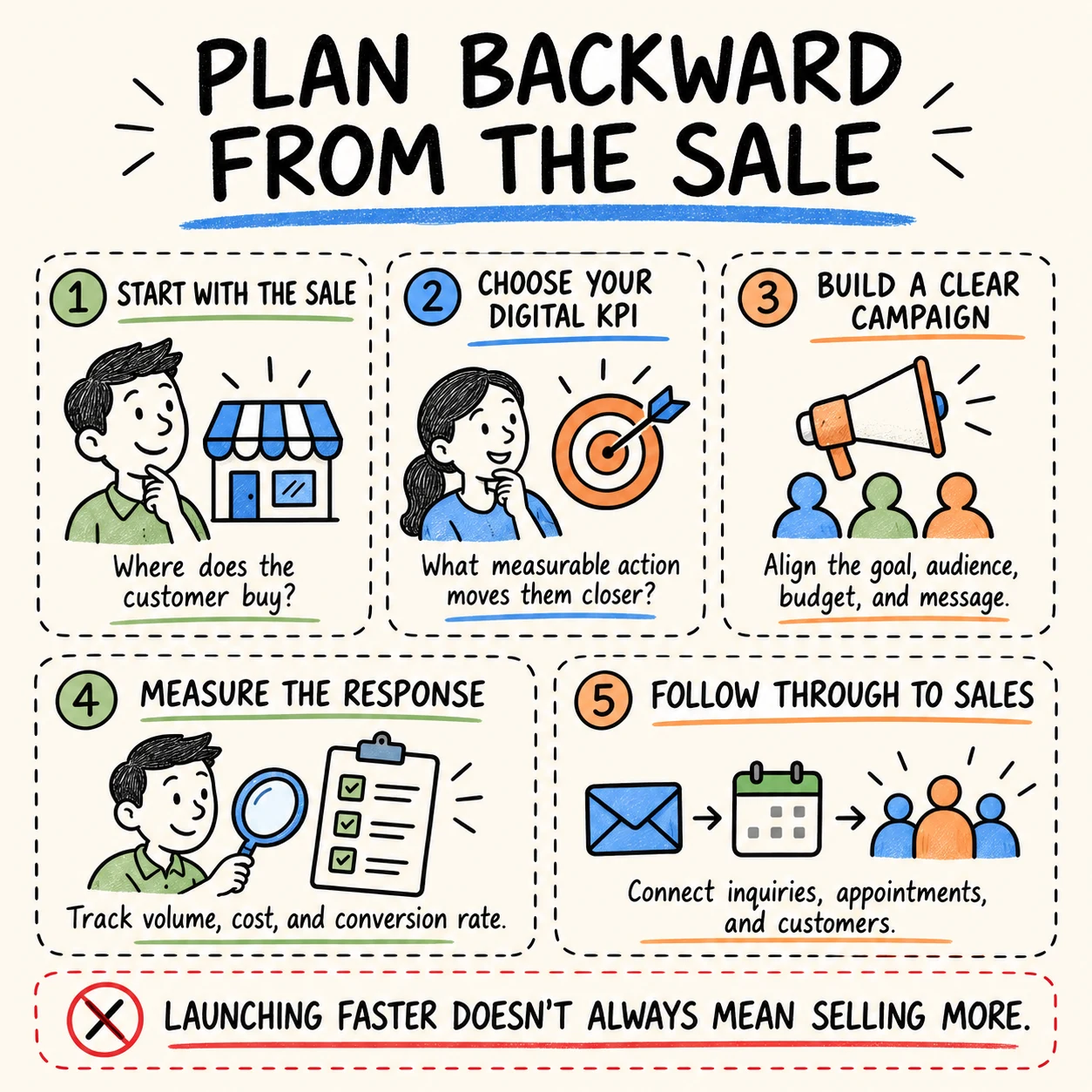
Start by identifying the most important measurable digital action before the sale. Then organize your next campaign around it:
- Describe where the sale happens and the steps that lead to it.
- Define the digital action, including what counts as completion.
- Check that you can record it accurately and connect it to follow-up.
- Choose the campaign settings, audience, budget, and message that support it.
- Review the resulting contacts or bookings through to the sales outcome.
Keep the existing advertising history so you can learn from it. Record what was measured and what remains unknown, rather than inventing a sales result for an old promotion.
This is the clarity I aim to bring to Meta Ads management: a defined purpose, an understandable structure, and results the owner can evaluate.
What should you decide before spending on your next Facebook ad?
Write down the digital KPI that matters most before the sale, and explain why it belongs in your customer's journey. Then decide how you'll verify that those actions become customers.
Sales are the outcome you're working toward. The campaign can generate opportunities, while follow-up, availability, the offer, and the customer's decision determine how those opportunities progress. Measuring that connection keeps the campaign focused on the business.
My work as a marketing consultant in the San Fernando Valley starts with making these decisions clear. Before you activate the next advertisement, be able to explain what you're paying to generate, how you'll recognize it, and what should happen afterward.
If you'd like help defining that KPI and connecting your campaign to your sales process, book a call. We can work through the journey and identify a practical starting point for your business.

Ready to bring in more customers?
Get a free 30-minute marketing review. We'll look at what you have today and identify the one or two changes that could make the biggest difference.