
How Bilingual Digital Marketing Helps You Reach More Local Customers
Bilingual marketing is not about more content. It is about useful English and Spanish content that earns trust and brings in local customers.
 Miro GiovanniniDigital Marketing ConsultantOctober 28, 2026 · 9 min read

Bilingual digital marketing helps you reach English- and Spanish-speaking customers with messages that fit each audience. Start by finding out which languages your local customers use. Then create ads, social posts, and website pages for each group. Don't just translate the words: adapt the offer, tone, and examples, and make sure people can get help in the language they chose.
For a San Fernando Valley business, that might mean testing separate English and Spanish search ads, then tracking calls, leads, and sales from each. The goal is not more content. It's more useful content that earns trust and brings in customers.
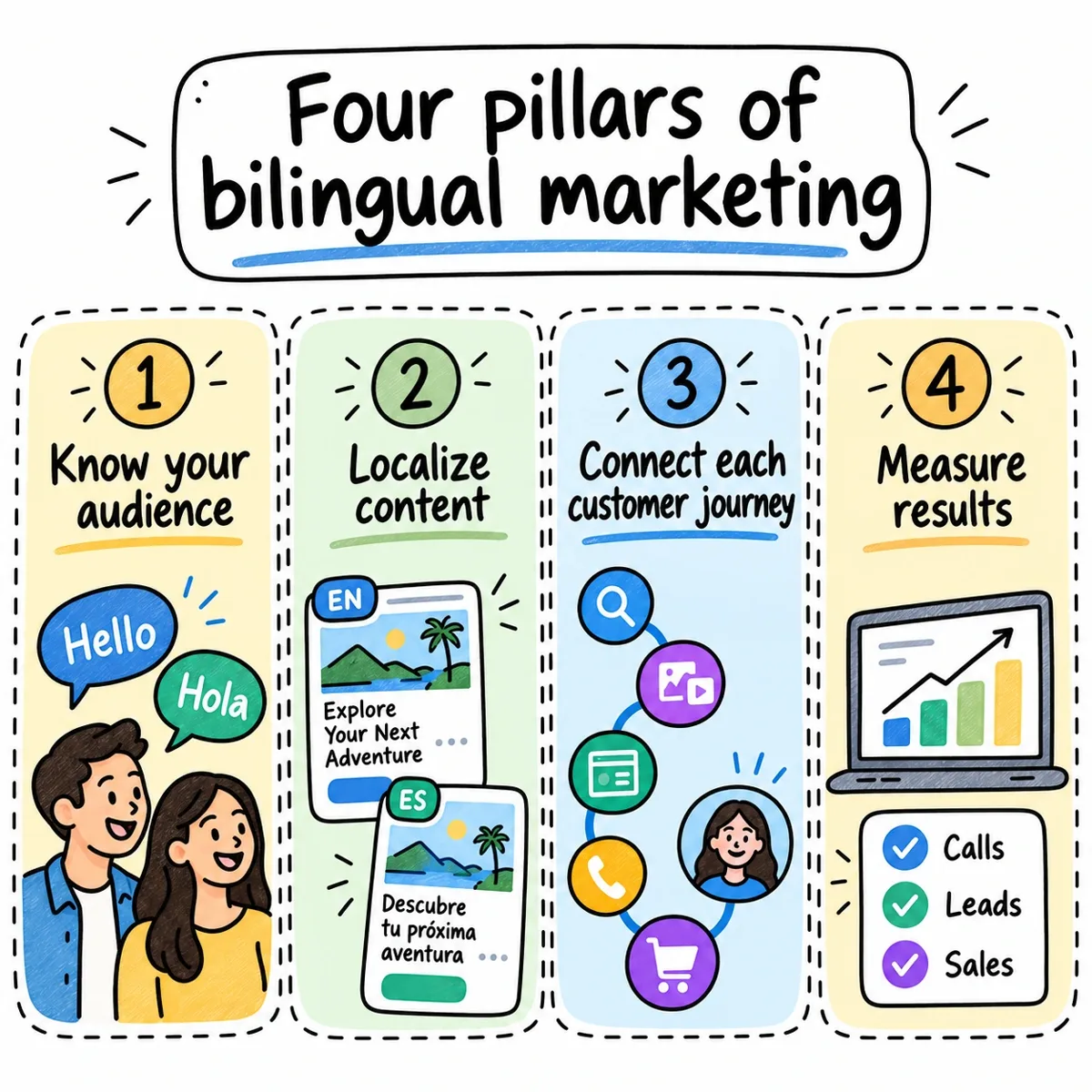
The Strategic Foundation of Bilingual Digital Marketing
Modern consumer bases are rarely monolingual. In major metropolitan hubs and diverse communities across North America, reaching modern buyers requires stepping beyond single-language campaigns. Market access is no longer just about bidding on high-volume keywords; it is about establishing cultural intelligence and creating genuine consumer connection.
When businesses embrace a dual-language framework, they tap into underserved demographics that competitors routinely ignore. According to detailed demographic research like the B16001: Language Spoken at Home by ... - Census Data table, tens of millions of households in the United States operate primarily or bilingually in languages other than English. When a brand communicates with consumers in their language of preference, brand resonance transforms from transactional visibility into long-term loyalty.
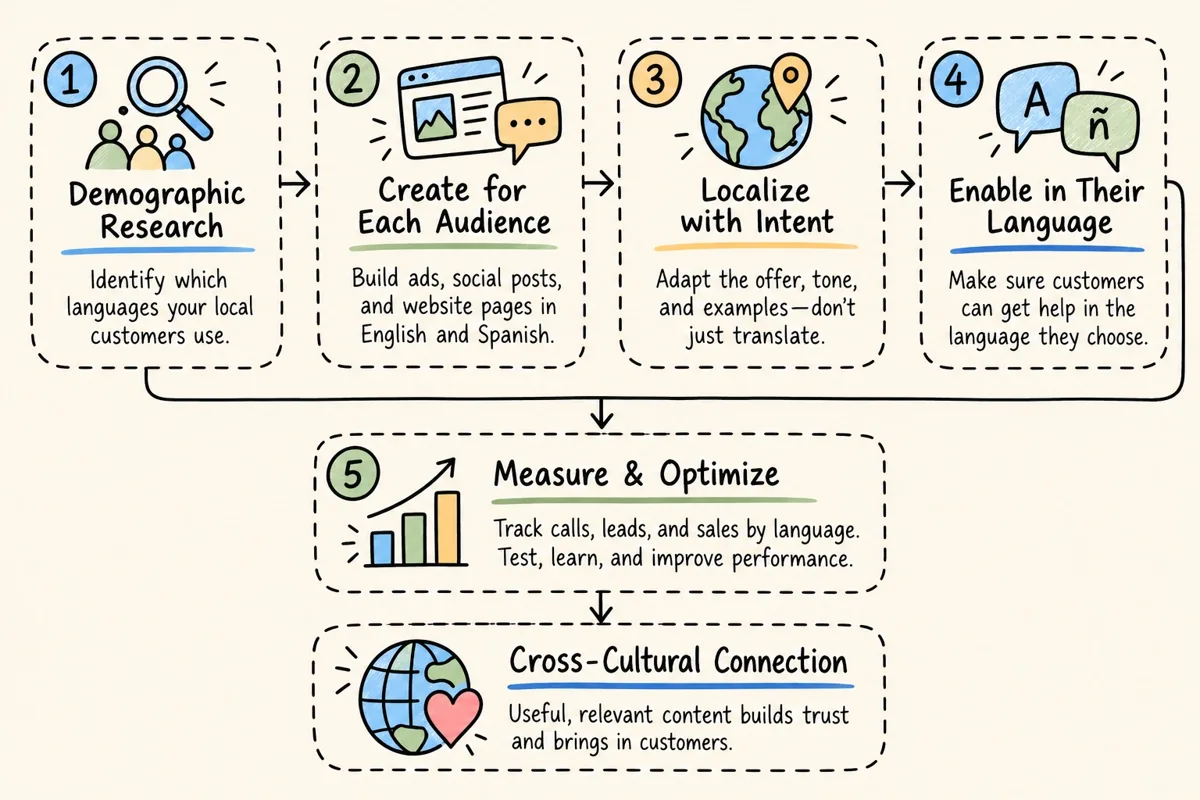
Translation vs. Localization: Capturing Nuance and Cultural Context
A foundational mistake businesses make when expanding their reach is treating translation as a complete strategy. Translation simply converts words from one language into another. Marketing localization (often called transcreation), on the other hand, preserves your brand's intent, humor, emotion, and tone while adapting idioms, imagery, and cultural contexts.
Direct translation frequently fails because it ignores regional dialects, cultural references, and everyday phrasing. For instance, translating an English marketing slogan word-for-word into Spanish can lead to confusing phrasing or unintended double entendres that alienate prospective buyers.
| Attribute | Direct Translation | Marketing Localization (Transcreation) |
|---|---|---|
| Primary Goal | Linguistic accuracy and literal word matching | Cultural resonance, emotional engagement, and conversions |
| Tone & Voice | Often formal, robotic, or mismatched | Adapted to match natural community speech and regional idioms |
| Visual Elements | Unchanged assets across all language audiences | Tailored imagery, color palettes, and cultural representations |
| Idiomatic Expressions | Translated literally (often losing core meaning) | Reimagined using equivalent native cultural phrases |
| Consumer Sentiment | Perceived as an afterthought or compliance check | Perceived as authentic, respectful, and customer-first |
Visual localization is just as vital as localized copy. If your ad speaks to Spanish-speaking homeowners in Los Angeles, but the accompanying creative depicts winter landscapes and generic stock figures, the disconnect undermines trust immediately.
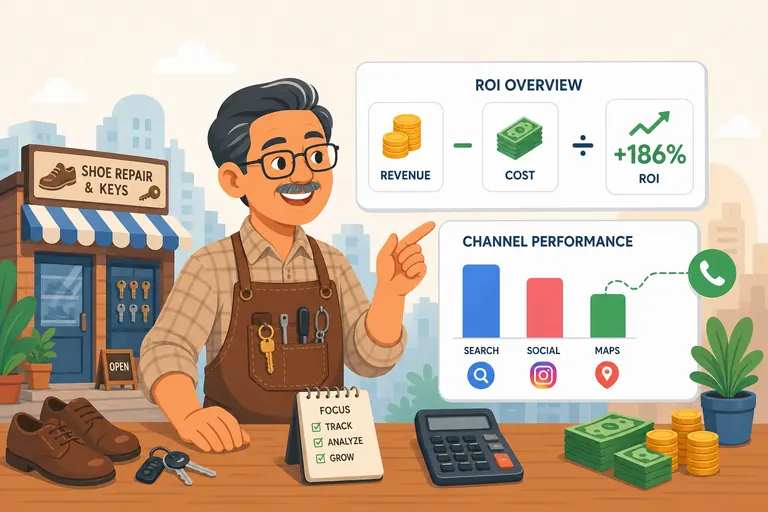
Building Brand Trust and Measuring ROI Across Demographics
Building authentic connections directly elevates brand credibility. When shoppers see tailored landing pages, culturally aligned ad creatives, and native customer support, conversion rates rise and customer lifetime value expands.
To validate your investment, tracking granular performance metrics by language segment is essential. We monitor performance across distinct funnels by reviewing multi-touch attribution, language-specific bounce rates, cost per acquisition (CPA), and overall customer retention. If you are uncertain how to evaluate performance across these new customer segments, our guide on evaluating marketing campaign performance breaks down how to identify whether your campaigns are generating real bottom-line revenue.
Designing Your Multichannel Bilingual Content Strategy
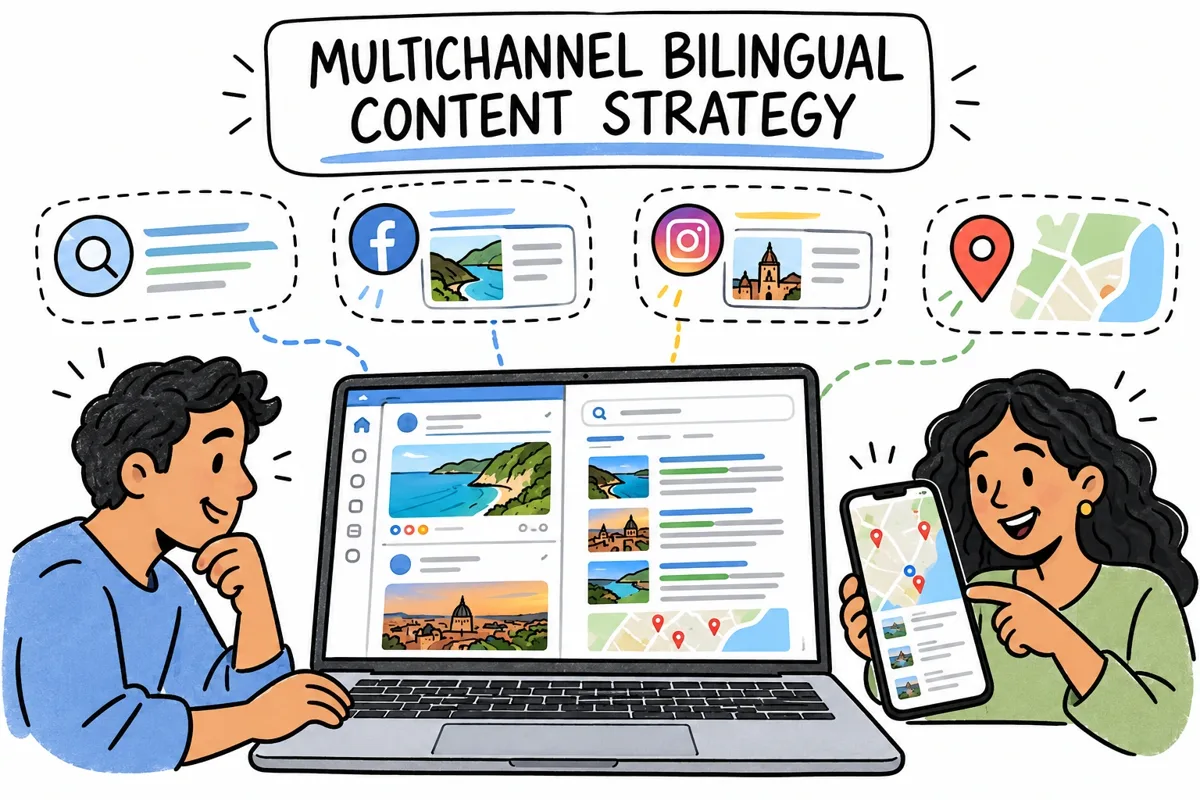
A successful dual-language initiative requires an integrated architecture across search engines, paid social channels, and web platforms. Fragmented execution—such as running localized top-of-funnel ads that point to an English-only checkout page—creates friction and wastes ad spend.
Social Media Architecture: Unified Profiles vs. Dedicated Language Channels
Choosing between maintaining separate social profiles for each language or operating a single, unified brand profile depends on your audience concentration, resources, and geographic footprint:
- Unified Profiles: A single brand account where content is published in alternating languages or formatted as dual-language posts. This setup consolidates follower counts and social proof, making it ideal for national brands or businesses with balanced bilingual communities.
- Dedicated Language Channels: Maintaining separate handles (such as
@Brandand@Brand_ES). This structure allows tailored community management, precise geotargeting, and zero linguistic clutter for monolingual followers. However, it requires twice the content production and active moderation.
Executing Bilingual Digital Marketing Across Paid Search and Social Ads
In paid media, search intent differs significantly across languages. Simply translating an English keyword list into Spanish overlooks common colloquial search terms, regional phrasing, and voice-search patterns.
- Paid Search (Google Ads): Group ad campaigns by target language. Create dedicated Spanish ad groups bidding on genuine Spanish search terms, leading directly to Spanish-language landing pages. You can explore how we manage high-intent campaigns through our Google Ads Services.
- Paid Social (Meta Ads): Meta's sophisticated machine learning allows you to target users based on device language, regional demographics, and content consumption behaviors. Our team utilizes dedicated Meta Ads Services to deliver culturally localized video and carousel creatives.
- Dynamic Creative Iteration: Rapidly testing visual variations and localized hooks is easier than ever when incorporating modern tools like our AI Creatives Services, helping you scale multiple ad variations without losing brand consistency.
Local SEO and Multilingual Website Architecture
To rank for local queries across English and Spanish search engines, your website architecture must be structured properly:
- Hreflang Implementation: Use correct
hreflangtags (such asen-usandes-us) to show search engines which language version to serve based on user preferences and location. - Dedicated URL Structures: Avoid dynamic JavaScript translation widgets that leave search engines unable to index translated text. Instead, use subdirectories (e.g.,
mirogiovannini.com/es/) or separate subdomains. - Localized Metadata: Optimize title tags, meta descriptions, image alt tags, and headers for language-specific search terms.
Building an accessible, search-engine-friendly site starts with solid foundations like our Website Design Services. Combining clean design with proven local marketing strategies ensures your business attracts nearby customers searching in either language.
Navigating Regional Nuances, Compliance, and Market Variations
Language is living, dynamic, and deeply regional. A strategy that resonates in Miami might fall flat in Southern California or Texas because regional backgrounds, idioms, and slang vary widely.
Regional Nuances: From US Hispanic Markets to Canadian Demographics
In the United States, Mexican-American phrasing often dominates Southwest markets, while Caribbean Spanish heavily influences South Florida and New York. Crafting copy that feels native requires understanding these community backgrounds.
Similar regional dynamics appear in international markets:
- Canadian Demographics: Approximately 18% of Canadians report conversational fluency in both English and French, a figure that rises to over 25% among young people aged 15 to 24.
- Regional Concentration: While Quebec mandates French-first communication, provinces like New Brunswick are officially bilingual, whereas Western Canada has lower daily bilingual usage.
Key regional variations across North America include:
- US Southwest & California: Conversational, accessible Spanish that balances Mexican idioms with modern English loanwords (Spanglish).
- US Southeast (Florida): Caribbean and South American Spanish nuances with formal and informal variations.
- Quebec, Canada: Distinct Québécois French idioms, requiring strict cultural localization rather than European French phrasing.
Regulatory Compliance: Legal Mandates and Language Laws
Depending on your operating regions, multilingual marketing may be a legal requirement rather than just a growth strategy. In Quebec, for example, Bill 96 establishes strict guidelines mandating French on commercial signage, digital assets, customer contracts, and marketing communications directed at local consumers.
Even in regions without statutory language mandates, adhering to consumer protection laws and accessibility standards ensures disclosures, warranties, and pricing terms are clearly understood by all prospective buyers.
Scaling Operations: Tools, Team Workflows, and Avoiding Common Pitfalls

Scaling multi-language campaigns requires structured workflows, verified translation technology, and native-speaker oversight to protect brand safety.
Essential Technology Stack and Workflows for Bilingual Digital Marketing
Building an efficient production engine requires pairing modern marketing tools with human review:
- Computer-Assisted Translation (CAT) & Translation Memory: Tools that store approved terminology ensure brand slogans, technical phrasing, and naming conventions remain identical across platforms.
- CMS Multi-Language Integrations: Content management platforms that automate string extraction and staging for localized blog articles and landing pages.
- Native-Speaker Review & Editorial Quality Assurance: Never publish machine-translated content without review from a native speaker who understands local context and everyday speech.
Critical Pitfalls to Avoid in Multilingual Campaigns
Even well-funded marketing campaigns can stumble if basic operational errors slip through. Steer clear of these common pitfalls:
- Unedited Machine Translation: Relying solely on automated translation tools results in awkward phrasing that damages credibility.
- Fragmented Conversion Paths: Driving Spanish ad clicks to an English-only contact form or phone line without bilingual staff creates an immediate drop-off.
- Cultural Stereotyping: Relying on surface-level cultural tropes instead of addressing consumer needs and pain points.
- Overlooking Regional Dialects: Using formal or academic phrasing when your target audience prefers casual, conversational community dialogue.
For broader insights on protecting your campaign budgets, review our breakdown on avoiding critical digital marketing mistakes before launching new initiatives.
Frequently Asked Questions About Bilingual Digital Marketing
How do I decide between separate social media accounts and a unified bilingual profile?
Base your decision on your operational capacity and audience overlap. If your business operates primarily within a single bilingual metro area, a unified profile with dual-language posts or alternating content can keep your audience together. If your brand serves distinct regional markets with unique product catalogs or compliance requirements, dedicated language accounts deliver cleaner targeting and simpler community management.
Why is direct machine translation risky for brand messaging?
Automated tools translate words literally rather than capturing intent. They miss sarcasm, emotional hooks, regional slang, and cultural sensitivities. This can lead to embarrassing semantic mistakes that dilute your message and turn away prospective customers.
How should businesses allocate marketing budgets across language segments?
Start by evaluating the demographic makeup and revenue potential of your local market. If Spanish speakers make up 35% of your service area, allocate a proportional testing budget across paid search and social to gauge customer acquisition costs. When deciding on your total promotional spend, check our guide on planning your digital marketing spend to establish a sustainable framework.
Conclusion
Expanding into dual-language outreach is one of the most effective ways to build a lasting competitive advantage. By pairing authentic cultural messaging with structured search campaigns and localized web design, your business can build genuine trust with customers your competitors overlook.
At Miro Giovannini Digital, we provide hands-on, founder-led digital marketing services—from paid search and paid social management to custom web development and dedicated Local SEO Services—giving local businesses across the San Fernando Valley and beyond the bilingual expertise needed to capture sustainable growth.
Written by
Miro Giovannini
Digital marketing consultant in the San Fernando Valley. 15 years with big brands, now working directly with local businesses on Google Ads, Meta Ads, websites and local SEO.
Keep reading
All articles
You’ll talk to me, not a sales team.
Your competitors are buying your customers' clicks today.
Tell me about your business and I'll get back to you personally with what I'd do first. No call needed.
Ready to talk? Call (747) 900-3578, text me, or book a free 30-min call.
A plan before we start · Month to month · You own every account · Max 3 new clients a month
I reply personally. No sales team, no spam.