

7 Digital Marketing Mistakes Local Business Owners Make
June 13, 2026 · By Miro Giovannini
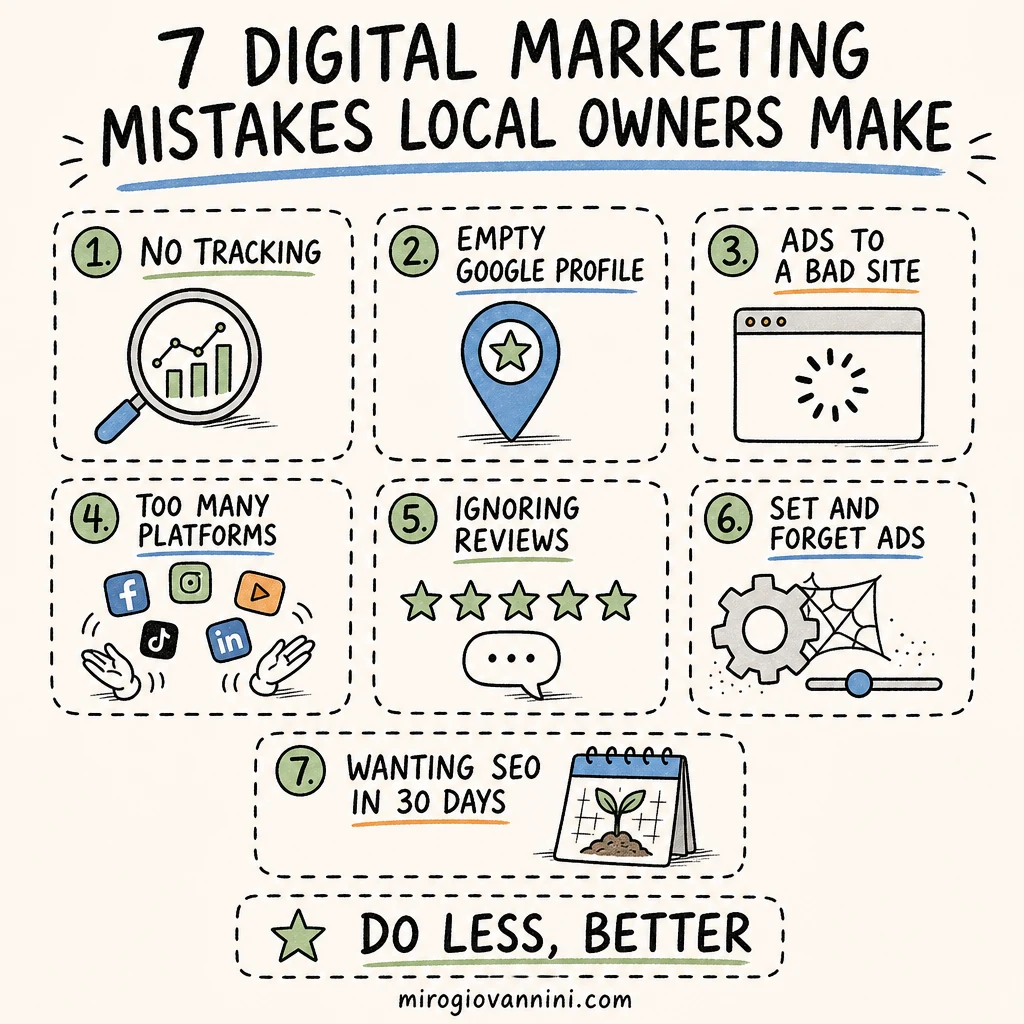
The seven digital marketing mistakes I see most often in local businesses are: not tracking results, neglecting the Google Business Profile, running ads to a weak website, spreading across too many platforms, ignoring reviews, setting up Google Ads and never touching them again, and expecting SEO to work in thirty days. Every one of them is fixable without a bigger budget.
After 15 years in digital marketing and working with businesses of all sizes, I see the same mistakes repeated by local business owners who are trying to do the right thing and still getting poor results. These are not obscure technical errors. They are common, costly, and, the good news, easy to fix once you know what to look for.
What Is the Most Expensive Digital Marketing Mistake a Local Business Can Make?
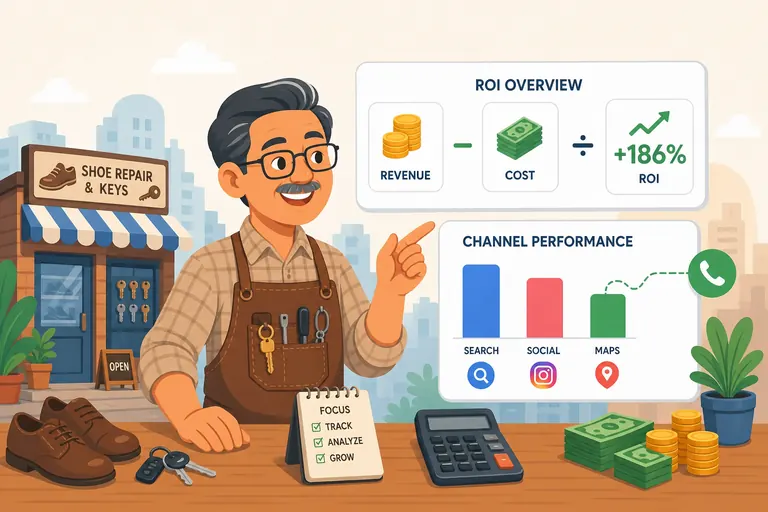
The most expensive mistake is running marketing with no tracking, because every decision after that is a guess. You are running Google Ads, posting on social media, maybe even doing some SEO work, but you cannot tell me how many leads you got last month, where they came from, or what each one cost.
When you cannot answer those three questions, you have no way of knowing which half of your budget to cut. You end up cutting the half that was working, because it was the one whose invoice arrived first.
How Do You Fix a Tracking Problem?
Install analytics on your website and define what counts as a conversion before you spend another dollar. Google's own conversion measurement documentation explains what the platform needs in order to optimize, and it is worth reading once even if someone else does the setup for you.
Then track phone calls, form submissions, and bookings as separate conversions, use call tracking numbers for offline attribution, and review the numbers monthly. You do not need to be a data scientist. You need to know what is working and what is not. My guide on how to know if your digital marketing is actually working walks through the specific numbers to look at.
Why Does an Incomplete Google Business Profile Cost You Customers?
An incomplete Google Business Profile costs you customers because it is the listing that appears in Maps and in the local pack, above the regular search results, in front of the people who are ready to buy right now. For many local businesses it generates more customer contacts than the website does.
Yet I regularly see profiles with no photos, incomplete hours, no reviews, and a description that says "We are a business." Google publishes its tips to improve your local ranking, and the short version is that relevance, distance, and prominence decide who shows up. Two of those three are things you control by filling the profile out properly.
What Does a Complete Profile Look Like?
Claim the profile, complete every field, upload at least 20 real photos, ask every satisfied customer for a review, and post business updates weekly. That is it. I wrote a full step-by-step in how to optimize your Google Business Profile, and for most local businesses this is the single highest-return hour of work available to them.
Should You Run Ads If Your Website Is Not Ready?
No. Running ads to a slow, confusing, or hard-to-contact website is paying for a billboard that points to a store with a locked front door. I have seen businesses spending $3,000 a month on Google Ads while sending that traffic to a site that takes eight seconds to load and looks broken on a phone.
Speed is not a nice-to-have here. Google's Web Vitals guidance sets the practical bar for how fast a page needs to feel before visitors start abandoning it, and paid traffic is the least forgiving traffic you will ever buy, because every one of those visitors cost you money.
Before investing in ads, invest in the page they land on. It does not need to be expensive. It needs to be fast, mobile-friendly, clear about what you do, and easy to contact you from. If you are not sure whether yours qualifies, 5 signs your website is costing you customers is a quick diagnostic.
How Many Marketing Channels Should a Local Business Use?
Two. "I need to be on Facebook, Instagram, TikTok, LinkedIn, YouTube, Pinterest, X, and Nextdoor" is the fastest way to be mediocre in eight places at once. A dentist in Encino does not need a TikTok strategy. A plumber in Van Nuys does not need Pinterest.
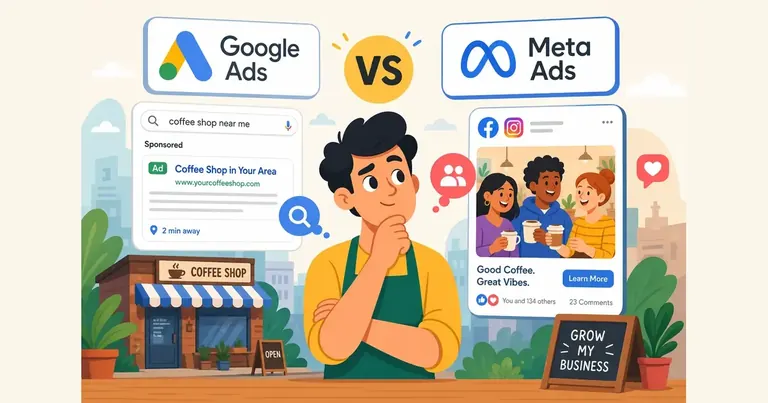
For most local businesses the two channels are Google, meaning ads plus SEO plus the Business Profile, and one social platform where your customers actually spend time. Do those two well before you add anything else. If you are weighing where to start, Google Ads or Meta Ads: which is better for local business covers the tradeoff in detail.
How Do You Know Which Two to Pick?
Pick the channel where people search for what you sell, and the channel where your customers already spend their attention. Emergency and high-intent services live on Google, because nobody browses Instagram for a burst pipe. Visual, discretionary, and impulse purchases do better on Meta. Almost every local business needs the first one. The second one is where you have a real choice.
Why Do Reviews Matter More Than Your Website Design?
Reviews matter more because they are the closest thing to word of mouth that a stranger can see, and they feed directly into local rankings. A business with 50 reviews averaging 4.7 stars will almost always outrank a competitor with 5 reviews, no matter how polished the competitor's website is.
Most owners either never ask, or only engage when something goes wrong. Both are fixable this week.
What Does a Review System Look Like?
Ask every happy customer, send a follow-up text or email with a direct link, respond to every review inside 48 hours, and aim for two to three new reviews a month at a minimum. Consistency beats bursts: ten reviews spread over five months looks healthier to both Google and a human reader than ten reviews that all arrived on a Tuesday.
One caution worth knowing: if you offer anything in exchange for a review, you are in territory the FTC regulates. Their guidance on endorsements, influencers, and reviews is the reference to read before you build any incentive into your process. The safest system asks for honesty, not for five stars. My guide on how to get more Google reviews covers the wording that works.
Can You Set Up Google Ads and Leave Them Alone?
No, and the accounts that waste the most money are the ones that were set up once and never opened again. Without regular maintenance your ads start showing for irrelevant searches, competitors outbid you, ad copy goes stale, and the budget drains with steadily worse returns.
What Is the Minimum Maintenance a Campaign Needs?
Check the search terms report weekly and add negatives for the searches that have nothing to do with your business. Review performance monthly and adjust bids, budgets, and copy based on what the data actually says. That is the floor, not the ceiling. If you do not have time for it, that is a legitimate reason to hire someone, and it is a much better reason than "I do not understand it."
The other side of this coin is over-adjusting. Changing bids, budgets, and targets every few days keeps the campaign in a permanent learning state and makes everything more expensive, which is the same mechanism I describe in should you pause your Google Ads during a slow season. Weekly attention, monthly decisions.
How Long Does SEO Take to Work for a Local Business?
Three to six months for meaningful movement, and around twelve months to compound. I talk to owners who hired an SEO company, saw nothing after 30 days, and concluded that SEO does not work. What actually happened is that they judged a marathon by the first two hundred meters.
Google's own SEO Starter Guide is blunt about this: the changes you make take time to be crawled, evaluated, and reflected in rankings. There is no version of this where results arrive next week.
What Should Happen in the First Six Months?
Months one to three go to technical fixes, content, and the Business Profile. Months three to six should show improvement in rankings and traffic. By months six to twelve you should be getting consistent organic leads. If you have seen no progress after six months of consistent work, something is wrong with the strategy and it is worth a second opinion. Giving up after 30 days, though, is not a verdict on SEO. It is a verdict on the plan.
What Do All Seven Mistakes Have in Common?
All seven come from the same place: doing things without a plan that connects them. Either nothing is being tracked, or effort is being spread so thin that nothing gets enough attention to work.
The fix is not to do more. It is to do less, better. A fast website, a complete Google Business Profile, targeted advertising you actually maintain, conversion tracking you trust, and a steady stream of reviews. Master those five and you will outperform the large majority of your local competitors, most of whom are making at least three of these mistakes right now.
What Should You Fix First?
Fix them in this order, because each one makes the next one work better. Week one: the Google Business Profile, since it is free and it moves the fastest. Week two: conversion tracking, so that everything you do afterward can be measured. Week three: the website, specifically load speed and how obvious it is to contact you. Week four: the ads, which now have a decent page to send traffic to and tracking that will tell you whether it worked.
Reviews and SEO run underneath all of it, continuously, forever. They are not projects with an end date. Two reviews a month and one useful page of content a month will do more over a year than any campaign you launch and forget.
If you only have one hour this month, spend it on the Business Profile. If you have one hour a week, spend it on the search terms report and asking two customers for a review. That is a real marketing program, and it costs nothing but the hour.
Want a fresh set of eyes on your marketing? Book a free 30-minute strategy call. I will review what you are doing now and tell you exactly what to fix first, with no pitch and no pressure.
Ready to bring in more customers?
Get a free 30-minute marketing review. We'll look at what you have today and identify the one or two changes that could make the biggest difference.