

Should You Pause Your Google Ads During a Slow Season?
July 28, 2026 · By Miro Giovannini
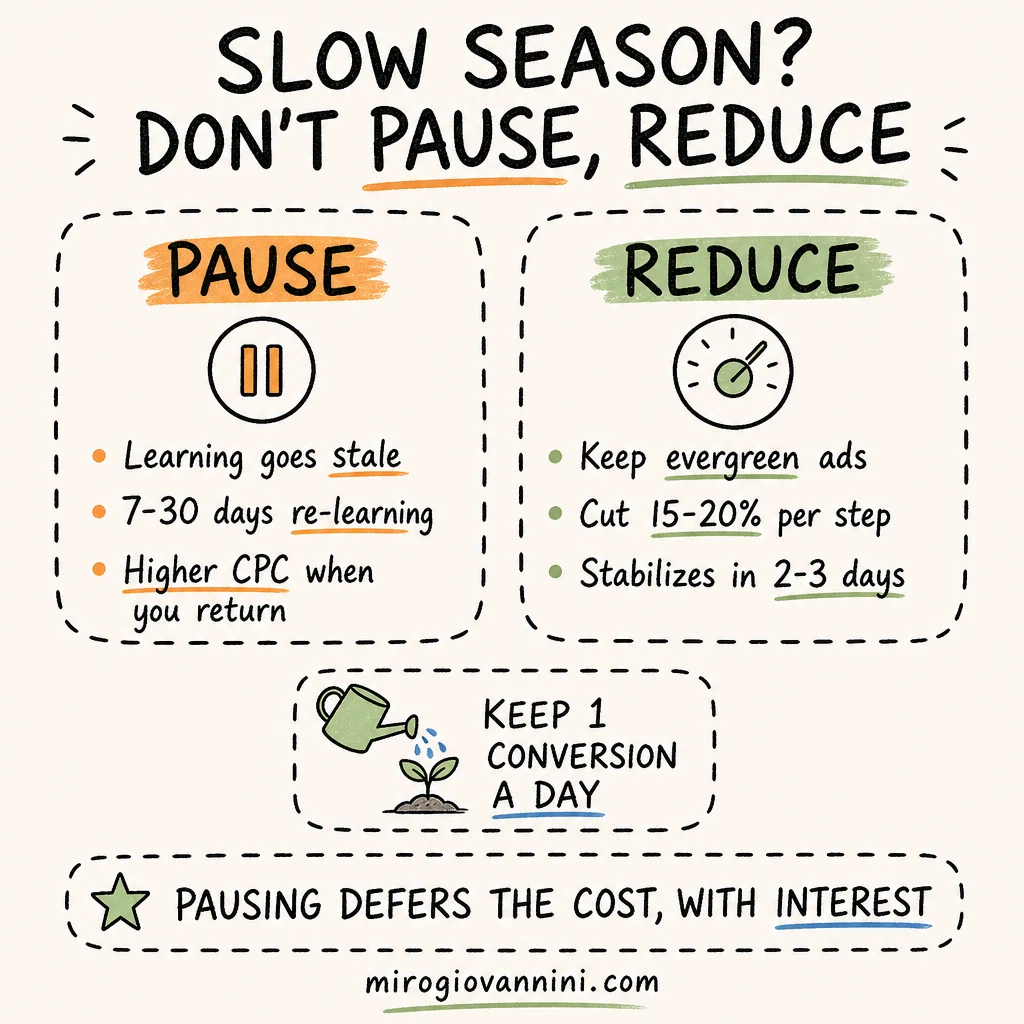
In almost every case, no, you should not pause your Google Ads during a slow season. You should reduce them. Pausing does not eliminate the cost, it defers it: when you switch the campaign back on, it re-enters a learning phase and you pay more per click and per lead for weeks while the algorithm recalibrates.
Every summer I get the same question from business owners. Things are slow, should I just turn my Google Ads off for a couple of months? I understand exactly where it comes from. As a business owner myself, I know you have a duty to maximize every dollar you invest. If something is not generating a return, it is not an investment. That logic is sound. But the question hides a more important one underneath it, and almost nobody asks it out loud.
What Are You Really Asking When You Ask About Pausing?
You are asking about your time horizon. How soon do I want to see a return? How long am I willing to wait? What happens if I do wait, and what is the cost of not waiting?
Those questions force you to examine your own beliefs about marketing, and every owner should sit with them for a minute. A local business does not have the financial backing of a corporation, so the time horizon is naturally shorter. That is fair. But we have to keep the purpose of marketing in perspective. Marketing is not there to keep the business afloat. It is there to help the business grow.
To get where others have not gotten, you have to be willing to invest what others have not invested. If survival were the correct formula for success, every business would be successful, and we know that is not the case.
For me the real measure of a business is not how long it has been alive. It is year-over-year growth. Survival is a given if the doors are still open. Growth is not. And growth, the way I understand it, is the ability to reach more people without raising your costs in the same proportion. Online advertising works the same way. Marketing is not an expense. It is an investment, and like any investment it produces a return over time.
Why Does Pausing Google Ads Cost You Money Later?
Because Smart Bidding runs on recent history, and pausing throws that history away. Google's Smart Bidding documentation describes bidding that uses machine learning to optimize for conversions at auction time, which means it depends on a continuous stream of recent signals about who converts and when.
When you pause a campaign for more than four or five days, and especially if the pause stretches past thirty, that history goes stale against your competition and against how users are actually behaving right now. When you switch it back on, the campaign enters a re-learning phase. Google's documentation on Target CPA bidding is explicit about this: after a significant change the strategy needs a learning window to gather data again, and performance during that window should not be judged as representative.
That phase usually runs somewhere between seven and thirty days, and while it runs you get volatility, a higher CPC, and an inflated cost per lead. So the money you saved during the slow months comes back as more expensive clicks and more expensive leads exactly when you need performance most.
Is This Only a Small Business Problem?
No. I have worked with a lot of clients in real estate, and this is not a matter of budget size. Even large corporations with comfortable budgets turn campaigns on and off constantly. It usually happens because upper management does not fully understand the impact of the decision. They are making a reasonable-sounding call without seeing the mechanics underneath it.
The consequence is always the same: higher costs. If you switch on and off, on and off, you interrupt how much the algorithms can learn. Every time you turn it back on, you reset that learning and the platform has to run its internal experiments again to figure out who to show your ads to and when. Concretely, turning campaigns on and off makes every single one of your metrics more expensive.
What Should You Do Instead of Pausing?
Reduce, do not pause. There is a version of a slow season where spending less is the right call, and it looks nothing like switching everything off.
Which Campaigns Should You Keep Running?
Keep your evergreen campaigns, the ones targeting the searches that happen all year: your core service terms, your brand name, and your highest-intent keywords. Turn off the seasonal or promotional campaigns that were built for a period that has ended. A campaign built around a specific offer has a natural end date. Your "emergency plumber near me" campaign does not.
How Should You Tighten Targeting in a Slow Period?
Narrow to what converts. Cut the broad keywords first, tighten the geography to the areas that actually produce customers, and cut the audiences and placements with volume but no conversions. Pull the search terms report and add negatives aggressively. A slow season is the right moment to be ruthless about waste, because every dollar has to work harder.
How Much Can You Safely Cut the Budget?
Bring it down gradually, in steps no larger than fifteen to twenty percent per adjustment, until you reach the minimum that still sustains at least one conversion per day. That single daily conversion is the threshold that keeps the algorithm fed.
Do not make sudden cuts. The way you reduce matters as much as the decision to reduce. A campaign reduced gradually stabilizes in two or three days. A campaign that sat paused for weeks or months can take two to four weeks to recover its previous performance. If you want to understand how these dynamics affect what you actually pay, what Google Ads really cost for small businesses covers the same principle from the cost side.
To be transparent: Google does not publish an official percentage for how much your costs rise after a pause, because it varies by industry and by how long you were off. But the technical recommendation is not ambiguous. Reduce, do not pause.
When Is Pausing Actually the Right Call?
There are three situations where pausing is correct, and it is worth naming them so this does not read as dogma.
The first is when you cannot serve the customers. If you are booked out for two months or short-staffed to the point that new leads go unanswered, paying for leads you cannot handle is worse than pausing. Unreturned calls damage your reputation in ways that cost more than the ad budget.
The second is when the business genuinely closes. A seasonal operation that shuts its doors for three months is a different case from a business that is merely slower in August.
The third is when something is broken. A landing page that is down, tracking that is misconfigured, or a promotion that expired are all reasons to stop spending immediately and fix the problem. Spending into a broken funnel is the one thing worse than not spending at all, which is the situation I describe in why your Google Ads are getting clicks but not customers.
Outside of those three, reduce.
What Should You Do With the Slow Months?
Use them on the work you never have time for when you are busy. Rewrite the ad copy that has been running untouched for a year. Fix the landing page. Fill out the Google Business Profile properly. Ask for the reviews you have been meaning to ask for. Build the content that will rank six months from now.
Slow seasons are when your competitors go quiet. That makes auctions cheaper and attention easier to earn. If you are already in motion when demand comes back, you are ahead of everyone who spent the off-season switched off.
How Do You Restart After a Long Pause?
If a campaign has already been off for months, restart it deliberately rather than flipping it on at the old budget. Start at roughly half of the daily budget you intend to end at, hold it steady for one to two weeks without touching targets, and let the campaign gather conversions again. Then step the budget up in increments of no more than twenty percent every few days.
Expect the first two weeks to look bad. That is the re-learning phase doing its work, not a verdict on the campaign, and the worst thing you can do is react to it by changing targets, which restarts the clock. Judge the account at week four, not on day three.
Also check what changed while you were away. Competitors may have entered your auctions, your landing page may have drifted, and your tracking may have quietly broken during a site update. Restarting a campaign into a funnel you have not verified is how a bad first month becomes a permanent conclusion.
What Are the Two Mistakes I See Most Often?
Both are about expectations rather than tactics.
The first is believing that switching ads on during a slow season will suddenly fix everything that was not worked on during the rest of the year. Google Ads is an important part of your digital ecosystem, but it is not the entire ecosystem. Campaigns need attribution and support from your other channels, online and offline. Ads cannot carry a business on their own, which is part of why choosing where to spend between ads and SEO matters so much.
The second is turning campaigns on, not seeing immediate results, and turning them off again. I see this constantly. Owners blame the tool, when what actually happened is that they lost perspective on the time horizon. The platform was never given enough runway to do its job.
So, Should You Pause?
In almost every case, no. Reduce instead.
Cut back to your evergreen ads, tighten your keywords and segments, and lower your daily budget in gradual steps to the minimum that still produces about one conversion a day. Protect the algorithm's learning at all costs, because that learning is the asset you have been paying to build. Pausing does not pause your costs. It defers them, with interest.
If you are heading into a slow stretch and you are not sure where your floor should be, or if your campaigns have been switched on and off enough times that the numbers stopped making sense, that is a solvable problem. Book a call and we can look at your account together.
Slow seasons are not the time to disappear. They are the time to get more precise about where your money goes, so that when demand comes back you are already in motion instead of starting over.
Ready to bring in more customers?
Get a free 30-minute marketing review. We'll look at what you have today and identify the one or two changes that could make the biggest difference.