
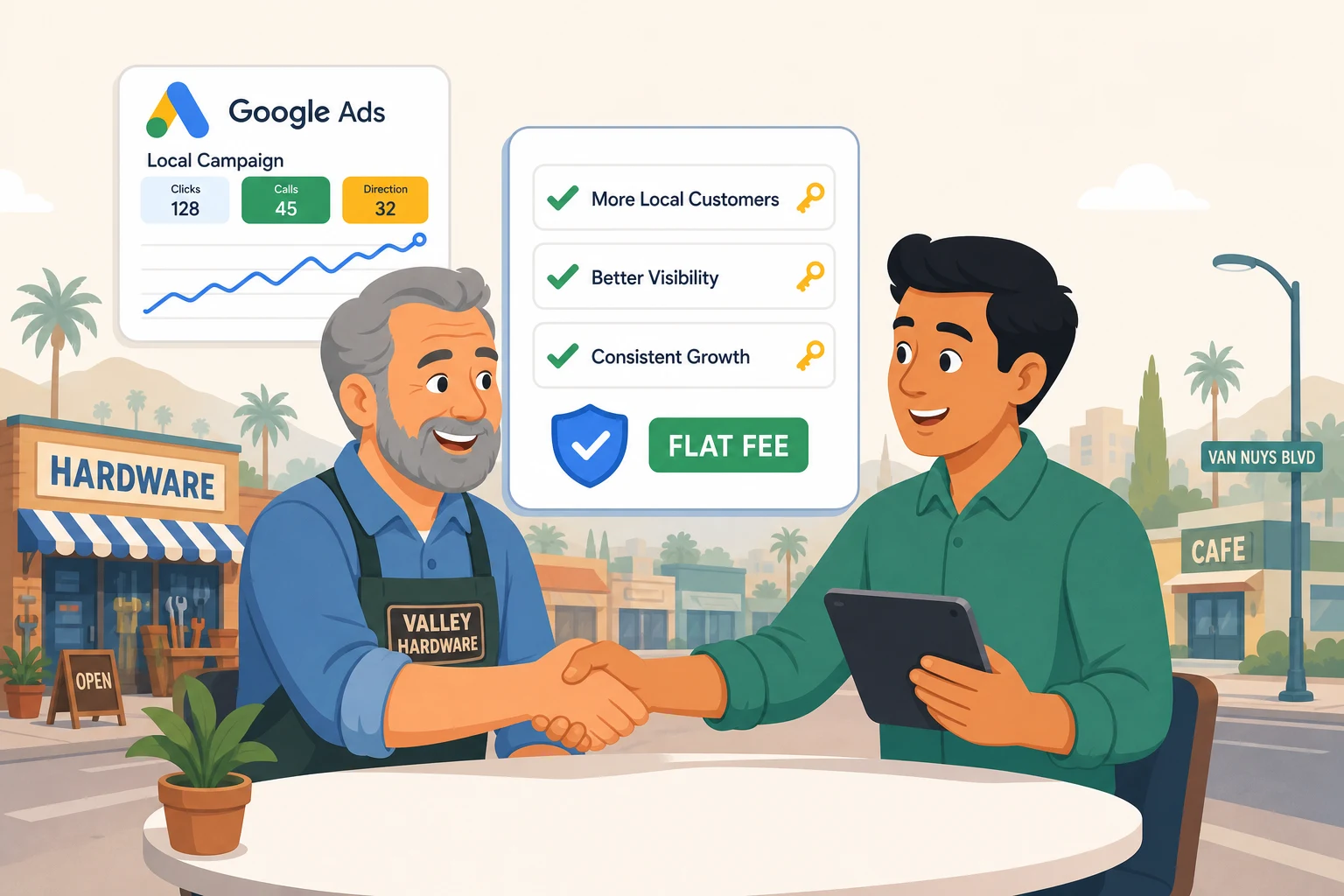
How to Choose a Google Ads Manager in the San Fernando Valley
August 29, 2026 · By Miro Giovannini
Choosing a Google Ads manager in the San Fernando Valley comes down to one thing: can this person explain how your ad spend turns into revenue, and will they prove it every month with numbers you understand. Everything else — certifications, dashboards, jargon — is secondary.
I work with local businesses across Burbank, Glendale, North Hollywood and the rest of the Valley, and the single most common thing I hear from an owner who just left another provider is not "the campaign failed." It is something quieter and worse: they have no idea whether it worked. They tell me they think results improved, because the shop felt busier. When I ask them to send me last month's digital KPI report, they go blank and tell me they do not know what that is.
That is the real problem this guide solves.
What Does a Google Ads Manager Actually Do for a Local Business?
A Google Ads manager plans the keyword and bidding strategy, writes and tests the ads, controls where and when they appear, connects conversion tracking so every lead is measured, and reports monthly on what the money produced. The job is roughly one part campaign operation and two parts strategy and measurement.
What a Google Ads Manager Is Responsible For Each Month
The operational side is the visible part: adding negative keywords, adjusting budgets and bids, testing ad copy, checking search terms, pausing what loses money. It matters, but it is also the easiest part to hire. Plenty of competent people can do it.
The valuable part is deciding what to bid on and why, what a lead is worth to your business, and what to change when the plan does not work.
What a Google Ads Manager Cannot Control
No manager controls whether your phone gets answered, how fast you call a lead back, your prices, or your reviews. A good one says this out loud in the first conversation and asks about your intake process before touching a campaign. If nobody asks how you handle incoming calls, you are talking to an operator, not a strategist.
Why Can't Most Local Businesses Tell If Their Google Ads Are Working?
Most local businesses cannot tell if their Google Ads are working because nobody set up conversion tracking and nobody defined what success was supposed to look like before the money started moving. Without that, "results" become a feeling.
Why "I Think It's Working" Is Not a Result
Feeling busier is not evidence. Restaurants get busy in August. Home services get calls after a heat wave. If your only proof is an impression of foot traffic, you cannot separate a campaign that earned its keep from a season that would have happened anyway. That uncertainty is what keeps owners paying for years without knowing what they bought.
What a Monthly Google Ads Report Should Contain
At minimum, it should walk down the funnel in plain language: how many people saw your business online (reach), how often on average (impressions and frequency), how many showed interest (click-through rate and link clicks), and how many converted — a purchase, a lead, a booked appointment, a visit to your location. Then it should close with money: what you invested and what you got back.
How Should a Google Ads Manager Set Your Goals and KPIs?
A Google Ads manager should set KPIs in a chain that starts with your business, not with the ad platform. First, analyze the commercial objectives of the business, short term and long term. Second, define online marketing goals that answer those commercial objectives. Third, build the KPI list from those marketing goals.
How Many KPIs Should a Small Business Track?
Up to three primary KPIs and up to three secondary ones. That is the ceiling I use. A report with twenty metrics is not more rigorous, it is less decided. If everything is a KPI, nothing is, and the owner ends up staring at a dashboard he cannot act on.
Every KPI has to trace back to a marketing goal, and every marketing goal to something the business actually needs, like filling weekday lunch tables or booking replacement jobs instead of cheap repairs.
ROMI vs ROAS: Which Number Tells You If You're Profitable?
Both, and they answer different questions. ROAS measures the profitability of the ad spend specifically. ROMI measures how profitable the entire marketing investment is for the business, including the management fee and everything else you spend to market. A campaign can post a strong ROAS and still be a mediocre investment once the full cost of marketing is counted. Ask any candidate to explain the difference. Many cannot.
Google makes the same point in its own advertiser guidance: it tells business owners to understand the total cost of their advertising, including any fees a third party charges, and to use that total to judge return on investment. Google's advertiser guide to working with third parties is worth ten minutes of your time before you sign anything.
Does Hiring a Local Google Ads Manager in Burbank, Glendale or North Hollywood Matter?
Yes, and more than most people assume — but not for the reason agencies usually claim. It is not about "understanding the community." It is about access to information you cannot get from a screen.
What a Local Google Ads Manager Can Do That a Remote Agency Can't
Being nearby means you can visit the business constantly, talk face to face with its customers, and form hypotheses through participant observation. You learn the area, the surrounding offer, and how the customer segment in that specific pocket of the Valley is actually composed. North Hollywood at 7pm is not Calabasas at 7pm.
You can research the competition on the block from Google Maps. But walking into the restaurant, talking to the server, placing an order and having it delivered, or running the pickup flow yourself — that only happens in person. Those details change the ad copy, the offer, and the hours you bid on.
When Hiring a Local Google Ads Manager Does Not Matter
There is a part of the research where distance makes no difference, and it is worth separating it from the part where it does.
Desk research is location-independent: pulling the competitor set from Maps, reading their reviews, checking which of them are bidding on the same terms, sizing search volume, comparing prices and hours as they are published online. All of that comes from data anyone can reach from anywhere, and a remote specialist will do it just as well.
Field research is not. How the room feels at 7pm, what the server says when you ask a question, whether the pickup flow works, what the business on the next block is pulling customers away with — none of that lives in a dataset. It only exists in person.
So: distance costs you nothing on the analytical layer and costs you the experiential layer entirely. If a business is fully e-commerce with no physical location, that experiential layer barely matters, and you should judge providers on strategy alone.
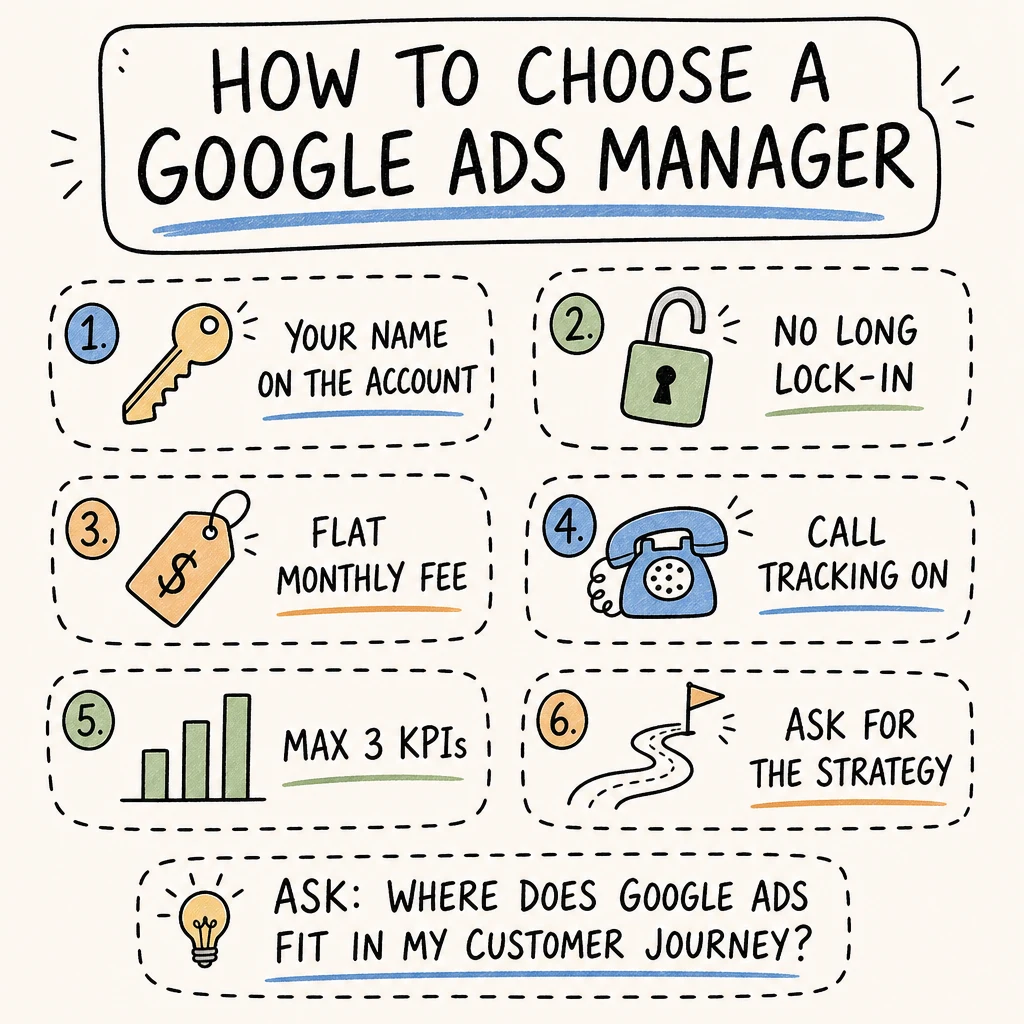
What Questions Should You Ask Before Hiring a Google Ads Manager?
Ask strategic questions, not operational ones. Operational competence is relatively easy to find. Strategic thinking is not, because it requires a different kind of vision and a different level of maturity.
Strategic Questions That Reveal a Real Google Ads Strategist
Ask these, and listen for the reasoning behind the answer rather than the answer itself:
- What is the strategy? Not the task list — the actual thesis about how we win.
- Where does Google Ads fit in my customer's journey? At what moment does it intervene, and what is it supposed to do at that moment?
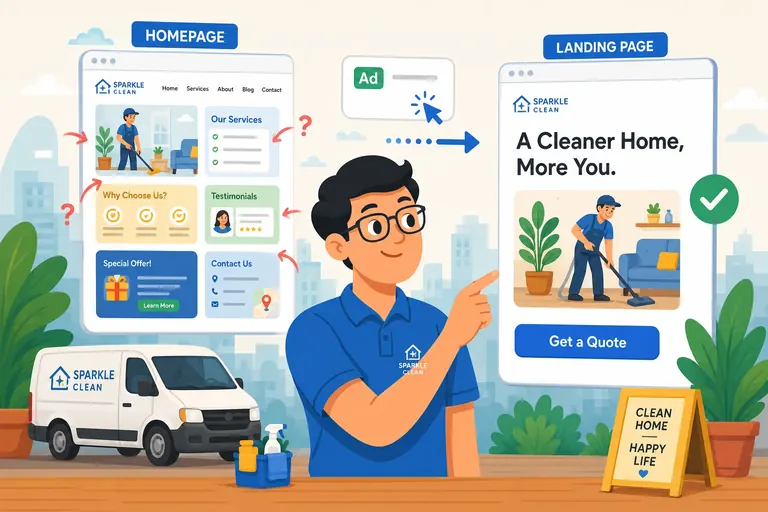
- How does Google Ads contribute to my sales funnel? What happens before the click, and what has to happen after it for this to turn into revenue?
- What is the plan for the next six months?
- If we prove the initial hypothesis wrong, how does the plan change?
Those last two are the filter. An operator has no answer to either, because an operator never had a hypothesis in the first place — there was only a set of tasks. A strategist will tell you what they would test next and what evidence would make them abandon the current approach.
Why the Customer Journey Question Matters Most
Because Google Ads is not a standalone machine that produces customers. It intervenes at one moment — usually when someone already has intent and is choosing between options — then hands the person off to your landing page, your phone line, your front desk.
A candidate who can map that handoff will also spot where your funnel leaks, and will sometimes tell you the ads are not your first problem. That answer is worth more than a campaign.
Certifications are a floor, not a differentiator. Google's Partner program requirements are based on certifications, ad spend and optimization score thresholds — worth confirming, not worth deciding on.
What Are the Red Flags When Hiring a Google Ads Manager?
The clearest red flag is anyone whose business model depends on locking you in rather than earning the renewal. Beyond that, watch for these:
- They cannot explain what a lead is worth to your business.
- They talk about impressions and clicks and never about revenue.
- They promise a specific position or a guaranteed number of leads before seeing your data.
- They will not put the ad account in your name.
- They want your business in a shared account with other advertisers. Google requires a separate account for each end-advertiser, partly because account history drives Quality Score, so pooling advertisers can distort results and restrict delivery.
- They avoid setting up call tracking. For most local businesses the phone is the conversion, and Google offers phone call conversion tracking precisely so those calls are counted.
Google's third-party policy states the standard plainly: third parties must be honest and transparent about their company, services, associated costs and expected results. If getting a straight answer about fees feels like work, you already have your answer.
Who Should Own Your Google Ads Account?
You should. The Google Ads account must be in the client's name, because the client is the one paying for the media. The data generated belongs to the client too, without being forced to stay tied to one specific agency or provider to keep it.
What Google Says About Manager Account Ownership
This is not just an opinion, and the mechanics are documented. A client account can have only one owner. If a manager account creates a new account, that manager automatically becomes the owner. If a manager links an account that already exists, it does not get ownership by default.
Critically, Google states that owner privileges "do not take data ownership or administrative rights away from client accounts" — the client account still owns its data and can remove ownership access by unlinking. You can read the mechanics in Google's documentation on ownership of client accounts.
The practical rule: let an agency manage your account through their manager account, but keep the account itself, and keep an admin user that belongs to you.
Why Account Ownership Gives You Negotiating Power
When you own the platform, you have leverage and flexibility — in choosing providers, and in deciding whether to continue with one at all. If you are good enough at your service as a provider, you should not try to tie the client down. That is the philosophy of someone who does not trust what they are offering.
Should You Sign a Long-Term Google Ads Management Contract?
No long lock-in. Under the same logic as account ownership, the client should be free to leave whenever they want, without a lengthy minimum term. That way the agency has to demonstrate value constantly and hold a high standard.
I have seen agencies take a client for granted and let the service slide, and the consequence is that the client loses money. My philosophy is simple: if you genuinely want to help your clients, you will do everything in your power to make sure they benefit from your work, and as a result they will choose you every month. A healthy relationship should be a choice, not an imposition.
How Much Does Google Ads Management Cost for a Local Business?
There are several models, and the right one depends on the size of the account.
Flat Fee vs Percentage of Ad Spend
Some agencies charge a share of the sales generated and take no fee, only the media. Others set the fee as a percentage of monthly ad spend — this is common in corporate accounts, where large media budgets justify that structure, and the percentage typically ranges from around 5% to 25% depending on the amount invested. And then there is the flat monthly fee, with no additional commissions or variable amounts.
Why a Flat Monthly Fee Fits Local Businesses Best
For a local business, the flat fee is the model that fits. It lets the owner predict monthly spend and keep tighter control of cash flow. A local business is very sensitive to those swings, which is exactly why predictability in cost matters so much.
A percentage-of-spend model also creates an awkward incentive: the manager's income rises when your budget rises, whether or not the increase was the right call.
How to Choose a Google Ads Manager: The Short Checklist
Before you sign, confirm all of it:
- The Google Ads account is in your name, and you hold admin access.
- You keep the account and the historical data if the relationship ends.
- No long minimum term.
- A flat monthly fee you can predict.
- Conversion tracking configured before launch, including calls.
- A defined chain from business objectives to marketing goals to a maximum of three primary KPIs.
- A monthly report that ends in ROAS and ROMI, not in impressions.
- Answers to the strategic questions that show reasoning, not vocabulary.
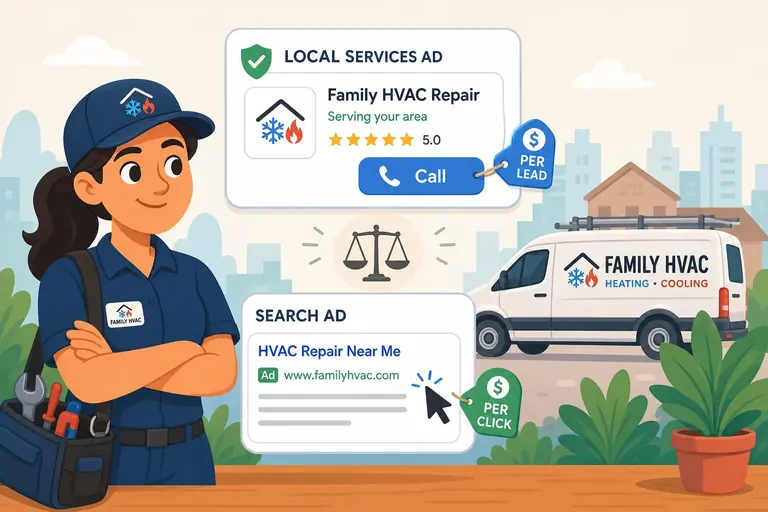
If you are still deciding whether you need help at all, this piece on when it's time to hire a marketing expert covers that decision first. If you already run ads and the leads are not converting, start instead with why Google Ads get clicks but not customers. And if you run a home service business weighing your options, compare the numbers in what Google Local Services Ads actually cost.
I'm Miro Giovannini, a digital marketing consultant based in the San Fernando Valley, and I manage Google Ads for local businesses here — which is why I can walk into a client's location on a Tuesday afternoon and leave with three things I could not have learned from a dashboard. If you want a straight assessment of your current setup — who owns your account, what you are actually paying, and whether the numbers justify it — book a call and we will go through it together.
Ask any candidate the six-month question and the what-if-we-are-wrong question. The answers will tell you more than any certification badge on their website.
Ready to bring in more customers?
Get a free 30-minute marketing review. We'll look at what you have today and identify the one or two changes that could make the biggest difference.