
How to Make AI-Generated Creatives That Bring in Customers
AI creatives let a small business test more ad ideas without a new shoot each time. The trick is keeping only the versions that bring qualified leads or sales.
 Miro GiovanniniDigital Marketing ConsultantOctober 26, 2026 · 10 min read

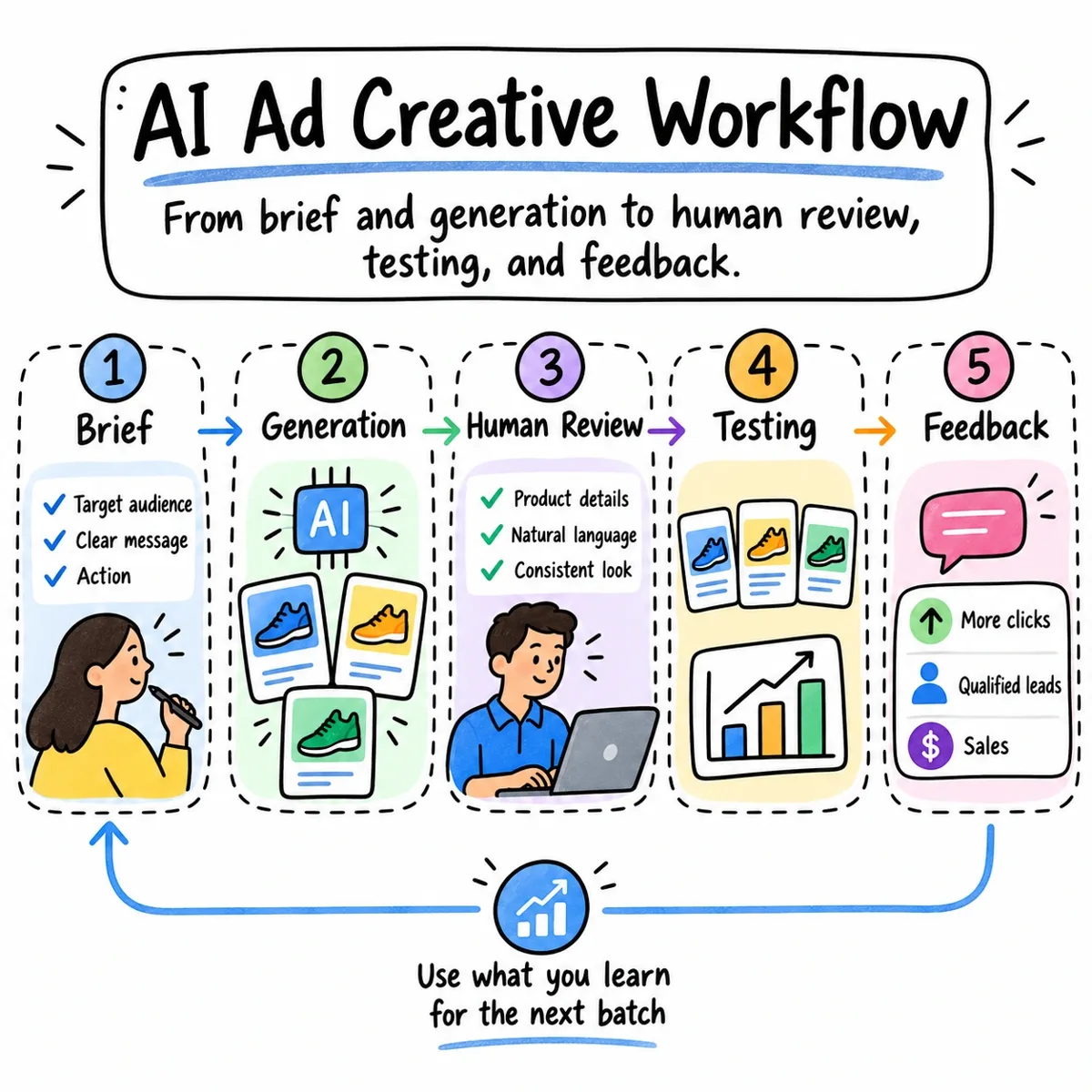
Start with the offer, not the AI tool. Pick one local audience, one clear message, and one action you want people to take. Then use AI to make a few versions of the ad: different images, headlines, or English and Spanish copy. Check every version for accurate product details, natural language, and a consistent look before you publish it.
AI-generated creatives can help a small business test more ideas without paying for a new shoot each time. But more ads do not always mean better ads. Watch which versions bring qualified leads or sales, then use what you learn to shape the next batch.
The Strategic Advantage of AI Generated Creatives in Modern Advertising
Digital advertising has reached an inflection point where production speed often dictates campaign success. In October 2026, roughly 83% of advertising executives report using artificial intelligence somewhere in their creative workflows, up from 60% just two years ago. Moreover, approximately 35% to 55% of Google Display, Performance Max, and Demand Gen image assets are now partially or fully AI-generated.
The core advantage lies in production economics. Traditional creative workflows create a severe bottleneck: you book a photographer, rent a studio, wait two weeks for retouching, and end up with three visual options. If none of those three connect with your target market, your media budget stalls.
By contrast, an AI-assisted batch workflow allows us to produce dozens of tailored ad variations in hours rather than weeks. This shift enables rapid concept testing across platforms while preserving capital for media distribution.
| Production Factor | Traditional Commercial Photoshoot | AI-Assisted Batch Creative Workflow |
|---|---|---|
| Turnaround Time | 5 to 10 business days | Same-day delivery (1 to 2 hours) |
| Asset Output | 10 to 50 finished stills | 50 to 150+ multi-format variations |
| Estimated Cost | $2,000 to $5,000+ per session | ~$170 total (API generation + labor) |
| Iteration Flexibility | Requires paid reshoots | Near-instant prompt and layer adjustments |
| Multi-Language Scale | Costly multi-talent casting | Automated visual and copy localization |
Production Speed and Cost Efficiency
The raw cost of generating marketing visuals has plummeted. API image generation costs dropped from approximately $0.16 per visual in 2023 to between $0.03 and $0.05 on modern foundational models like Flux. Cost efficiency is now the top cited benefit of AI adoption among advertisers at 64%, overtaking pure novelty.
Video production has mirrored this trajectory. Nearly two in three digital video buyers (64%) utilize generative AI for video assets, with short-form engines like Veo3 and Sora 2 powering 18% to 30% of short 6-to-15 second Google Ads video placements.
When applied strategically, high-velocity creative testing yields dramatic efficiency. In a published benchmark, one agency produced over 150 video ad variations in two weeks for a client, cutting Cost Per Acquisition (CPA) by 45% (from $55 to $30) and increasing Return on Ad Spend (ROAS) by 73% while sidestepping $3,500 in upfront production fees.
Limitations, Creative Homogenization, and the 37-Point Perception Gap
Despite these efficiency gains, generative tools introduce distinct operational risks. The biggest trap is creative homogenization: when every competitor uses identical prompts, digital feeds drown in plastic-looking aesthetics and generic copy that audiences instantly tune out.
There is also a significant perception gap between marketers and consumers. Industry research shows that 82% of executives believe consumers feel positive about AI-generated advertising, but only 45% of consumers share that enthusiasm—a 37-point disconnect.
Acceptance also fragments across demographics. While 73% of Gen Z and Millennial buyers state that knowing an ad used AI does not hurt their purchase intent, older demographics often associate unedited synthetic imagery with deceptive marketing. If an ad looks artificial, consumer trust evaporates before the prospect ever reads your headline.
Step-by-Step Production: From Strategic Brief to Controlled Output
Treating generative software as an open-ended slot machine results in off-brand assets and wasted ad spend. High-performing campaigns rely on a disciplined, step-by-step production loop.
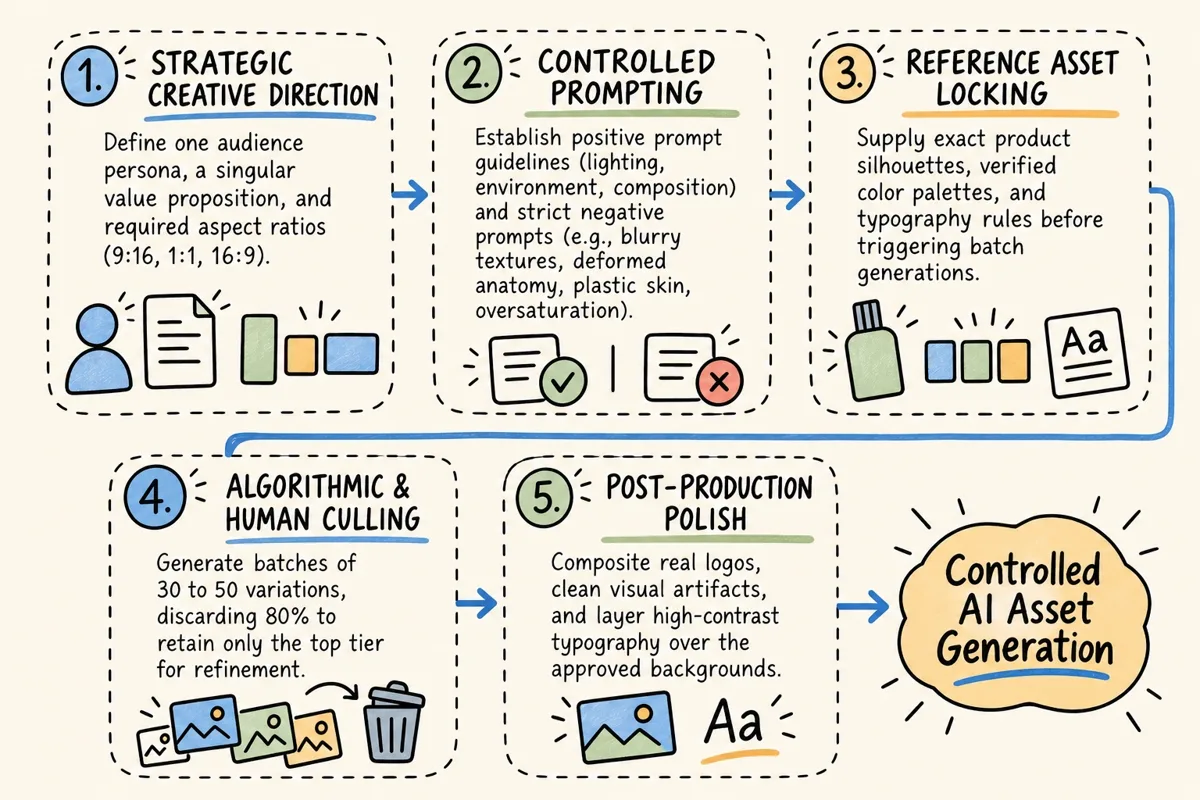
- Strategic Creative Direction: Define one audience persona, a singular value proposition, and required aspect ratios (9:16 for Reels/Stories, 1:1 for Feed, 16:9 for Desktop).
- Controlled Prompting: Establish positive prompt guidelines (lighting, environment, composition) and strict negative prompts (e.g., blurry textures, deformed anatomy, plastic skin, oversaturation).
- Reference Asset Locking: Supply exact product silhouettes, verified color palettes, and typography rules before triggering batch generations.
- Algorithmic & Human Culling: Generate batches of 30 to 50 variations, discarding 80% to retain only the top tier for refinement.
- Post-Production Polish: Composite real logos, clean visual artifacts, and layer high-contrast typography over the approved backgrounds.
Maintaining Brand Consistency in AI-Generated Creatives
Maintaining visual identity requires strict guardrails. Generative models struggle with exact vector rendering; left unchecked, they will distort your typography, alter your hex codes, and redraw your logo into an unrecognizable shape.
We prevent brand drift by separating background generation from brand identity layers. Generate the atmospheric environment or contextual background using generative tools, but keep your product packaging, typography, and brand marks as vector or high-resolution raster overlays. If you run a local business and want structured support executing these workflows, our AI creatives service provides custom visual production that keeps your marketing assets strictly aligned with your brand standards.
Inpainting and Background Generation Without Distorting Core Products
For physical e-commerce goods and local service showcases, you must never allow an AI tool to re-render the core item being sold. Doing so risks false advertising claims and high return rates.
Modern workflows solve this via inpainting and saliency masking. Academic breakthroughs in diffusion model pipelines for CTR optimization demonstrate that isolating product pixels with a protection mask while regenerating contextual backgrounds yields higher engagement without altering the product's physical reality.
For instance, an e-commerce brand can place a real product cutout onto an AI-generated marble countertop, seasonal autumn setting, or modern office desk in seconds, preserving product authenticity while gaining infinite staging flexibility.
Scaling Campaign Iteration and Performance Optimization
High-volume production is only valuable when tied to systematic testing. Creating 100 ads that say the same thing in slightly different shades of blue does not help your bottom line. True scaling means testing distinct angles: problem-aware hooks, social proof angles, localized scenery, and direct promotional offers.
Scaling Performance Testing with AI-Generated Creatives

When testing ad variations, isolate your variables so you know why an ad performed well. Test three distinct visual backgrounds against the same winning headline, or test three opening video hooks against the same core product demonstration.
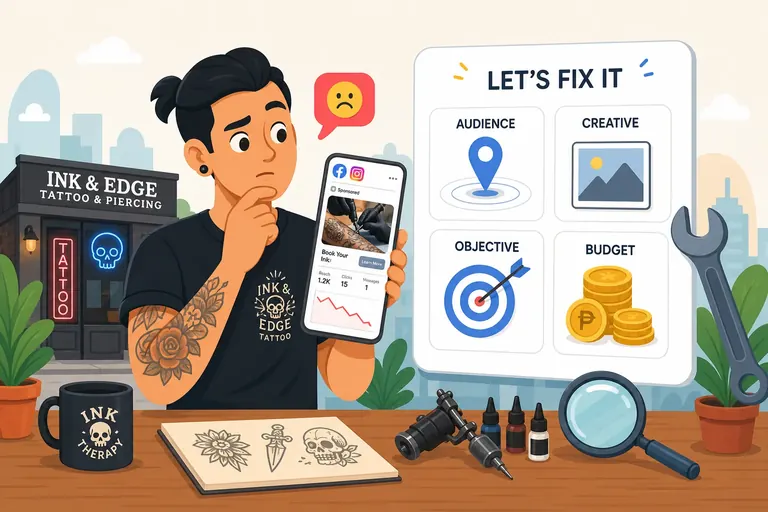
If your paid campaigns stall despite fresh visual assets, look beyond the imagery. Reviewing our systematic approach to diagnosing Facebook ad performance will help you pinpoint whether performance drops stem from audience saturation, weak offers, or creative fatigue.
Connecting Ad Assets to Conversion-Focused Landing Environments
A brilliant ad visual cannot rescue a disjointed post-click experience. If an ad features a clean, bilingual promotional offer or a specific visual style, the destination page must mirror that messaging instantly.
Directing paid traffic to a generic homepage dilutes ad relevance and depresses conversion rates. Aligning your creative hooks with a dedicated campaign landing page architecture ensures seamless message continuity from the initial click to the final conversion action.
When tracking campaign efficacy, focus on metrics that measure business growth rather than surface-level vanity signals:
- Thumb-Stop Rate (3-Second Video View Rate): Measures whether your visual hook grabs immediate audience attention.
- Outbound Click-Through Rate (CTR): Evaluates how effectively your ad message drives genuine interest.
- Cost Per Acquisition (CPA): Tracks the true media cost to acquire a paying customer or qualified lead.
- Conversion Rate (CVR): Measures landing page alignment with your upstream ad promises.
- Return on Ad Spend (ROAS): The ultimate measure of revenue generated per dollar spent on ad inventory.
Compliance, Risk Management, and Quality Assurance
As generative media expands across digital networks, regulatory bodies and ad platforms have established strict advertising policies. Automated production requires rigorous human quality control to maintain compliance and protect brand equity.
Human-in-the-Loop Quality Control and Disclosure Standards
Every synthetic or AI-assisted creative must pass through human review before launch. Major platforms like Google, Meta, and TikTok now integrate metadata tracking and automated C2PA content provenance labels.

Your human quality review must verify three critical compliance pillars:
- Factual Integrity: Ensure all promotional claims, pricing, and warranties are legally accurate and clearly stated.
- Platform Disclosure Policies: Check whether your format mandates synthetic media labeling (especially in health, finance, housing, or political categories).
- Intellectual Property Safety: Confirm that prompt structures do not inadvertently replicate copyrighted artistic styles, trademarked brand marks, or celebrity likenesses without explicit authorization.
Avoiding Common Pitfalls and Wasted Media Spend
The most common way businesses waste budget with generative tools is by uploading unvetted bulk exports directly into ad managers. Watch out for these frequent mistakes:
- Anatomical and Physical Distortions: Unchecked generations frequently contain distorted hands, unnatural eye reflections, or impossible physics that instantly signal low quality to prospective buyers.
- Hallucinated Text: Generative image tools often attempt to render background signs, producing nonsensical gibberish that distracts viewers from your core call-to-action.
- Prompt Drift Across Iterations: Changing a single word in a prompt can alter your lighting style and color temperature entirely, breaking visual cohesion across your campaign assets.
The Future of Generative Advertising and Strategic Creative Direction
Artificial intelligence has made asset generation inexpensive, but it has made strategic taste and human judgment more valuable than ever. When any business can generate 50 product images in an hour, competitive advantage shifts away from who owns the fastest generation tool.
Winning brands distinguish themselves through authentic storytelling, deep local customer understanding, and disciplined performance testing. Use AI to handle time-consuming asset resizing, background variations, and translation drafting. Reserve your human focus for creative direction: identifying acute customer pain points, crafting irresistible offers, and building long-term brand affinity.
Frequently Asked Questions About AI in Advertising
How does AI-generated creative production differ from ad personalization?
AI-generated creative production refers to the upstream creation of raw marketing assets (images, video clips, and copy variations) prior to campaign launch. Ad personalization—often powered by Dynamic Creative Optimization (DCO)—is the downstream technology that selects and displays those modular assets in real time based on a specific user's browsing behavior, demographic profile, or geographic location.
Do platforms and regulators mandate disclosure labels for AI-generated ads?
Yes, disclosure mandates depend on your jurisdiction and ad placement. Platforms like Meta and Google automatically read C2PA provenance metadata and apply labels to synthetic visuals. Furthermore, regulatory frameworks in the European Union and specific regional US jurisdictions require clear disclosures when photorealistic imagery depicts events, people, or product demonstrations that did not occur in reality.
When should brands avoid using fully synthetic assets in marketing campaigns?
Brands should avoid fully synthetic visuals when presenting core product proof, genuine customer testimonials, or sensitive human-centric narratives. If you sell a physical item, your audience expects to see the actual product, not an idealized algorithmic estimation. In these instances, use generative AI strictly for moodboards, conceptual planning, or background staging while keeping the focal subject authentic.
Conclusion
Generative AI offers unprecedented leverage for digital advertising, compressing production timelines from weeks into hours and lowering testing barriers for businesses of all sizes. However, scalable growth requires pairing rapid asset creation with strict brand governance, seamless post-click landing pages, and rigorous performance tracking.
At Miro Giovannini Digital, we provide hands-on marketing leadership—combining custom ad management, conversion-focused web design, and local SEO services—to help businesses scale their customer acquisition predictably. If you are ready to modernize your campaign workflows and launch creatives that convert, reach out to us today to build your next breakthrough campaign.
Written by
Miro Giovannini
Digital marketing consultant in the San Fernando Valley. 15 years with big brands, now working directly with local businesses on Google Ads, Meta Ads, websites and local SEO.

You’ll talk to me, not a sales team.
Your competitors are buying your customers' clicks today.
Tell me about your business and I'll get back to you personally with what I'd do first. No call needed.
Ready to talk? Call (747) 900-3578, text me, or book a free 30-min call.
A plan before we start · Month to month · You own every account · Max 3 new clients a month
I reply personally. No sales team, no spam.