
Google Performance Max for Small Businesses: How It Works and Is It Worth It?
Is Performance Max worth it for your small business? Learn how I evaluate valuable conversions, pair PMax with Search, allocate budget, and prepare creative assets.
 Miro GiovanniniDigital Marketing ConsultantOctober 21, 2026 · 10 min read

Google Performance Max can be worth it for a small business if it brings in valuable leads or sales at a cost the business can sustain. To evaluate that, you need reliable tracking, useful creative assets, and a budget that gives the campaign a fair opportunity to perform.
When there is no previous campaign data, I recommend starting with Google Search, introducing Performance Max afterward, and maintaining both when the results support it. My initial approach is a 50/50 budget split, with the option to move toward 70% PMax and 30% Search based on conversion volume, cost, and quality.
Here's how the campaign works and how I would approach that decision.
What is Google Performance Max?
Performance Max, usually shortened to PMax, is a goal-based Google Ads campaign type. You supply conversion goals, a budget, creative materials, and other inputs. Google's AI uses them to optimize bidding and ad delivery.
Google's Performance Max overview describes it as a complement to keyword-based Search campaigns. For a small business, that means another way to reach potential customers while continuing to use Search for relevant queries.
Where can Performance Max ads appear?
PMax can reach people across Search, YouTube, Display, Discover, Gmail, and Maps. Retailers can also use a Merchant Center product feed for Shopping ads, as Google's format requirements explain.
The campaign distributes activity across those channels according to predicted opportunities, goals, budget, and eligibility. Google's channel performance report helps you examine that distribution and the results it produces. Access to a channel doesn't guarantee that your campaign will spend there.
Performance Max vs. Google Search
A keyword-based Search campaign lets you organize advertising around searches related to your services. PMax works across several channels using the goals, assets, and signals you provide. Search can also use automated bidding; the distinction is broader than manual advertising versus AI.
Consider a hypothetical HVAC business in Encino. Search could reach someone looking for AC installation. PMax could also present its offer through video and image placements, giving the business additional ways to communicate the same service.
Search gives you a focused place to examine the relationship between a query and your message. My guide to Google Ads impressions without clicks explores that specific task.
Why I recommend starting with Search
When there is no previous data, I prefer Search because it connects the offer to identifiable customer searches. Before expanding, I want to understand which services attract inquiries and whether tracking records the actions that matter.
Google explains that Smart Bidding can use data across campaigns, including for a new campaign with no history of its own. Starting with Search is my strategic preference, rather than a Google requirement.
The practical benefit is a clearer foundation: an offer, a conversion setup, and some evidence about customer response. Those help you make more informed decisions when introducing PMax.
Choosing conversions that matter to your business
For a service business, a completed quote request represents more progress toward a sale than a visit to the contact page. That is why I prioritize completed forms and other commercially valuable actions.
The distinction matters at each step. Clicking a purchase button indicates intent; a completed order confirms a purchase. Clicking “submit” on a form only becomes a useful conversion when the submission succeeds.
Google's lead generation recommendations encourage optimizing toward valuable actions further along the sales process when possible. For our HVAC example, a completed installation inquiry would be a meaningful starting point. Whether that inquiry comes from a suitable potential customer is the next question.
Primary and secondary conversion actions
Google uses primary conversion actions for bidding when their standard goal is selected for the campaign. Secondary actions generally support observation, although actions included in a custom goal can still be used for bidding.
Review which actions the campaign is optimizing toward. Tracking several steps is useful; treating every step as a separate business opportunity can distort your assessment.
Where your tracking supports it, feed qualified-lead or sales outcomes back into Google Ads. Google's high-quality lead guidance recommends choosing a relevant stage for bidding and connecting measurement with the path to a sale.
Keep form submissions, qualified leads, and customers distinguishable in reporting. My guide to knowing whether your digital marketing is working explains that broader connection.
Audience signals and their limitations
Audience signals are optional suggestions that help Google's AI understand whom you consider relevant. They can include website visitors, customer lists, and custom segments based on relevant interests or search terms.
Google's audience signals documentation explains that PMax can reach people beyond those suggestions when it predicts they are likely to convert.
Think of signals as guidance. Adding an audience doesn't restrict the campaign to that group. Likewise, search terms supplied within a custom segment don't function as the campaign's Search keywords.
Reading audience insights
Google's results evaluation guide describes audience insights with “Signals” labels for segments you supplied and “Optimized” labels for segments its AI discovered. These reports provide useful visibility into converting audience segments.
The limitation is tracing exactly how your inputs influenced an automated decision. I would use a segment's performance to inform the next adjustment, while avoiding the assumption that its label proves one particular signal caused a conversion.
That distinction helps you work with the reporting available without expecting it to explain every decision.
Running Search and Performance Max together
My preference is to maintain both when the budget and results support it. Search retains its role around relevant keywords while PMax adds opportunities across other channels.
The campaigns can overlap on Search. Under Google's campaign prioritization rules, an eligible exact-match Search keyword identical to the query takes priority over PMax for that Search ad opportunity. Eligibility and budget constraints matter, and Shopping follows different considerations.
Evaluate their combined contribution. Google's PMax search terms report lets you inspect searches and associated conversions. As part of that review, look for queries containing your business name: someone already seeking your company represents a different opportunity from someone discovering it.
Starting with a 50/50 budget split
When introducing PMax, I use half the advertising budget for Search and half for PMax as an initial allocation to evaluate. That is my methodology.
The total budget still needs to make the split practical. Google's PMax budget guidance recommends an average daily budget of at least three times the cost per conversion for the actions selected for that campaign. This is a planning recommendation, not a guarantee of three daily conversions or a universal dollar minimum.
Cost per conversion is advertising spend divided by counted conversions. Make sure the action behind that number is meaningful before using it to guide investment.
If dividing the available budget would leave too little room to evaluate either campaign, I would keep Search focused until a useful PMax evaluation is feasible.
When I would consider 70% PMax and 30% Search
I would consider that allocation if PMax delivers more valuable conversions at an acceptable cost. Compare equivalent actions over comparable periods, then check whether those inquiries become suitable leads or customers.
A lower cost per form submission is less persuasive when most forms are irrelevant. Equally, more leads may justify additional investment if their quality holds up and the business can handle them.
Review total spending and qualified opportunities across both campaigns. A 50/50 allocation alone isn't a controlled experiment, and attributed conversions don't establish how much additional business PMax created. Google's Performance Max experiments include uplift testing for investigating that question.
Preparing creative assets for Performance Max
An asset group brings together materials such as headlines, descriptions, images, and videos. Google combines assets from the same group into ads, so the materials need to work together.
For the hypothetical HVAC business, an installation message should fit the accompanying visuals and destination page. Organizing everything around a clear offer gives the campaign a coherent set of materials.
I put substantial effort into this initial preparation, then continue improving the assets as results become available.
Videos first, then images
My production priority is video, followed by images. I prepare multiple useful formats so the campaign has appropriate creative options for different placements. Google's video asset guidance supports providing video to expand eligibility for video inventory.
Prepare horizontal, square, and vertical videos, plus suitable landscape, square, and portrait images. Google's specifications list 16:9, 1:1, and 9:16 for video, and 1.91:1, 1:1, and 4:5 for images.
This is a preparation priority, rather than a claim that video always performs best. Each version should communicate the offer clearly in its intended format.
Making the most of Google's creative templates
I make extensive use of the tools and templates within Google Ads. Google's video creation tool lets advertisers build videos using existing images, logos, text, colors, and available music.
Those resources help turn a set of brand materials into multiple usable versions. A horizontal composition may need adjustment for a vertical screen, particularly when the subject, message, and logo compete for space.
Google can also generate or resize certain video assets. Review the resulting message and cropping before relying on those versions.
The work involves more than filling available slots: each asset needs a purpose. If you need production help beyond the templates, my AI creative services cover images and short videos.
How I optimize a Performance Max campaign
I begin with the cost, volume, and quality of conversions, then investigate what needs attention. One area I prioritize is the asset group: adding relevant videos, improving images, and developing useful variations.
I also review Google Ads recommendations and apply those that address a clear need, such as a missing format or an opportunity to improve the campaign setup.
Google's Ad Strength guidance helps identify gaps in asset group coverage. An Excellent rating is useful feedback on preparation; profitability still depends on actual business outcomes.
Checking the landing pages
The advertisement and destination need to work together. With Final URL expansion enabled, Google can select another relevant page on your domain instead of the URL you initially supplied.
Review the pages receiving traffic and exclude destinations that are unsuitable for the campaign. For the HVAC example, an installation offer should lead to a clear route for requesting that service.
Test the form itself too. If submissions fail or the next step is confusing, improving the advertisement leaves that obstacle unresolved.
Allowing enough time to evaluate results
Google's general PMax guidance recommends at least six weeks to gather data for comparison and optimization. Initial learning and meaningful evaluation are related, but they aren't the same milestone.
Allow for the delay between an ad interaction and a recorded conversion. Avoid repeated major changes before earlier adjustments can be evaluated, while addressing broken tracking, invalid leads, or website problems promptly.
Six weeks provides a planning reference. Your decision still depends on the amount and quality of evidence collected.
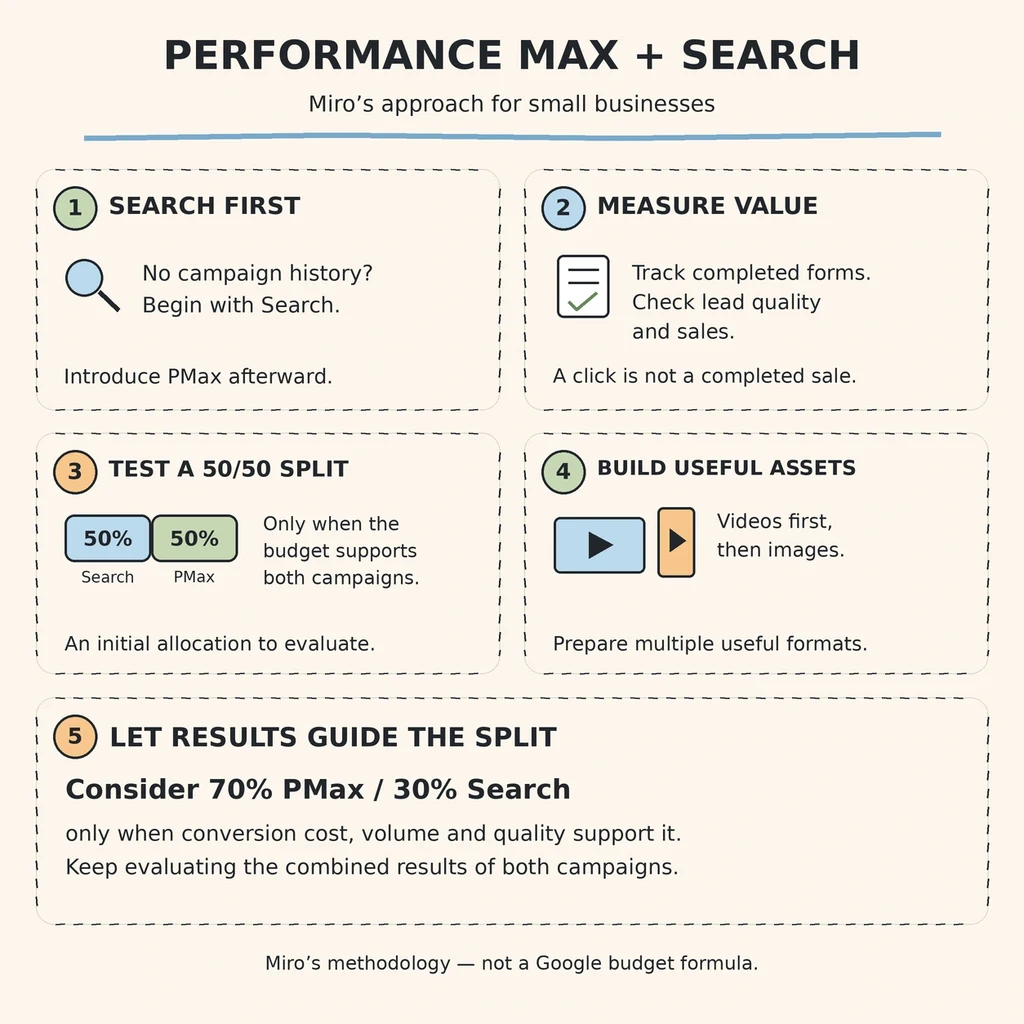
Is Performance Max worth it for your small business?
PMax deserves consideration when you can measure valuable actions, prepare useful assets, and fund a meaningful evaluation alongside Search. Its continued place in the budget should depend on the business opportunities it contributes and what those opportunities cost.
For a business starting without data, my recommendation remains Search first, PMax afterward. Start with an allocation you can evaluate, and consider shifting toward 70/30 when conversion quality, volume, and cost support the change.
My Google Ads management approach connects those campaign decisions with business goals. That connection is what makes the investment worth assessing.
If you're considering Performance Max and want to assess whether your business is ready, book a call. We can discuss your campaigns, conversion tracking, and the next step that fits your goals.
Written by
Miro Giovannini
Digital marketing consultant in the San Fernando Valley. 15 years with big brands, now working directly with local businesses on Google Ads, Meta Ads, websites and local SEO.



You’ll talk to me, not a sales team.
Your competitors are buying your customers' clicks today.
Tell me about your business and I'll get back to you personally with what I'd do first. No call needed.
Ready to talk? Call (747) 900-3578, text me, or book a free 30-min call.
A plan before we start · Month to month · You own every account · Max 3 new clients a month
I reply personally. No sales team, no spam.