
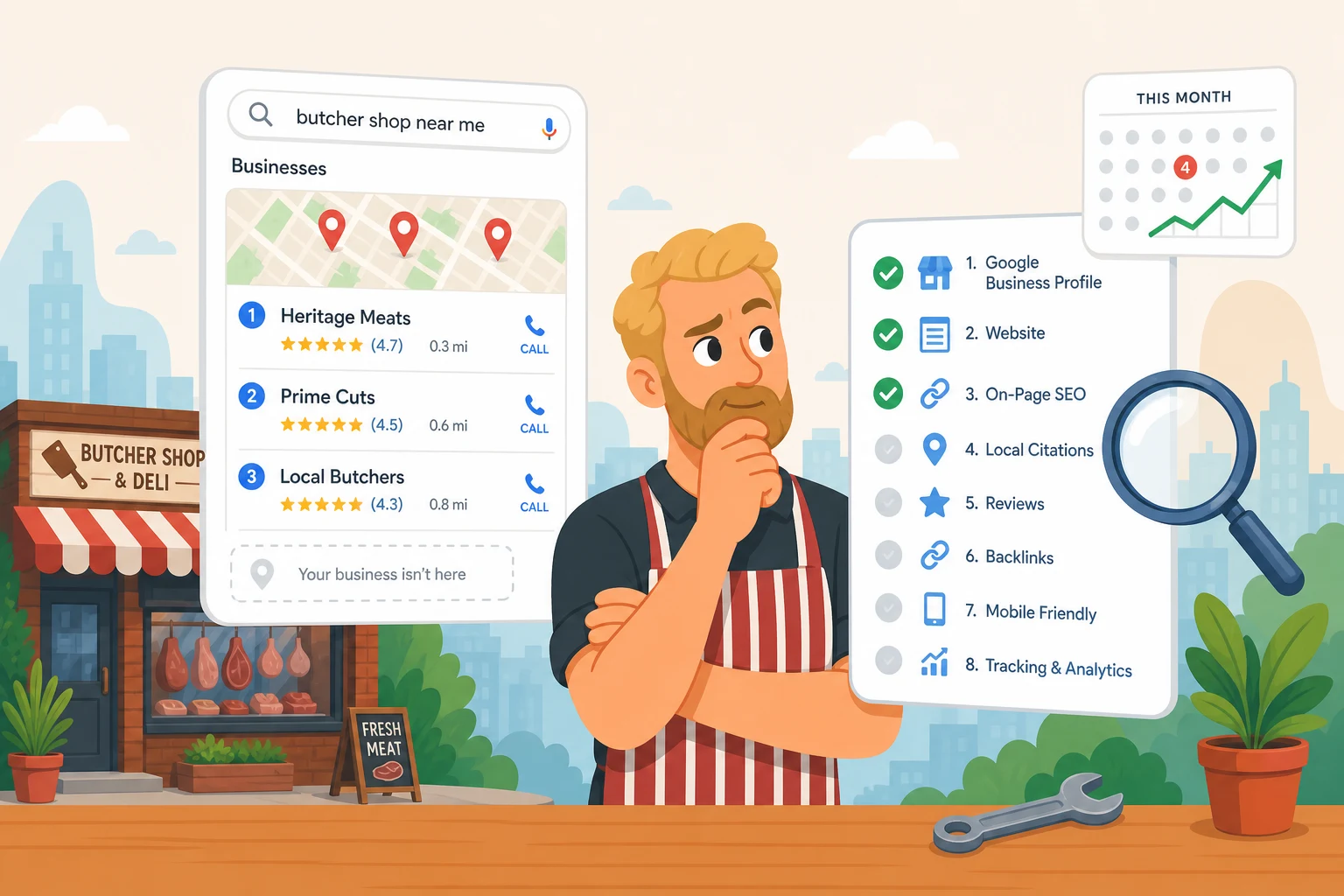
My Local SEO Isn't Working: 8 Reasons Your Business Doesn't Rank
September 3, 2026 · By Miro Giovannini
Your local SEO isn't working usually for one of eight reasons: a website with weak structure, thin or irrelevant content, no inbound links, a missing or incomplete Google Business Profile, inconsistent NAP information across the web, no fresh content on the site, content written for crawlers instead of people, and not enough time or consistency for any of it to compound.
I get this message a lot from local business owners: "I've been doing local SEO for months and I still don't show up on Google." Almost every time, the problem isn't a secret trick they're missing. It's that one of the fundamentals underneath the local layer was never in place.
Why Isn't My Local SEO Working?
Local SEO isn't a separate discipline that floats on top of nothing. It sits on top of regular SEO. When I audit a business that isn't ranking, I check things in a fixed order: site architecture first, then content, then inbound links. Only after those three are healthy do I look at the local signals, Google Business Profile, Yelp, and the other directories.
Business owners usually check something else entirely. They open their website, see that it loads, see that there's some text on it, and conclude the site is fine. A site that works isn't the same as a site that ranks. Below are the eight reasons I see most often, in the order I'd fix them.
Reason 1: Your Site Architecture Is Working Against You
Site architecture is how your pages are organized and linked to each other. If everything lives on one long homepage, or if your service pages are buried three clicks deep with no internal links pointing at them, Google has a hard time understanding what you do and where you do it.
The fix: give every service its own page, and every location its own page if you serve more than one area. Link to them from your main navigation and from inside relevant body text. Keep URLs short and readable. Make sure the site is crawlable and every important page is one or two clicks from the homepage.
Reason 2: Your Content Isn't Relevant to Your Audience
Most local sites have content. Very few have content that answers what their customers actually ask. A plumber's homepage that says "quality service since 2004" tells a search engine nothing about emergency repairs, water heaters, or the neighborhoods served.
The fix: write pages around the real problems people bring you. Use the words your customers use, not industry vocabulary. Every page should make it obvious what the service is, who it's for, and where you deliver it.
Reason 3: No Other Website Links to Yours
Inbound links are still one of the strongest signals of whether a site deserves to rank. If no other page on the internet points to yours, you're asking Google to trust a business it has no external evidence for.
The fix: start local and start real. Chambers of commerce, suppliers and manufacturers you work with, local associations, sponsorships, local press, partner businesses. A handful of genuinely relevant local links beats a hundred junk ones.
Reason 4: Your Google Business Profile Is Missing or Incomplete
This is the single most common local problem I see, and it's the cheapest to fix. Either the profile doesn't exist, or it exists as an unclaimed listing with a category, a phone number, and nothing else.
Google's own guidance says the local ranking is determined by relevance, distance, and prominence, and that a complete, accurate profile is what makes your business relevant to a search (Google Business Profile Help).
The fix: claim and verify the profile at Google Business Profile. Pick the most accurate primary category, then add secondary ones. Fill in services, hours, service areas, description, and photos. Keep it accurate rather than clever, and follow Google's representation guidelines — a business name stuffed with keywords is a suspension risk, not a ranking hack.
Reason 5: Your NAP Is Inconsistent Across the Web
NAP means name, address, and phone number. Inconsistent NAP is the quiet killer of local rankings. The suite number is on the website but not on Yelp. The old phone number is still on three directories. The business name is "Valley Auto Repair" in one place and "Valley Auto Repair & Tires LLC" in another.
The fix: decide on one exact version of your name, address, and phone. Write it down. Then update your website, Google Business Profile, Yelp, Apple Maps, Bing Places, and the industry directories that matter in your field until every one matches character for character. Adding LocalBusiness structured data to your site helps confirm those details.
Reason 6: Your Site Has No Blog or No Updated Articles
A site that hasn't published anything in two years looks abandoned, both to people and to search engines. It also has almost no surface area: a five-page site can only rank for what those five pages cover.
The fix: publish regularly about the questions customers ask you. Not filler, and not one post a week if you can't sustain it. Two solid articles a month that genuinely help someone will do more than twenty thin ones. Update your old posts, too — refreshing an existing page is often faster than writing a new one.
Reason 7: You're Writing for Crawlers Instead of People
Here's where I'd push back on a lot of local SEO advice. Obsessing over keywords is overrated, and it's more overrated now than it's ever been. Generative AI has become a real part of how people discover businesses, and those systems favor pages that give the user real value over pages engineered to hit a keyword density.
Google says the same thing in its own documentation on creating helpful, people-first content: content made primarily to attract search engine visits rather than to help people is exactly what its systems try to demote.
The fix: keep keyword research as direction, not as a script. Use a phrase because it's how people actually ask the question. Then answer the question better than the pages currently ranking do.
Reason 8: You Haven't Been Consistent Long Enough
SEO takes time. From month four onward is when I start expecting real results, and that assumes work happened every one of those months. A lot of "local SEO isn't working" is really "local SEO was worked on for six weeks and then abandoned."
The fix: commit to a horizon you can actually sustain and keep the work steady. Consistency is the whole game.
What Are Business Owners Looking At That Doesn't Matter?
Three things eat a disproportionate amount of attention:
- Where the site ranks for one favorite keyword. Rankings vary by device, location, and searcher. The number you see isn't the number your customer sees.
- How the homepage looks. A redesign that doesn't change structure, content, or links rarely changes rankings.
- Directory count. Being in eighty directories with inconsistent information is worse than being in ten with perfect information.
How Long Does Local SEO Take to Show Results?
Expect meaningful movement from month four onward, with earlier signals along the way. Google Business Profile fixes can move things within weeks because the profile is a direct data feed. Content and links compound much more slowly.
What Should You Measure Before the Customers Arrive?
Calls, direction requests, and website clicks from your Google Business Profile. Impressions and average position in Google Search Console. Form submissions and phone calls on the site. Impressions rising before clicks rise is normal and it's a good sign — it means you're becoming visible for more queries, and relevance and click-through follow.
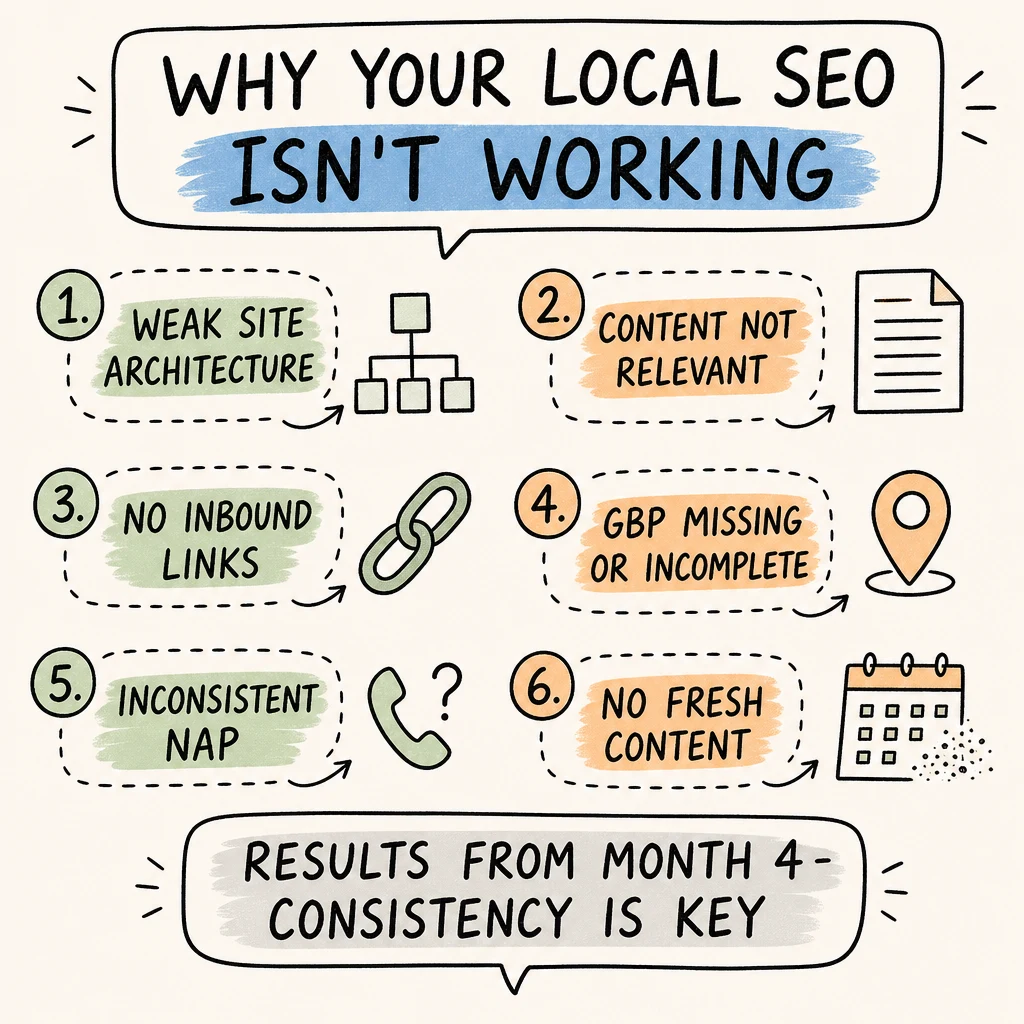
In What Order Should You Fix Local SEO Problems?
- Site architecture: pages exist, are organized, and are crawlable
- Content: relevant to real customer questions, service and location pages in place
- Inbound links: real local sources pointing at the site
- Google Business Profile: claimed, verified, complete, correct primary category
- NAP: identical everywhere it appears
- Publishing: consistent, useful, updated
- Reviews: a steady stream, requested the way Google allows
- Tracking: so month four can be measured against month one
If you've already gone through this list and want the tactical sequence, I wrote a companion piece: Fix Your Local SEO Fast: A Step-by-Step Repair Guide.
Why Does a Competitor Rank Higher Than Me in Google Maps?
Usually because they're closer to the searcher, their profile is more complete, or they have more prominence — more reviews, more mentions, more links from other sites. Distance is the one variable you can't change. The other two are work.
How Do I Check What My Competitor Is Doing Differently?
Search your main service plus your city from a browser, open the top three map results, and compare their profiles to yours line by line: primary category, number of services listed, photo count, review count and recency, and whether their website has a dedicated page for that exact service. The gap is almost always visible within five minutes, and it's almost always one of the eight reasons above.
Does AI Search Change Local SEO in 2026?
It changes what gets rewarded, not what's required. AI-generated answers still pull from pages and business data that are crawlable, accurate, and genuinely useful. That means the fundamentals matter more, not less: a clear structure so your pages can be parsed, accurate business data so you're described correctly, and content written to help a person rather than to hit a keyword count.
What Should a Local Business Do Differently for AI Search?
Answer questions directly and early on the page. State plainly who you are, what you do, and where you do it. Keep your business details identical everywhere, because that's what AI systems use to decide which facts about you are trustworthy. And publish content that would still be worth reading if search engines didn't exist.
What Happens If You Fix Only the Google Business Profile?
You'll usually see a bump in map visibility and then a plateau. The profile can win you proximity-based searches, but it can't carry the queries where Google is choosing between websites. That's why the profile is step four in my order, not step one — it's the fastest win, but it's not a substitute for the site underneath it.
Do You Need an Agency to Fix Local SEO?
No. Most of reasons four through six can be fixed by an owner with a couple of focused afternoons. Architecture, content strategy, and links are where outside help usually pays for itself, because they take sustained work rather than a one-time cleanup.
If you'd rather have someone diagnose it properly, that's what I do in my local SEO service, and you can see the rest of what I work on at mirogiovannini.com. If the site itself is the bottleneck, website design is usually the first fix.
The businesses that win local search aren't the ones with the cleverest tactics. They're the ones that got the fundamentals right and then kept showing up, month after month. If you want a second pair of eyes on why your local SEO isn't working, book a call and we'll look at it together.
Local SEO rarely fails because of one dramatic mistake. It fails quietly, in the gap between a website that works and a website that earns its ranking.
Ready to bring in more customers?
Get a free 30-minute marketing review. We'll look at what you have today and identify the one or two changes that could make the biggest difference.